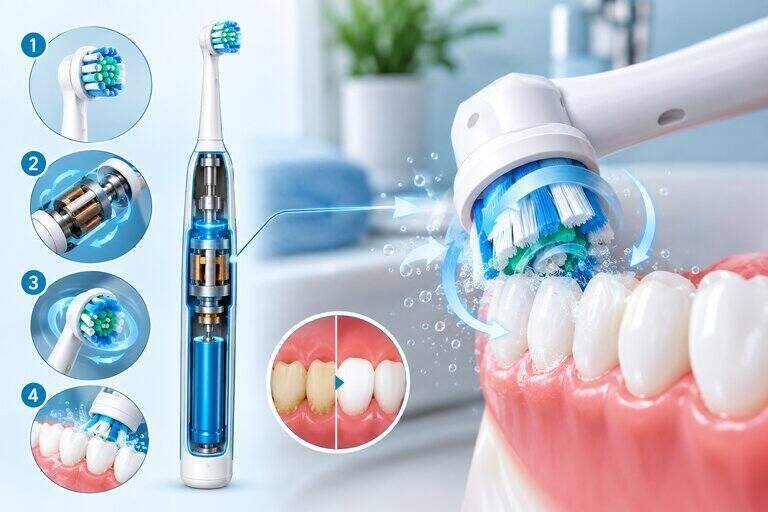
Dental care has changed a lot with electric toothbrushes. These devices offer a new way to clean teeth that’s often more effective than brushing by hand. Understanding how does an electric toothbrush work can help you see why they clean your teeth so much more thoroughly, and knowing the mechanics behind that cleaning power can help you get more out of your daily routine.
Good oral health depends on the right cleaning method. Clinical research shows electric toothbrushes with oscillating-rotating heads are meaningfully better at removing plaque than manual brushes, which is why they’ve become a key part of keeping teeth and gums healthy for millions of U.S. households.
Key Takeaways
- Electric toothbrushes rely on a motor and battery to convert electrical energy into rapid bristle movement
- Oscillating-rotating brushes remove about 21% more plaque than manual brushing after three months
- Sonic toothbrushes typically move at 24,000 to 48,000 movements per minute
- Improves brushing consistency, technique, and duration
- Especially helpful for users with limited hand dexterity or mobility
Understanding Electric Toothbrush Technology and Its Evolution
The world of dental care has changed a great deal with electric toothbrushes. We’ve moved from simple manual brushing to advanced, motor-driven cleaning devices, and that journey has genuinely reshaped daily oral care.
From Manual to Electric: A Brief History
The first electric toothbrush, called the Motodent, was patented by Tomlinson Moseley in 1937. A more influential design came later: Dr. Philippe-Guy Woog invented the Broxodent in Switzerland in 1954, originally for patients with limited motor skills and orthodontic patients. It was later brought to the U.S. market, where cordless, battery-powered models followed in the 1960s.
Modern Technology Features in Today’s Electric Toothbrushes
Today’s electric toothbrushes offer far more cleaning power than those early models. Depending on the technology, they can move anywhere from 24,000 to over 192,000,000 times per minute, well beyond what manual brushing can achieve. Key features include:
- Multiple brushing modes
- Pressure sensors
- Smart connectivity
- Precision cleaning technologies
| Toothbrush Type | Movements per Minute | Technology |
|---|---|---|
| Manual Brushes | 300-600 | Hand-powered |
| Sonic Toothbrushes | 24,000-48,000 | High-frequency vibrations (200-400 Hz) |
| Ultrasonic Toothbrushes | Up to 192,000,000 | Piezoelectric ultrasound waves (1.6 MHz) |
How Electric Toothbrushes Transform Dental Care
Electric toothbrushes have made oral hygiene noticeably more consistent for a lot of people. Dentists point to their ability to remove plaque and improve gum health with far less technique-dependence than manual brushing requires. Their precision and consistency are a big part of why they’ve become a standard recommendation in modern dental care.
Essential Components of an Electric Toothbrush
Electric toothbrushes are compact but sophisticated tools. Knowing the key parts of an electric toothbrush helps explain the engineering behind how does an electric toothbrush work in practice.
At the heart of an electric toothbrush are several important parts that work together to clean your teeth:
- Rechargeable Battery: The power source that keeps your toothbrush running for days between charges
- Electric Motor: Creates the movement needed to remove plaque effectively
- Circuitry: Manages brush speed, the built-in timer, and any smart features
- Brush Head: Designed with bristles shaped for effective, gentle cleaning
Today’s electric toothbrushes pack a surprising amount of engineering into a small handle. The battery typically lasts for days on a single charge, powering the motor that drives the bristle movement.
Thanks to precision engineering, these toothbrushes stay compact while adding features like pressure sensors and Bluetooth connectivity, which represents a real step forward from the line-powered models of decades past.
The American Dental Association recommends replacing your brush head every three to four months to keep the bristles effective and reduce bacterial buildup, regardless of how well the handle itself is holding up.

How Does an Electric Toothbrush Work
Electric toothbrushes change how we brush by doing most of the cleaning work for us. Knowing how does an electric toothbrush work helps you use one correctly and get the most benefit from it.
At a basic level, electric toothbrushes convert stored electrical energy into precise, repetitive tooth movement, doing far more cleaning motion per minute than a hand ever could.
Power Source and Energy Conversion
At the center of an electric toothbrush is its power source. Most models use rechargeable lithium-ion batteries for steady, long-lasting power. The battery drives a small motor that converts electrical energy into movement, producing high-frequency vibrations at the brush head.
- Rechargeable lithium-ion batteries provide long-lasting power
- Motors convert electrical energy into precise brush movements
- Sonic models typically operate between 200 and 400 Hz
Motion Mechanisms: How the Cleaning Actually Happens
Electric toothbrushes use a few different mechanisms to clean teeth effectively:
- Oscillating-rotating action, where a round brush head alternates spinning direction
- Sonic vibration technology, which creates rapid side-to-side bristle movement
- Pulsating motion, which adds an in-and-out component to loosen debris
Each mechanism cleans teeth in a slightly different way. Sonic toothbrushes, for example, can move tens of thousands of times a minute, far beyond the roughly 300 strokes a minute a typical manual brushing session produces.
Brush Head Movement and Cleaning Action
How the brush head moves is central to how does an electric toothbrush work so effectively at removing plaque. Many electric brush heads use angled or multi-level bristles designed to reach between teeth and along the gumline, areas that are frequently missed during manual brushing.
With their high-frequency vibrations and purpose-built bristle design, these toothbrushes create fluid dynamics in saliva and toothpaste that can disrupt plaque even slightly away from where the bristles directly touch. This helps deliver a more thorough clean with less technique-dependent effort.
Cleaning Power Compared With Manual Brushing
Your oral health depends on more than just a basic brushing routine. Electric toothbrushes change dental care by offering far more consistent cleaning motion than brushing by hand can provide.
According to a Cochrane systematic review of powered versus manual toothbrushes, oscillating-rotating electric toothbrushes showed measurable, consistent benefits over manual brushing:
- 21% less plaque after three months of use
- 11% less gingivitis after three months of use
That review also found that oscillating-rotating brushes were the only powered toothbrush type to consistently show a statistically significant benefit over manual brushing across the studies reviewed. Other technologies, including sonic brushes, showed benefits in some trials without the same consistency.
Electric toothbrushes are especially useful for people with limited hand dexterity or inconsistent brushing habits, since the device does much of the cleaning work. Their steady, repeatable motion reaches difficult spots more reliably, which can lower the risk of missed plaque over time.
Choosing the best electric toothbrush for your needs means more than just cleaner teeth. It’s about supporting your dental health with a device that reduces how much good technique depends on you.
Advanced Features and Smart Technology Integration
Electric toothbrush technology has expanded well beyond basic cleaning. Many current models include features designed to improve technique and consistency, not just raw cleaning power.

Today’s electric toothbrushes offer smart features meant to make brushing more effective and easier to stick with as a daily habit.
Pressure Sensors and Timer Functions
Many electric toothbrushes include built-in pressure sensors that help protect your gums from overly aggressive brushing. They alert you when you’re pressing too hard, which helps prevent gum irritation and enamel wear over time.
- Real-time pressure monitoring
- Automatic alerts for excessive brushing force
- Built-in two-minute timers for a full, dentist-recommended brushing session
Bluetooth Connectivity and App Integration
Many newer electric toothbrushes connect to a companion app on your phone, giving you more detailed feedback on your brushing habits. You can track coverage, get personalized tips, and see how your technique changes over time.
| Feature | Benefit |
|---|---|
| Mouth-coverage tracking | Shows which areas you’re missing during brushing |
| Brushing performance metrics | Detailed oral hygiene insights over time |
| Personalized coaching | Tailored brushing recommendations based on your habits |
Multiple Brushing Modes and Customization
Many electric toothbrushes offer several brushing modes to suit different needs, such as sensitive teeth, gum care, or whitening. You can usually switch between them with a single button press.
Electric toothbrushes have become more than simple cleaning tools. With features like these, many people find they’re easier to use consistently and correctly than a manual brush, which matters just as much as raw cleaning power for long-term oral health.
Maintaining and Maximizing Your Electric Toothbrush
Keeping your electric toothbrush in good shape matters just as much as understanding how does an electric toothbrush work in the first place. Regular care keeps it working at its best.

Here are some important habits to keep your electric toothbrush working well. For a full walkthrough, see our guide on how to keep an electric toothbrush clean.
- Rinse the brush head thoroughly after each use
- Wipe down the handle weekly to prevent bacterial buildup
- Store the toothbrush upright in an open position so it can air-dry
- Replace the brush head every three to four months, or sooner if the bristles fray
Don’t overlook battery care on rechargeable models. Avoid routinely letting the battery drain all the way to empty, and avoid leaving it at a full charge for extended periods when you don’t need to. For more detail on how long a handle typically lasts, see our guide on how long an electric toothbrush lasts.
| Maintenance Task | Frequency | Purpose |
|---|---|---|
| Rinse Brush Head | After Each Use | Remove Bacteria and Debris |
| Wipe Handle | Weekly | Prevent Bacterial Buildup |
| Replace Brush Head | Every 3-4 Months | Maintain Cleaning Effectiveness |
Following these maintenance habits keeps your toothbrush cleaning effectively and helps the brush head do its job properly between replacements.
Common Questions About How an Electric Toothbrush Works
Do electric toothbrushes clean teeth better because of speed alone?
Not entirely. Speed matters, but bristle design, brushing mode, and consistent daily use all play a role. The oscillating-rotating design has the strongest evidence behind it, not simply the highest movement count.
Is a higher movements-per-minute number always better?
Not necessarily. Sonic and ultrasonic toothbrushes move far faster than oscillating-rotating models, but the Cochrane review found oscillating-rotating brushes had the most consistent evidence of benefit across clinical trials.
Can an electric toothbrush damage my gums?
Used correctly, no. Most gum irritation comes from pressing too hard, which is why pressure sensors on many modern models are useful, they alert you before you brush too aggressively.
Do I need a smart, app-connected toothbrush to get the plaque-removal benefits?
No. The core plaque and gingivitis benefits come from the motor and brush head mechanism itself. App connectivity and coaching features are helpful for improving technique, not requirements for effective cleaning.
How is an electric toothbrush different from a manual one mechanically?
A manual brush relies entirely on your hand movement, roughly 300 strokes a minute. An electric toothbrush uses a battery-powered motor to move the brush head thousands of times a minute, which is the main mechanical reason it can outperform manual brushing.
Do all electric toothbrushes use the same technology?
No. Oscillating-rotating, sonic, and ultrasonic toothbrushes all use different motors and movement mechanisms, and they aren’t interchangeable in how they clean or how they feel to use.
Conclusion
Learning how does an electric toothbrush work can genuinely change your daily brushing routine. These devices have evolved a long way since the Motodent’s 1937 patent and the Broxodent’s debut in 1954, and today’s models offer far more consistent cleaning than manual brushing alone.
Electric toothbrushes meaningfully improve oral health for a lot of people. According to Cochrane’s review of the evidence, oscillating-rotating models cut plaque by about 21% more than manual brushes after three months of use, with gum health improving alongside it. Features like pressure sensors and timers help you use that cleaning power correctly.
Their underlying motion, whether oscillating, sonic, or ultrasonic, cleans more consistently than a hand-brushed routine, which is a big part of why they’ve become a standard recommendation in modern dental care.
These toothbrushes work well for a wide range of people, from those with limited dexterity to anyone simply wanting a more thorough, consistent clean. With modes for sensitive teeth, whitening, and gum care, choosing an electric toothbrush means more personalized, technique-forgiving oral care. If you’re deciding between specific models, our electric toothbrush buyer’s guide compares current options in more detail.

Hi, I’m Mamon, the content creator behind this blog. I share my experience in blogging, WordPress, SEO, and affiliate marketing through honest product reviews, in-depth buying guides, and practical how-to articles. Every piece of content is thoroughly researched and written to help readers make informed decisions.
Leave a Reply