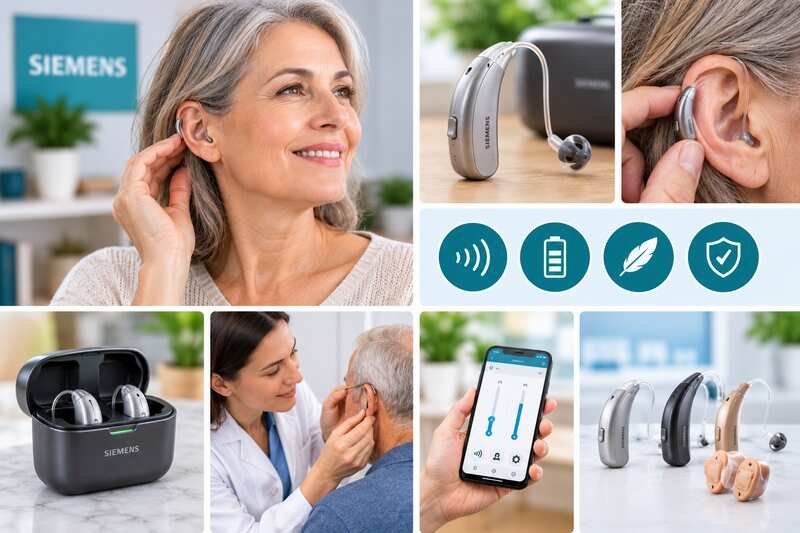
If you are searching for siemens hearing aid reviews in 2026, one fact matters before you compare a single model. Siemens does not make hearing aids under its own name anymore. The technology, the engineering team, and the product lines you remember carried on. They just carry a new brand name today.
This guide covers what actually happened to Siemens hearing aids. It explains what you are really buying today when a listing says “Siemens.” It also shows you how to choose a hearing aid that fits your hearing loss and your lifestyle. Budget factors into that choice too.
A Quick History Behind Siemens Hearing Aids
Siemens has one of the longest track records in hearing technology of any name in the industry. That history dates back to an early amplifying device the company built in 1878. Siemens went on to develop some of the first industrialized hearing instruments in the early 1900s. Early behind-the-ear and in-the-ear devices followed over the decades after that.
That long engineering history is exactly why so many people still search for siemens hearing aid reviews today. The brand name has changed hands, but the reputation for quality German engineering stuck around.
In 2015, Siemens sold its audiology division to the private equity firm EQT. The deal was reportedly worth more than two billion euros. The new owner renamed the business Sivantos and relaunched the hearing aid product lines under a new brand: Signia. In 2019, Sivantos merged with Widex, another major hearing aid manufacturer, to form WS Audiology. That company actually designs and sells what used to be Siemens-branded hearing aids today.
What Happened to the Siemens Brand?
This rebrand causes a lot of understandable confusion. The underlying research and development team carried over from Siemens into Signia. So did much of the manufacturing know-how, and even some of the same engineers. You might already own an older Siemens-branded hearing aid, such as a Siemens Pure, Siemens Motion, or Siemens Life model. It will still work fine. Signia and its network of hearing care providers now handle replacement parts and professional support, not Siemens directly.
The video below, from a licensed audiologist, walks through exactly how the Siemens-to-Signia transition happened. It also clears up naming confusion that still shows up in siemens hearing aid reviews and articles across the web.
Today’s Signia Lineup: The Modern Equivalent
If the engineering behind Siemens hearing aids is what interests you, Signia’s current lineup is where that lineage lives on. The Pure and Pure X series are behind-the-ear models with a discreet, slim profile. They are similar in spirit to the original Siemens Pure line. Rechargeable battery life can stretch well past a full day of use.
The Styletto AX is a slimmer, more fashion-forward receiver-in-canal design. People who want something less visible on the ear often choose this style. The Motion X series is a more traditional behind-the-ear model that delivers longer battery life and higher power output. That combination suits more significant hearing loss better than smaller styles do. The Insio Charge&Go AX line covers in-the-ear and in-the-canal styles for people who want a smaller, custom-fit device.
Pricing on these current models generally starts in the range of two thousand dollars per pair. Premium features like advanced noise processing or smartphone connectivity push that price higher. That is a meaningful investment either way. That is exactly why reading real siemens hearing aid reviews before you buy matters so much.
Who Actually Needs a Hearing Aid?
Hearing loss is far more common than most people realize. It is also widely undertreated across the country. Hearing aid use lags far behind hearing loss itself. The National Institute on Deafness and Other Communication Disorders, part of the National Institutes of Health, tracks this gap closely. Only one in four adults who could benefit from a hearing aid has ever actually used one. Left untreated, hearing loss raises the risk of depression, anxiety, reduced mobility, falls, and even dementia.
Common early signs are easy to miss at first. You might find yourself asking people to repeat themselves often. You might struggle to follow conversations in restaurants or other noisy places. You may also turn the television volume up higher than others in the room prefer. Or you may feel like people around you are mumbling. Our guide on what level of hearing loss requires a hearing aid breaks down the categories of hearing loss. It also explains when a device becomes necessary. Want to understand what puts your hearing at risk in the first place? Our article on five things that can damage your hearing is a useful companion piece.
Prescription vs. Over-the-Counter Hearing Aids
The hearing aid industry has changed a lot since the original Siemens product lines were on the market. One of the biggest shifts is the arrival of over-the-counter hearing aids in the United States. The FDA established a new OTC hearing aid category effective October 17, 2022. That rule allows adults with perceived mild to moderate hearing loss to buy certain hearing aids directly. They no longer need a prescription, exam, or fitting from an audiologist.
OTC hearing aids are not appropriate for everyone, though. The FDA is clear that these devices do not treat severe or profound hearing loss. Anyone under 18 still needs a prescription regardless of the severity of their hearing loss. Red flag symptoms deserve a doctor’s evaluation rather than a self-fitted device. These include sudden hearing changes, ear pain, drainage, and severe dizziness. They also include hearing loss that is noticeably worse in one ear than the other. Licensed hearing care providers typically sell modern Signia devices, the direct descendants of the old Siemens lineup. These devices also tend to cover a wider range of hearing loss than most OTC options. That is worth factoring in if your hearing loss is more than mild to moderate.
Does Insurance or Medicare Cover Hearing Aids?
Cost is one of the biggest reasons people put off buying a hearing aid. That holds true even after reading siemens hearing aid reviews and deciding a Signia model is the right fit. Original Medicare, meaning Part A and Part B, does not cover the cost of hearing aids. It will cover certain diagnostic hearing exams when a doctor orders one. The device itself, though, is an out-of-pocket expense under original Medicare.
Medicare Advantage plans are a different story. Most Medicare Advantage plans now include some level of hearing aid coverage as an added benefit. That coverage typically comes with limits, though. Common examples include annual dollar caps, device copays, or limits on how often you can get a new pair. Call your specific plan directly and ask about hearing aid benefits. Do not assume either full coverage or no coverage at all. Private insurance plans vary just as widely. A quick call to your insurer or benefits department before you buy can save meaningful money either way.
How to Choose the Right Hearing Aid
Reading through siemens hearing aid reviews and their modern Signia counterparts is a good starting point. The right hearing aid ultimately depends on your hearing loss, lifestyle, and budget, not just brand history. A hearing test from an audiologist gives you an actual hearing loss profile to shop against. That beats guessing from symptoms alone.
Style matters too once you know your hearing loss profile. Behind-the-ear models like the Pure and Motion series tend to offer longer battery life and higher power. Smaller in-the-ear and in-canal styles prioritize discretion over raw power instead. Our advanced hearing aids reviews and buying guide covers additional models and features worth comparing beyond the Signia lineup. Our guide on how to select a hearing aid for seniors is a good resource too. It helps if you are buying for an aging parent or relative rather than for yourself.
Budget matters as well. Higher-end features like automatic noise reduction, directional microphones, and smartphone streaming are genuinely useful for many people. They are not strictly necessary for everyone, though, and a simpler, less expensive device is sometimes the more practical choice.
Getting Used to a New Hearing Aid
Getting comfortable with a new hearing aid takes a short adjustment period for almost everyone. That is true whether you land on a current Signia model or a different brand entirely. Sounds that you have not heard clearly in years can feel unexpectedly loud at first. Think of the hum of a refrigerator or your own footsteps. That sensation typically fades within the first few weeks as your brain re-adjusts to fuller-range sound again.
Proper daily habits also make a real difference in how well any hearing aid performs over time. Our guide on how to put a hearing aid in your ear correctly covers proper insertion technique. Good technique affects both comfort and sound quality. Regular cleaning matters just as much. Earwax and moisture buildup are two common reasons a hearing aid starts sounding muffled or stops working altogether. Our guide on how to clean a hearing aid earmold walks through the basics. It shows you how to keep a device in good working condition between professional cleanings.
What Do Real Reviews Say About Today’s Signia Models?
Reading actual owner feedback alongside professional siemens hearing aid reviews gives you a more complete picture than spec sheets alone. A few themes come up consistently across current Signia owners. Owners praise rechargeable battery life more than almost any other feature. A single charge on many current models covers a full day of active use, including streaming phone calls or music. Sound quality in quiet, one-on-one conversations also tends to score well. That reflects decades of engineering the original Siemens research team carried forward.
Complaints tend to cluster around a smaller set of issues. Some owners report that moisture and humidity can affect performance in hot climates or during heavy exercise. That is worth asking about if you live somewhere humid or sweat heavily during workouts. Price is another recurring theme, since premium features add up quickly compared to basic OTC devices. A follow-up adjustment from a provider usually resolves fit and comfort complaints. That does not point to a flaw in the hearing aid itself. It is one more reason a proper fitting appointment beats buying a device sight unseen online.
What to Expect From a Hearing Care Provider Visit
Whether you go the OTC route or work with a licensed provider, a first visit starts with a hearing test. Audiologists call this test an audiogram. This maps out exactly which frequencies you struggle to hear and how severe that loss is at each one. From there, a provider can recommend styles and power levels that actually match your results, rather than a generic best-seller.
Many providers also offer a trial period, often 30 to 45 days, before you commit to a purchase. Use that window seriously. Wear the device in situations that matter most to you, whether that is family dinners, work meetings, or watching television. Take note of what does and does not improve. A provider can usually make adjustments during the trial period. Small tweaks to volume or noise settings often solve problems that might otherwise feel like a bad fit.
Conclusion
The short answer to most siemens hearing aid reviews searches is that the Siemens name lives on through Signia. The same engineering team and product philosophy built that brand after Siemens sold its audiology division in 2015. If you are shopping for a hearing aid, compare Signia models such as Pure X, Styletto AX, and Motion X. Weigh them against other manufacturers too. Figure out whether a prescription device or an FDA-regulated OTC option fits your level of hearing loss. That approach serves you far better than searching for a Siemens-branded product manufacturers no longer make.
Take the time to get an actual hearing test before you buy anything. Compare a few current models against your specific needs and budget. Then give yourself a few weeks to adjust once you choose a device. Hearing loss is common and treatable, and no one should feel embarrassed about it. The right hearing aid can make a meaningful difference in day-to-day conversations, safety, and overall quality of life.

Hi, I’m Mamon, the content creator behind this blog. I share my experience in blogging, WordPress, SEO, and affiliate marketing through honest product reviews, in-depth buying guides, and practical how-to articles. Every piece of content is thoroughly researched and written to help readers make informed decisions.
Leave a Reply