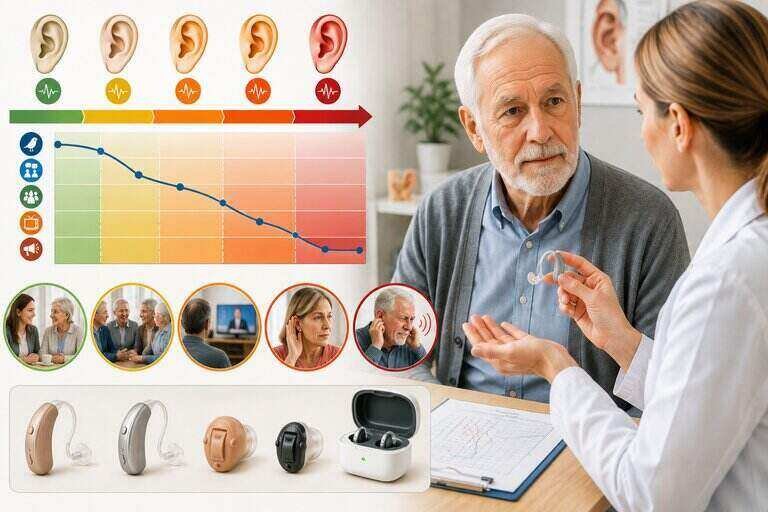
If you keep asking people to repeat themselves, you have probably wondered what level of hearing loss requires a hearing aid. The honest answer depends on the degree of loss shown on a hearing test. It also depends on how much your daily life is affected. This guide breaks down the official degree categories, explains what each one means for U.S. readers, and helps you decide when it is time to see a specialist. It also covers how common hearing loss really is. You will also learn what happens if you put off treatment, and what to expect at your first hearing test.
Key Takeaways
- Hearing loss is measured in decibels (dB) and grouped into standard degree categories.
- Most audiologists recommend a hearing aid once loss reaches the moderate range or higher.
- Even mild loss can justify a device if it affects conversation, work, or safety.
- An audiologist and a hearing test called an audiogram provide the only reliable diagnosis.
- Waiting too long to treat hearing loss is linked to higher dementia risk and social isolation.
What Is Hearing Loss?
Hearing loss is a condition where you struggle to perceive sound at normal volume. It can affect one ear or both. In most cases, it develops gradually rather than all at once. This is why many people do not notice it until family members point it out. If you suspect a problem, do not wait. Early diagnosis makes treatment far more effective.
Signs You May Be Experiencing Hearing Loss
Before any formal test, these everyday signs often point to a hearing problem.
- People around you seem to mumble or speak too softly.
- You strain to follow conversations, especially in groups.
- Phone calls are harder to understand than face-to-face talk.
- You feel more irritable or frustrated during conversations than you used to.
- You miss parts of what is said in meetings or at religious services.
- Movie dialogue is difficult to follow, particularly in a theater.
- You turn the TV or radio up louder than other people prefer.
- You frequently ask people to repeat themselves.

How Common Is Hearing Loss in the U.S.?
Hearing loss is far more common than most people realize. Roughly 15 percent of American adults, or about 37.5 million people, report some trouble hearing. That share climbs sharply with age. About 5 percent of adults aged 45 to 54 have disabling hearing loss. That share climbs to 22 percent of those aged 65 to 74, and more than half of adults over 75. An estimated 28.8 million U.S. adults could benefit from a hearing aid. Yet fewer than one in three people over 70 who could benefit has ever actually used one. These numbers help explain why so many people eventually ask what level of hearing loss requires a hearing aid, often years after symptoms first appear.
How Hearing Loss Is Measured
An audiologist measures your hearing with a test called an audiogram. You wear headphones in a sound booth and respond to tones at different pitches and volumes. The quietest sound you can hear at each pitch becomes your hearing threshold, measured in decibels (dB). Some appointments also include speech-in-noise testing, which checks how well you understand words when background sound is present. This second test often explains real-world struggles that a tone-only test misses. Most audiograms are painless and take less than an hour from start to finish. They end with a plain-language review of your results, so you understand exactly where you fall on the degree scale.
What Level of Hearing Loss Requires a Hearing Aid? The Standard Degree Scale
According to the American Speech-Language-Hearing Association, hearing loss is grouped into standard degree categories. Each one is based on your softest audible sound, measured in decibels.
| Degree | Range (dB HL) | Typical Hearing Aid Need |
| Normal | -10 to 15 | Not needed |
| Slight | 16 to 25 | Rarely, unless specific needs exist |
| Mild | 26 to 40 | Sometimes, depending on lifestyle |
| Moderate | 41 to 55 | Usually recommended |
| Moderately Severe | 56 to 70 | Strongly recommended |
| Severe | 71 to 90 | Required for most daily communication |
| Profound | 91+ | Required; a cochlear implant may also be considered |
Normal and Slight Hearing Loss
At these levels, most everyday sounds remain audible. Someone with slight loss may miss faint speech in a noisy room but generally functions well without a device.
Mild Hearing Loss
Soft conversations and speech in background noise become difficult to follow. Some people manage without a device at this stage. Others benefit from a simple, entry-level hearing aid, especially in demanding work or social settings.
Moderate Hearing Loss
Normal conversation, a running dishwasher, and a refrigerator hum all become hard to hear. This is the point where most audiologists start recommending a hearing aid, since daily communication is noticeably affected.
Moderately Severe to Severe Hearing Loss
Conversational speech and moderately loud household sounds fall below your hearing threshold. A hearing aid becomes necessary for most people at this stage. Advanced digital features like directional microphones make a meaningful difference here.
Profound Hearing Loss
Only very loud sounds, like a fire alarm or nearby traffic, remain audible. Powerful hearing aids can help, though a cochlear implant is sometimes recommended when hearing aids no longer provide enough benefit.

Watch: What Are the Levels of Hearing Loss?
This video from Cochlear Americas walks through each degree category and how it affects everyday listening.
Notice how the explanation ties each category back to real, everyday listening situations rather than just a number on a chart.
So, What Level of Hearing Loss Requires a Hearing Aid?
There is no single decibel number that applies to everyone. Most audiologists agree that moderate loss and above generally calls for a device. Conversation itself becomes difficult at that point. But the honest answer to what level of hearing loss requires a hearing aid also depends on your lifestyle. A musician or teacher with mild loss may need help sooner than someone with a quieter daily routine and moderate loss.
Two people with the same audiogram results can have very different real-world experiences. That is why the number on the chart is only a starting point, not the final word on whether you need a device.
Other Factors That Affect the Decision
Which Ear Is Affected
Loss in both ears usually has a bigger daily impact than loss in just one. Your brain relies on both ears to locate sound and filter out noise.
Your Occupation and Social Life
Jobs that require frequent phone calls, meetings, or public speaking often push people toward a hearing aid sooner than a quieter job would.
Tinnitus
Ringing or buzzing in the ears frequently accompanies reduced hearing. Some modern hearing aids include built-in sound therapy features that can ease tinnitus symptoms at the same time.
Age and Cognitive Load
Straining to hear takes a mental toll. Older adults in particular may notice more fatigue and difficulty concentrating, since the brain has to work harder to fill in gaps.
How to Prepare for a Hearing Test
A little preparation makes your appointment more useful. Write down specific situations where you struggle, such as phone calls, restaurants, or meetings. These details help your audiologist interpret your results. Bring a list of current medications, since some drugs can affect hearing. If possible, bring a family member who has noticed changes in your hearing. Their perspective often fills in details you might miss yourself. Walking in prepared makes it much easier to get a clear answer to what level of hearing loss requires a hearing aid for your specific situation. You get a personal answer instead of a generic recommendation.
What Happens If You Wait Too Long?
Putting off treatment carries real risks beyond missed conversations. According to Johns Hopkins Medicine, a long-term study found that mild hearing loss roughly doubled dementia risk. Moderate loss tripled it, and severe loss increased it fivefold compared to normal hearing. Researchers believe the strain of processing degraded sound, combined with social withdrawal, contributes to this connection. Despite these risks, most people wait around ten years after noticing symptoms before seeking help.
Left untreated, it can also disrupt balance. Your ears provide cues your brain uses to stay steady, and losing them raises fall risk in older adults. None of this means every case needs immediate treatment. It is still a strong reason not to delay a hearing test if you suspect a problem.
Next Steps After Diagnosis
Once your audiologist confirms your degree of hearing loss, the next decision is picking a device. It should fit both your needs and your budget. Our guide on how to select a hearing aid walks through styles, features, and the FDA’s over-the-counter rules for U.S. buyers. If you want to compare specific products first, our roundup of advanced hearing aid reviews is a useful next stop.
People with milder loss sometimes start with a personal sound amplification product instead of a medical-grade hearing aid. This is worth discussing with your audiologist first, since these devices are not regulated the same way.
Related Hearing Health Guides
After you get your first device, one more guide can help. Our guide on how to put a hearing aid in your ear correctly covers a comfortable, secure fit.
Frequently Asked Questions
What level of hearing loss requires a hearing aid?
Moderate loss (41 to 55 dB) and above generally requires a hearing aid for most people. Lifestyle and personal needs can justify a device at the mild level too.
Can mild hearing loss get worse without treatment?
It can, especially if the underlying cause is age-related or noise-related. Regular checkups help track any progression.
Is a hearing test painful or uncomfortable?
No. An audiogram is painless and typically takes 30 to 60 minutes, including time to review the results with your audiologist.
Can hearing loss in only one ear still require a hearing aid?
Yes. Single-sided hearing loss can make it hard to locate sound or understand speech in noise, and specific devices are designed for this situation.
Does insurance cover a hearing test?
Many U.S. health plans cover diagnostic hearing tests, though coverage for the hearing aid itself varies. Check your specific policy for details.
What happens if I ignore moderate hearing loss?
You risk ongoing communication problems, social withdrawal, and according to research, a higher long-term risk of cognitive decline.
How often should I get my hearing tested?
Adults over 50 are generally advised to get a baseline test and repeat it every one to three years. Test sooner if symptoms change.
Can hearing loss be prevented?
Some causes, like age-related decline, cannot be prevented, but noise-induced hearing loss often can be. Wearing hearing protection around loud machinery, concerts, or power tools reduces your long-term risk significantly.
Bottom Line
So, what level of hearing loss requires a hearing aid? For most people, the answer starts at moderate loss, but mild loss can qualify too if it affects your work, safety, or relationships. The only way to know for certain is a professional hearing test. Do not wait years to get checked. Early action protects your hearing, your independence, and quite possibly your long-term brain health.

Hi, I’m Mamon, the content creator behind this blog. I share my experience in blogging, WordPress, SEO, and affiliate marketing through honest product reviews, in-depth buying guides, and practical how-to articles. Every piece of content is thoroughly researched and written to help readers make informed decisions.
Leave a Reply