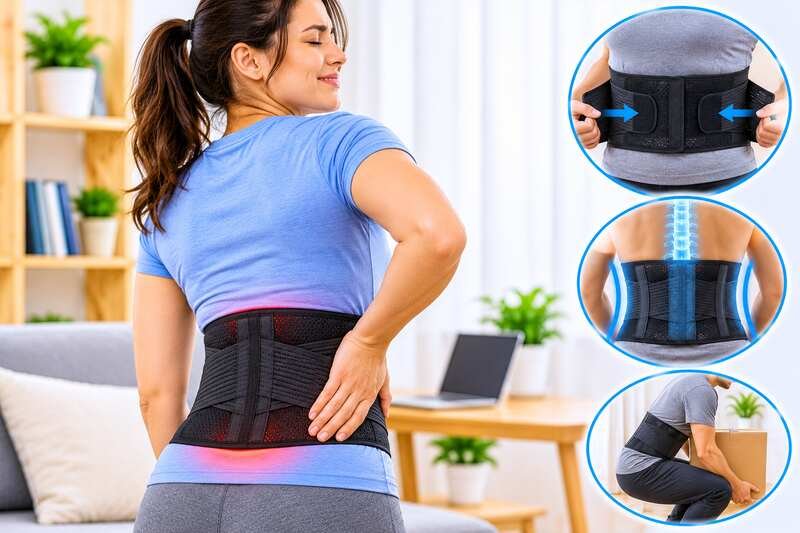
The best lumbar support belt gives your lower back firm, even compression so everyday tasks like standing at a counter, driving, lifting a laundry basket, or working a long shift feel more manageable. A good belt wraps the lumbar spine, uses stays or panels to limit painful bending and twisting, and lets you dial the pressure up or down as your back changes during the day.
Back pain is common. According to the CDC’s National Center for Health Statistics, 39.0% of U.S. adults had back pain in the past three months, which made the back the most common pain site in the survey. Women (40.6%) reported it slightly more often than men (37.2%). With that many people looking for relief, the market is crowded with belts that look alike but work very differently.
This guide compares 10 lumbar support belts sold on Amazon in the U.S., from elastic everyday wraps to pulley-tightened medical-grade braces and a rigid LSO. It explains who each one suits, what the listings and reviews actually say, and how to pick the right size. If you want posture correctors and general-purpose braces instead, see our main guide to the best back braces. None of the models below are repeated from that guide.
Best Lumbar Support Belt Picks at a Glance
- Best overall: Sparthos Back Brace, rated 4.4 stars from more than 65,000 ratings
- Best medical-grade pulley belt: Aspen QuikDraw PRO, with a 4:1 pulley system and a removable rigid front panel
- Best lightweight pulley belt: BaxMAX Lumbar Support Belt, with a 5:1 compound pulley in a 5-ounce mesh belt
- Best budget pick for office wear: FlexGuard Support Lower Back Brace, with metal support bars and adjustable straps
- Best for seniors and plus sizes: BraceAbility Lower Back & Spine Pain Brace, one size for 28 to 60 inch waists
- Best for lifting at work: TESETON Back Brace, with 8 reinforced bones and a 10-inch-wide body
- Best budget one-size belt: MUELLER Sports Medicine Adjustable Back Brace, rated 4.3 stars from about 14,900 ratings
- Best lightweight pick: Fitomo Back Brace, with 4 carbon fiber splints
- Best for sports: Shock Doctor Ultra Back Support, rated Level 3 maximum protection
- Best rigid support: BraceAbility LSO Back Brace, with hard front and back panels and a hot/cold pocket
Lumbar Support Belt Comparison Table
| Model | Support type | Key feature | Fit range | Best for |
|---|---|---|---|---|
| Sparthos Back Brace | Elastic + stays | Adjustable lumbar pad | S to XXXL | Most people |
| Aspen QuikDraw PRO | Inelastic pulley | 4:1 pulley, rigid front panel | 21 to 57 in | Doctor-grade support |
| BaxMAX Lumbar Support Belt | Mesh + compound pulley | 5:1 pulley | M to XXL | Drivers, weak hands |
| FlexGuard Lower Back Brace | Fabric + metal bars | Adjustable straps | M/L and XL | Office wear, budget |
| BraceAbility Lower Back & Spine | Dual pulley corset | Hand loops for weak grip | 28 to 60 in | Seniors, plus sizes |
| TESETON Back Brace | Elastic + stays | 8 bones, 10-inch width | Up to XXXL | Lifting at work |
| MUELLER Adjustable Back Brace | Elastic + springs | 8 steel springs | 22 to 50 in | Budget buyers |
| Fitomo Back Brace | Elastic + splints | 4 carbon fiber splints | M to XL | Low-profile wear |
| Shock Doctor Ultra | Compression + supports | Silicone anti-slip gripper | S to XL | Athletes |
| BraceAbility LSO | Rigid panels | Hot/cold gel pack pocket | 25 to 65 in | Maximum stability |
Ratings and review counts in this guide come from each product’s Amazon listing data at the time of writing. They change often, so check the current numbers before you buy.
1. Sparthos Back Brace for Lower Back Pain

Photo amazon
The Sparthos Back Brace is ideal for most people who want their first lumbar support belt and do not want to overthink it. It suits warehouse staff, nurses, parents lifting toddlers, and anyone with on-and-off lower back pain who needs support for walking, bending, and light lifting. It is our pick for the best lumbar support belt overall.
Pros:
- Rated 4.4 stars from more than 65,000 ratings, one of the largest review bases in the category
- Adjustable lumbar pad adds targeted pressure where you need it
- Firm vertical support stays stop the belt from rolling
- Breathable, lightweight fabric you can wear under clothing
- Sizes run up to XXXL
Cons:
- Hand wash only
- Elastic design gives moderate, not maximum, support
Key specs: polyester elastic body, hook-and-loop closure, removable lumbar pad, vertical stays, about 0.37 kg (0.8 lb), sizes S to XXXL.
The Sparthos earns the top spot because it does the basics well and has a huge amount of real-world feedback behind it. At one point its listing ranked #1 in Amazon’s Lumbar Supports category. That volume matters, because fit varies so much by body shape.
The lumbar pad is the feature most owners mention. It sits in a pocket on the inside of the belt and pushes gently into the curve of your lower back. You can remove it if it feels like too much pressure, which is useful on days when your back is only mildly sore.
Who should skip it: If you need strong, clinic-level compression after a doctor’s visit, the pulley belts from Aspen and BaxMAX below will hold you more firmly.
2. Aspen QuikDraw PRO Back Brace with Pulley System

Photo amazon
The Aspen QuikDraw PRO is ideal for people whose doctor or physical therapist has suggested a firmer, medical-grade lumbar brace. It suits people with chronic lower back pain, people returning to activity after an injury, and anyone who has found that elastic belts loosen too quickly.
Pros:
- Patented pulley system with a 4:1 mechanical advantage makes strong compression easy
- Separate pull tabs tighten the upper and lower parts of the brace independently
- Removable rigid front panel adds abdominal compression
- Back pocket accepts a hot or cold pack
- Rated 4.6 stars on its Amazon listing
Cons:
- Costs more than elastic belts
- Sizing runs large for some users, so measure carefully
Key specs: inelastic, breathable medical-grade fabric, hook-and-loop closure with dual pull tabs, removable rigid anterior panel, about 12 oz, sizes XS (21 to 27 in) to XXL (46 to 57 in).
Aspen is a medical brand that mainly sells through clinics, and its own site says only licensed practitioners can buy direct. Medical supplier AliMed lists the QuikDraw PRO at about $118 for clinical buyers. Through Amazon, regular shoppers can buy the same brace.
The two pull tabs are the reason people stay loyal to it. According to Aspen’s fitting instructions, the left drawstring controls compression on the lower part of the brace and the right drawstring controls the upper part. That lets you focus pressure low on the sacrum or higher on the lumbar spine, depending on where your pain sits.
Who should skip it: If you only need light support for chores, the extra cost and the rigid panel may be more than you need.
3. BaxMAX Lumbar Support Belt with Compound Pulley System

Photo amazon
The BaxMAX Lumbar Support Belt is ideal for people who want pulley-level compression in a very light belt. It suits drivers, desk workers, and anyone with weak hands or arthritis who struggles to pull a standard Velcro belt tight.
Pros:
- 5:1 compound pulley makes it easy to get the belt much tighter with a light pull
- Very light, at about 5 ounces
- Breathable nylon mesh, so it does not trap heat like neoprene
- Thin enough to wear over or under clothing
- Durable pulley cord with a Kevlar core
Cons:
- One of the more expensive belts on this list
- No removable lumbar pad, so the support comes from compression rather than a pad pressing into the curve of your back
Key specs: nylon mesh body, 5:1 compound pulley with Kevlar-core cord, industrial hook-and-loop closure, about 5 oz, sizes Medium to XX-Large (XX-Large fits 45 to 50 in).
A compound pulley works like a block and tackle. With a 5:1 ratio, you pull the handles about five inches for every inch the belt tightens, which is why BaxMAX says the belt can get about five times tighter than an elastic back brace. That leverage is the main reason to choose it over a regular elastic belt.
Because the mesh is so light, you can loosen it at your desk or in the car and tighten it again before you stand up or lift something. As with any firm belt, do not wear it at full tension all day unless your doctor or physical therapist tells you to.
Who should skip it: If you want a padded belt that pushes into the curve of your lower back, the Sparthos or MUELLER, with their removable lumbar pads, are a better fit.
4. FlexGuard Support Lower Back Brace

Photo amazon
The FlexGuard Support Lower Back Brace is ideal for budget shoppers and office workers who want firmer support than a plain elastic wrap without the bulk of a pulley brace. It suits people with mild to moderate lower back pain from long hours at a desk or on their feet.
Pros:
- Metal support bars along the back help keep your posture steady
- Adjustable compression straps let you set how tight it feels
- Breathable fabric for longer wear
- One of the most-reviewed lumbar belts on Amazon, with roughly 14,000 ratings
- Backed by a lifetime warranty and comes with a printed back-care guide
Cons:
- Only two size ranges, so very small or very large waists may not get a good fit
- Some owners find it a little bulky, and it is not machine washable
Key specs: fabric and metal construction, hook-and-loop closure with adjustable side straps, about 0.45 kg (1 lb), sizes Medium/Large (29 to 38 in) and Extra Large (37 to 44 in).
The FlexGuard sits in the middle of the market. The metal bars make it firmer than a basic elastic belt, but it is still light and simple enough to wear through an eight-hour workday rather than just a short burst of heavy lifting.
Because there are only two sizes, measure your waist at the level of your belly button before you order. If you are close to the top of the Medium/Large range, the Extra Large may be more comfortable.
Who should skip it: If you lift heavy objects at work, choose the TESETON or a pulley belt for stronger support.
5. BraceAbility Lower Back & Spine Pain Brace

Photo amazon
The BraceAbility Lower Back & Spine Pain Brace is ideal for seniors, plus-size adults, and anyone with weak hands or arthritis who struggles with stiff Velcro straps. It is one size and fits waists from 28 to 60 inches.
Pros:
- One size fits 28 to 60 inch waists, so no guessing between sizes
- Hand loops help people with limited grip or upper body strength put it on alone
- Dual pulley system gives compression from L1 through S1
- Breathable nylon mesh
- Rated 4.3 stars from about 1,250 ratings
Cons:
- One-size design can feel bulky on very small frames
- Hand wash only
Key specs: nylon mesh, dual pulley corset design, hook-and-loop closure, 6-inch-tall belt with 8-inch-tall back panels, about 349 g (0.8 lb).
The hand loops are a small detail that makes a big difference. Many people with arthritis or shoulder pain can tighten a pulley belt but cannot pull the two ends of a wide Velcro belt together. The loops give you something to grip, and the pulleys do most of the work.
The maker lists uses including lower back strains, spinal stenosis, degenerative disc disease, bulging or herniated discs, and facet syndrome. Those are listing claims, not a diagnosis, so if you have one of those conditions, ask your doctor whether a corset-style brace is right for you.
Who should skip it: If you have a very small waist, a sized brace like the Aspen will fit more closely.
6. TESETON Back Brace for Lifting at Work

Photo amazon
The TESETON Back Brace is ideal for people who lift, bend, and carry at work and want full coverage across the stomach and lower back. It suits warehouse workers, movers, caregivers, and anyone who spends a long shift on their feet.
Pros:
- 8 reinforced bones give 360-degree vertical support
- 10-inch (25 cm) width covers the whole lower back and stomach
- Two elastic straps add extra compression for lifting
- Double Velcro closure holds well
- Comes in black, pink, beige, and purple, in sizes up to XXXL
Cons:
- The tall body can make sitting uncomfortable for people with short torsos
- One reviewer found it better for posture than for heavy lifting
Key specs: stretch neoprene and polyester with ventilation holes, 8 reinforced bones, double Velcro closure, 2 compression straps, about 12.8 oz.
The TESETON is popular, and its listing has ranked as high as #3 in Amazon’s Lumbar Supports category. The wide body is the main reason. It spreads pressure over a bigger area, which many people find more comfortable than a narrow belt pressing on one band of the back.
The maker recommends measuring your waist one inch above your belly button before choosing a size. Reviewers report wearing it through full workdays.
Who should skip it: If you spend most of the day sitting, a lighter belt like the BaxMAX or FlexGuard will be more comfortable.
7. MUELLER Sports Medicine Adjustable Back Brace

Photo amazon
The MUELLER Sports Medicine Adjustable Back Brace is ideal for budget buyers who want a trusted brand and a one-size belt. It suits people with occasional back strains from yard work, sports, or housework.
Pros:
- 8 flexible steel springs conform to the lower back
- One size fits 22 to 50 inch waists
- Breathable, odor-resistant mesh
- Rated 4.3 stars from about 14,900 ratings
- Mueller has made sports medicine products for over 60 years
Cons:
- No removable lumbar pad on this model
- Elastic support is moderate rather than firm
Key specs: neoprene blend, nylon, and polyester with stainless steel springs, 9-inch elastic band, dual adjustable straps, about 0.4 kg (0.9 lb), part number 6711.
This is a different model from the MUELLER Lumbar Back Brace with a removable pad that we reviewed in our main back brace guide. The Adjustable Back Brace is simpler. It skips the pad and uses eight steel springs and a tapered cut to hug the back.
Owners like how quickly it goes on, which makes it the best lumbar support belt here for a tight budget.
Who should skip it: If you want a lumbar pad pressing into the curve of your back, choose the Sparthos instead.
8. Fitomo Back Brace with Carbon Fiber Splints

Photo amazon
The Fitomo Back Brace is ideal for people who want a light, low-profile lumbar support belt that still has firm stays. It suits drivers, gardeners, and people who wear a belt under fitted clothes.
Pros:
- 4 carbon fiber splints, which the maker says are 2 to 5 times as rigid as aluminum at half the weight
- AirMesh fabric reduces heat buildup
- Non-slip inner lining helps it stay in place
- Contoured shape follows the curve of the lower back
- Rated 4.4 stars from about 2,880 ratings
Cons:
- Fewer size options than some rivals
- Stock can be limited in some sizes
Key specs: AirMesh body, 4 carbon fiber splints, adjustable straps, non-slip lining, 24 cm (about 9.5 in) back height.
The benefit of carbon fiber is that you get firm, springy support without the weight of metal stays. That makes the Fitomo a good pick for long drives or gardening, where a heavy belt can start to feel hot and bulky.
The listing claims about rigidity come from the maker and have not been independently tested. Even so, its 4.4-star average across nearly 3,000 ratings puts it on par with the Sparthos.
Who should skip it: If you need a size beyond XL, the BraceAbility or BaxMAX offer wider ranges.
9. Shock Doctor Ultra Back Support

Photo amazon
The Shock Doctor Ultra Back Support is ideal for athletes and active people who want a back support that stays put while they move. It suits golfers, tennis players, gym-goers, and people returning to sport after a back strain.
Pros:
- Rated Level 3: Maximum Protection by the maker
- TPR molded stability supports in the lower back
- Silicone gripper pattern reduces slipping
- Terry-lined lumbar pad for comfort
- Vented stretch mesh for breathability
Cons:
- Smaller review base, with about 370 ratings
- Some reviewers find it a little itchy against bare skin
Key specs: vented stretch mesh, adjustable compression straps, TPR molded supports, silicone gripper, terry-lined lumbar pad, about 0.57 lb, rated 4.3 stars.
Shock Doctor is best known for sports protective gear, and this belt is built the same way. The silicone gripper is the feature that sets it apart. Elastic belts tend to ride up during twisting sports, and the gripper helps it hold its place through a round of golf or a gym session.
The maker designed it for moderate to major back instabilities, such as ligament sprains and muscle strains.
Who should skip it: If you want a belt mainly for sitting at a desk, the extra grip and padding are not necessary.
10. BraceAbility LSO Back Brace

Photo amazon
The BraceAbility LSO Back Brace is ideal for people who need the most stability on this list, usually because a doctor has recommended a rigid lumbosacral orthosis (LSO). It suits recovery from disc problems, spinal stenosis flare-ups, and other cases where limiting movement is the goal.
Pros:
- Rigid front and back panels limit bending and twisting
- Hot/cold gel pack pocket for heat or ice therapy
- Elastic double-pull straps make tightening easier
- Sizes from XS to 4XL, fitting 25 to 65 inch waists
- The listing says it was designed by a physiatrist
Cons:
- Bulky, so it is hard to hide under clothes
- Too restrictive for everyday light use
Key specs: rigid anterior and posterior panels, double-pull elastic straps, gel pack pocket, impact-resistant shell, sizes XS to 4XL.
An LSO is a different kind of product from the elastic belts above. The hard panels act like a shell, so they restrict motion much more. That is useful in specific situations, but it is not something to wear all day without guidance, because long-term rigid bracing can let your core muscles do less work.
If your doctor has given you a prescription for an LSO, ask whether an over-the-counter model like this one meets their requirements before you buy.
Who should skip it: If your back pain is mild or only shows up during chores, any of the elastic belts above will be more comfortable.
How to Choose the Best Lumbar Support Belt
The best lumbar support belt for you depends on how much support you need, how long you will wear it, and what you will be doing in it. Use these points to narrow the list.
Elastic, Pulley, or Rigid?
There are three main types of lumbar belt:
- Elastic belts with stays (Sparthos, FlexGuard, TESETON, MUELLER, Fitomo) are light, flexible, and easy to wear for hours. They give moderate support and are the best place to start.
- Inelastic pulley belts (Aspen, BaxMAX, BraceAbility corset) use cords and pulleys to get much tighter than elastic, with less effort. They suit people who need firmer support or have weak hands.
- Rigid braces (BraceAbility LSO) use hard panels to limit movement. They are usually recommended by a doctor for a specific problem.
Our guide to what a back brace does explains how each style shifts stress away from the spine.
Get the Size Right
Sizing is the most common reason people return even the best lumbar support belt. Most makers size by waist or belly measurement, not pants size. Measure around your body at the level of your belly button (some brands, such as TESETON, say one inch above it) and compare that number to the chart on the listing.
If you are between sizes, reviewers of several belts here suggest going up. One-size belts like the BraceAbility (28 to 60 in) and MUELLER (22 to 50 in) take away the guesswork.
Check the Stays and Panels
Stays are the strips inside the belt that stop it from folding over. More stays generally mean firmer support. In this list, they range from 4 carbon fiber splints in the Fitomo to 8 steel springs in the MUELLER and 8 reinforced bones in the TESETON.
Think About Breathability
If you will wear the belt for a full shift, choose mesh or perforated fabric. Neoprene belts hold heat, which can feel good on a cold morning but sweaty by the afternoon.
Look for FSA/HSA Eligibility
Many lumbar belts are listed as FSA/HSA eligible. If you have a flexible spending or health savings account, this can lower your real cost. Check with your plan administrator to confirm.
Lumbar Support Belt vs. Weightlifting Belt
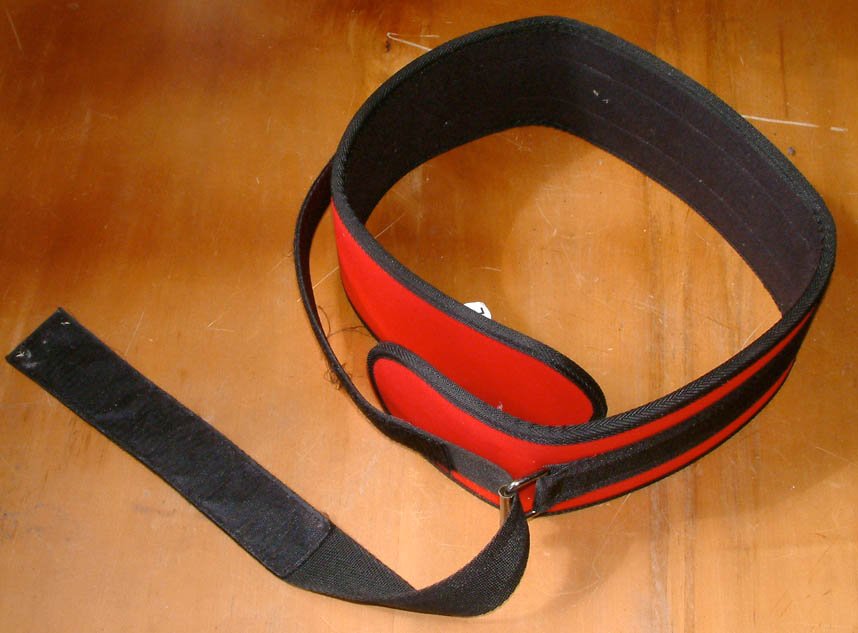
Photo: GeorgeStepanek, CC BY-SA 3.0, via Wikimedia Commons
A weightlifting belt and a lumbar support belt can look similar, but they do different jobs. A lifting belt is usually thick leather or nylon and is worn tight for a few heavy sets. It helps you brace your core against the belt to build pressure in your abdomen. It is not designed for pain relief or for wearing all day.
A lumbar support belt is softer and more flexible. It is meant to support a sore back through hours of normal activity, such as standing, walking, and light lifting. If your back hurts, a lumbar support belt is the right choice. If you are training heavy in the gym with a healthy back, a lifting belt is.
Do Lumbar Support Belts Actually Work?
Lumbar belts can make your back feel more stable and remind you to move carefully, but the research on long-term results is limited. A Cochrane review of lumbar supports found moderate evidence that they are no more effective than no intervention or training for preventing low back pain. In four studies with 1,170 people, there was little or no difference in short-term pain relief between people with acute or chronic back pain who used supports and those who received no treatment.
The review authors also noted that many of the studies were low quality and that more research is needed. In practice, many people find a belt helpful for comfort during flare-ups, long drives, or physical work. The key is to treat it as a short-term tool, not a cure, and to pair it with movement and strengthening.
If you want gentle ways to ease tension at home, try these lower back massage techniques alongside your belt.
How to Wear a Lumbar Support Belt Correctly
A lumbar belt only helps if it sits in the right place. Here is the basic method most makers recommend:
- Stand up straight with your shoulders relaxed.
- Center the back panel or lumbar pad over the lower curve of your spine, low on the back.
- Wrap both ends around your waist and fasten the front closure.
- Pull the side straps or pulley tabs until the belt feels snug but you can still breathe deeply.
- Check that you can sit, stand, and bend without the belt digging in.
For a full walkthrough with common mistakes, read our guide on how to properly wear a back brace. The video below also shows how to position and tighten a lumbar support belt.
How Long Should You Wear It?
Most people do best wearing a lumbar belt during the activities that bring on pain, such as lifting, long drives, or a long shift, and taking it off when resting. Wearing a belt all day, every day, can let your core muscles do less work over time. Loosen it when you sit for long periods, and do not sleep in it unless your doctor tells you to.
When to See a Doctor About Back Pain
A lumbar belt is for everyday aches and strains. See a doctor promptly if your back pain:
- Follows a fall or injury
- Comes with numbness, tingling, or weakness in your legs
- Comes with loss of bladder or bowel control
- Comes with fever or unexplained weight loss
- Has not improved after a few weeks
These can be signs of a problem that a belt cannot fix.
Frequently Asked Questions
What is the best lumbar support belt for lower back pain?
For most people, the Sparthos Back Brace is the best lumbar support belt to start with. It has an adjustable lumbar pad, firm stays, and a 4.4-star rating from more than 65,000 ratings. If you need firmer support, the Aspen QuikDraw PRO is the strongest pulley option here.
Can I wear a lumbar support belt all day?
You can wear a light elastic belt for a full workday if it is comfortable, but most experts suggest using it for the activities that cause pain rather than every waking hour. Take it off when resting so your core muscles stay active.
Should a lumbar support belt be tight?
It should be snug enough to feel supportive but not so tight that it restricts your breathing or leaves deep marks. If your legs tingle or your stomach feels squeezed, loosen it.
Can I sleep in a lumbar support belt?
Most people should not. Lying down already takes the load off your spine. Only sleep in a brace if your doctor has told you to, such as after certain surgeries.
Do lumbar support belts help with sciatica?
Some people with sciatica find that a belt eases pain during activity by limiting movements that irritate the nerve. Results vary, and a belt does not treat the cause. See a doctor if leg pain is severe or comes with numbness or weakness.
Is a lumbar support belt the same as a back brace?
A lumbar support belt is one type of back brace. It focuses on the lower back. Other back braces target posture or the upper back. Our main guide covers the wider range of back braces for posture and pain.
Conclusion
The best lumbar support belt is the one that fits your body, matches the support you need, and is comfortable enough that you will actually wear it. For most people, the Sparthos Back Brace is the safest first choice. If your back needs firmer, clinic-level compression, go for the Aspen QuikDraw PRO or the BaxMAX Lumbar Support Belt Seniors and people with weak hands will find the BraceAbility Lower Back & Spine Pain Brace easiest to put on.
Whatever you choose, measure carefully, wear the belt for the activities that bring on pain, and keep moving. Good footwear helps too, so take a look at our picks for the best shoes for lower back pain. If your pain is severe or not improving, see a doctor or physical therapist.
Related Review Articles
- Best Back Braces Comparison and Reviews
- Best Back Braces for Seniors
- Best Shoes for Lower Back Pain Reviews and Buyer’s Guide
- Best Handheld Back Massager Reviews and Buying Guide
- Hip Support Brace Comparison and Reviews
- Upper Back Exercises for Better Posture

Hi, I’m Mamon, the content creator behind this blog. I share my experience in blogging, WordPress, SEO, and affiliate marketing through honest product reviews, in-depth buying guides, and practical how-to articles. Every piece of content is thoroughly researched and written to help readers make informed decisions.
Leave a Reply