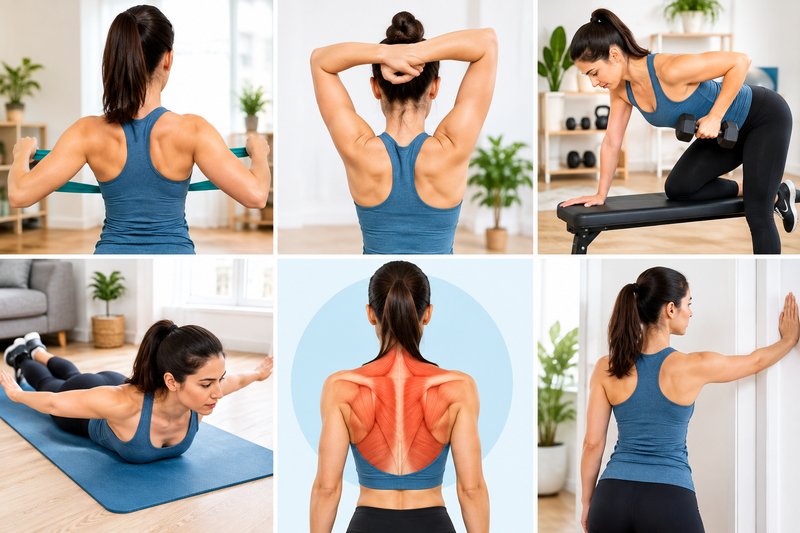
The best upper back exercises for posture strengthen the muscles between and below your shoulder blades while stretching the tight muscles across your chest. Moves like wall angels, band pull-aparts, rows and chin tucks help pull your shoulders back and your head over your spine. Most need little or no equipment, and a full routine takes 10 to 20 minutes. This guide covers 10 effective moves, how to do each one safely and a simple weekly plan you can start today.
Key Takeaways
- Strengthen the back, stretch the front: rounded shoulders usually come from weak upper back muscles and tight chest muscles.
- Research supports it: a 2024 review of 22 studies found that strengthening, stretching and shoulder exercises reduced forward head posture and rounded shoulders.
- You can start at home: wall angels, chin tucks and shoulder blade squeezes need no equipment.
- Aim for two or three sessions a week: this matches the CDC’s advice to train all major muscle groups at least twice weekly.
- Stop if it hurts: sharp pain, numbness or tingling is a reason to see a doctor or physical therapist.
Why Upper Back Strength Matters for Posture
Hours at a desk or on a phone pull your head forward and round your shoulders. Over time, the muscles across your chest get tight. The muscles that hold your shoulder blades back, such as the rhomboids and the middle and lower trapezius, get weaker. Physical therapists often call this pattern upper crossed syndrome.
The fix is to work both sides. Upper back exercises build the muscles that draw your shoulders back. Stretches loosen the chest muscles that pull them forward.
The evidence backs this up. A 2024 systematic review and meta-analysis in BMC Musculoskeletal Disorders pooled 22 studies with 903 participants. It found that strength exercises, stretching, shoulder-focused exercises and full-body programs all reduced forward head posture, rounded shoulders and excessive upper back rounding.
Signs Your Posture Needs Work
Not sure if you need upper back exercises? Look for these common signs:
- Your shoulders sit forward of your ears when viewed from the side.
- Your upper back looks rounded in photos.
- Your neck or upper back feels stiff after sitting.
- You find it hard to stand with your head and shoulder blades against a wall.
The wall test is a quick check. Cleveland Clinic notes that with good posture, the back of your head, shoulder blades, hips and the backs of your legs should all touch the wall when you stand against it.

Before You Start: Safety Tips
- Warm up first: march in place or circle your arms for three to five minutes.
- Move slowly: control each rep rather than using momentum.
- Keep your neck relaxed: your shoulders should move down and back, not up toward your ears.
- Start light: use a light band or dumbbell until the movement feels natural.
- Know when to stop: mild muscle effort is normal, but sharp pain is not.
If you have a recent injury, a spine condition or pain that spreads down your arm, check with a doctor or physical therapist before you begin.
10 Best Upper Back Exercises for Posture
The first five moves need no equipment or just a wall. The next three use a resistance band or dumbbells. The last two are gym staples.
1. Wall Angels
Wall angels train your shoulder blades to move well while your back stays upright. Cleveland Clinic physical therapist Jennifer Danzo, DPT, recommends them as a core posture move.
- Stand with your back against a wall, feet a few inches away.
- Press your head, shoulder blades and lower back gently into the wall.
- Raise your arms into a goalpost shape, with the backs of your hands on the wall.
- Slowly slide your arms up overhead, keeping contact with the wall.
- Slide them back down and repeat.
Try: 2 sets of 10 slow reps.
2. Chin Tucks
Chin tucks target forward head posture, which often goes hand in hand with rounded shoulders.
- Sit or stand tall and look straight ahead.
- Gently draw your chin straight back, as if making a double chin.
- Keep your eyes level and do not tilt your head down.
- Hold for five seconds, then relax.
Try: 10 reps, several times a day.
3. Shoulder Blade Squeezes
This simple move wakes up the rhomboids and middle trapezius. You can do it at your desk.
- Sit or stand tall with your arms relaxed.
- Squeeze your shoulder blades together and slightly down.
- Hold for five seconds without shrugging.
- Release slowly.
Try: 2 sets of 10 to 15 reps.
4. Prone Y-T-W Raises
These raises target the middle and lower trapezius, two muscles that often get weak with poor posture.
- Lie face down on a mat or bench with your forehead resting on a towel.
- Y: reach your arms overhead in a Y shape, thumbs up, and lift them a few inches.
- T: move your arms straight out to the sides and lift.
- W: bend your elbows, pull them toward your ribs and squeeze your shoulder blades.
- Lower with control after each shape.
Try: 8 reps of each letter. Add very light dumbbells once this feels easy.
5. Doorway Chest Stretch
A stretch belongs on this list because tight chest muscles pull your shoulders forward. Loosening them lets your upper back muscles do their job.
- Stand in a doorway with your elbows bent at shoulder height.
- Place your forearms on the door frame.
- Step one foot forward and lean gently until you feel a stretch across your chest.
- Hold for 20 to 30 seconds and breathe.
Try: 2 to 3 holds after your strength work.
6. Band Pull-Aparts
Band pull-aparts are one of the easiest upper back exercises to do at home. A light resistance band is all you need.
- Hold a band in front of your chest with straight arms, hands shoulder-width apart.
- Pull the band apart by moving your arms out to the sides.
- Squeeze your shoulder blades until the band touches your chest.
- Return slowly to the start.
Try: 2 to 3 sets of 12 to 15 reps.
7. Resistance Band Standing Row
Rows are the foundation of most upper back programs. Anchor a band to a sturdy door handle or post at chest height.
- Hold one end of the band in each hand and step back until it is taut.
- Stand tall with a slight bend in your knees.
- Pull your elbows back, keeping them close to your sides.
- Squeeze your shoulder blades, then return slowly.
Danzo tells people to “graze their ribcage with their elbows” and not to pull the elbows up high, according to Cleveland Clinic.
Try: 3 sets of 10 to 12 reps.
8. One-Arm Dumbbell Row
Working one side at a time helps you spot and fix strength differences between arms.
- Place your left knee and left hand on a flat bench.
- Hold a dumbbell in your right hand with your arm hanging straight down.
- Keep your back flat and your neck in line with your spine.
- Pull the dumbbell toward your hip, leading with your elbow.
- Lower it slowly, then switch sides after your set.
Try: 3 sets of 10 to 12 reps per arm. A sturdy workout bench for home makes this move more stable.
9. Bent-Over Row
The bent-over row works the whole upper back at once. It also balances out chest-heavy routines built around pressing moves.
- Hold a barbell or two dumbbells with your hands slightly wider than shoulder width.
- Brace your core, bend your knees slightly and hinge forward from your hips.
- Keep your back straight and let the weight hang below your shoulders.
- Pull the weight toward your lower ribs and squeeze your shoulder blades.
- Lower slowly to the start.
Try: 3 sets of 8 to 10 reps. Start light, since poor form here strains the lower back.
10. Seated Cable Row or Pull-Ups
If you have gym access, the seated cable row lets you add weight in small steps.
- Sit tall at a cable row station with your knees slightly bent.
- Grab the handle and keep your chest up.
- Pull the handle to your lower chest without leaning back.
- Return with control.
Pull-ups are a tougher option that you can do at home with a door bar. Beginners can use a resistance band for help or start with a lat pulldown machine.
Try: 3 sets of 8 to 12 cable rows, or as many clean pull-ups as you can, up to 3 sets.

A Simple Weekly Upper Back Routine
You do not need to do every exercise every day. This plan fits two or three sessions a week, in line with the CDC’s recommendation of muscle-strengthening activity at least two days a week.
| Day | Exercises | Time |
|---|---|---|
| Daily (at your desk) | Chin tucks, shoulder blade squeezes | 2 to 3 minutes |
| Session A (e.g., Monday) | Wall angels, band pull-aparts, band rows, doorway stretch | 15 minutes |
| Session B (e.g., Wednesday) | Y-T-W raises, one-arm dumbbell rows, bent-over rows, doorway stretch | 20 minutes |
| Session C (optional, e.g., Friday) | Repeat Session A or add seated cable rows or pull-ups | 15 to 20 minutes |
Rest at least one day between harder sessions. Add reps or resistance slowly once the current level feels easy.
What About Shrugs?
Shrugs are a popular upper back exercise, but they mainly work the upper trapezius. In people with rounded shoulders, that muscle is often already tight and overactive. The weaker middle and lower trapezius usually need more attention. For posture goals, rows, pull-aparts and Y-T-W raises are a better use of your time. Shrugs are still fine as part of a general strength program.
Common Mistakes to Avoid
- Shrugging during rows: keep your shoulders down and away from your ears.
- Using too much weight: heavy loads tempt you to swing and arch your lower back.
- Skipping the stretch: strength work alone may not undo tight chest muscles.
- Rushing reps: a slow two-second return builds more control.
- Training only once in a while: posture changes come from steady, repeated practice.
Upper Back Exercises vs. Posture Braces
A posture brace can remind you to sit up straight, but it does not build strength. Upper back exercises train your muscles to hold good posture on their own. Many people use both at first, then rely less on the brace as they get stronger. If you are considering one, see our guide to the best back braces and learn how to wear a back brace properly.
Frequently Asked Questions
How often should I do upper back exercises for posture?
Two to three strength sessions a week works well for most people. Gentle moves like chin tucks and shoulder blade squeezes can be done daily.
Can I fix my posture with exercises at home?
Yes, for most everyday posture problems. Wall angels, chin tucks, shoulder blade squeezes, Y-T-W raises and band exercises need little or no equipment.
How long does it take to improve posture with exercise?
It varies by person and how consistent you are. Many people notice they sit and stand more easily within a few weeks, but lasting change takes steady practice over months.
Do upper back exercises help with back pain?
They may help pain linked to poor posture and weak muscles. Pain that is severe, lasts for weeks or comes with numbness needs a medical evaluation first.
Is a rowing machine good for upper back posture?
Yes. Rowing works the upper back, shoulders and core. Our guide on how long you should row on a rowing machine can help you build it into your week.
Conclusion
Better posture comes from a stronger upper back and a looser chest. Start with the no-equipment moves, add a band or dumbbells as you progress and stick with two or three sessions a week. These upper back exercises take less than 20 minutes, and the payoff is a straighter, more comfortable stance at your desk and beyond.

Hi, I’m Mamon, the content creator behind this blog. I share my experience in blogging, WordPress, SEO, and affiliate marketing through honest product reviews, in-depth buying guides, and practical how-to articles. Every piece of content is thoroughly researched and written to help readers make informed decisions.
Leave a Reply