A back brace after surgery is one of the most common things patients go home with after spine surgery, but it is also one of the most debated. Some surgeons prescribe a brace for every patient, others rarely use one, and the research suggests the benefit may be smaller than many people expect. What matters most is following your own surgeon’s instructions.
This guide explains why surgeons prescribe braces after back surgery, the main types, what recent research says, typical wear schedules, how to put a brace on safely, and daily-life tips for recovery. It is general information to help you understand your care, not a replacement for your surgical team’s advice.

Why Surgeons Prescribe a Back Brace After Surgery
After spine surgery, a brace may be used to:
- Limit movement while bone grafts begin to fuse or tissues heal
- Remind you not to bend, lift, or twist too soon
- Ease pain by supporting sore muscles around the incision
- Provide confidence when you start walking and moving again
- Support the spine after fractures or certain complex procedures
Whether you need one depends on the type of surgery, how many levels were treated, bone quality, and your surgeon’s preference. Practice varies widely. A 2021 study in the International Journal of Spine Surgery noted that only about half of providers use postoperative bracing after posterior lumbar fusion, which shows a lack of agreement on its benefit.
Types of Back Braces Used After Surgery
| Brace type | What it is | Often used after |
|---|---|---|
| Lumbar corset | Soft fabric brace with stays, wraps the lower back | Lumbar fusion, discectomy, laminectomy |
| LSO (lumbosacral orthosis) | Semi-rigid or rigid panels for the lower back and pelvis | Lumbar fusion, lower spine fractures |
| TLSO (thoracolumbosacral orthosis) | Rigid brace covering the mid and lower back | Thoracic or thoracolumbar surgery and fractures |
| Chairback (Knight-Taylor) brace | Rigid frame with shoulder straps | Some fusion and fracture cases |
| Cervical collar | Neck brace | Neck (cervical) surgery |
Most braces after lumbar surgery are either soft corsets or LSOs. Rigid braces are more common after fractures or more extensive surgery.
If your surgery was on your neck, your surgeon may prescribe a cervical collar instead. Our guide on how to sleep with a neck brace offers tips for those first few weeks.
What the Research Says About Bracing After Spine Surgery
It may surprise you that strong evidence for routine bracing after lumbar fusion is limited.
The 2008 Randomized Trial
In a randomized trial published in the Journal of Bone and Joint Surgery, 90 patients having lumbar fusion for degenerative conditions were assigned either to wear a lumbar corset full-time for eight weeks after surgery or to wear no corset. At two years after surgery, the researchers found no significant advantage or disadvantage to using the corset in patient-reported function, X-ray results, or reoperation rates.
The 2024 Meta-Analysis
A more recent 2024 meta-analysis in the International Journal of Spine Surgery pooled five randomized controlled trials with 362 patients who had fusion for degenerative lumbar conditions. Patients who wore a brace did slightly better on some early pain and function scores, but none of the differences were statistically significant. Fusion rates were similar, and complications occurred in 14.9% of the brace group versus 17.4% of the no-brace group, which was also not a significant difference.
The authors concluded that wearing a brace after lumbar fusion did not make a substantial difference to pain relief, functional recovery, fusion, or complications.
What This Means for You
This research does not mean you should ignore your surgeon’s instructions. It applies to certain fusion procedures for degenerative conditions, not to every surgery. Your surgeon may prescribe a brace for good reasons specific to you, such as weak bones, a fracture, multiple levels, or a need to limit movement. Always follow the plan your surgical team gives you, and ask questions if you are unsure why a brace was or was not prescribed.
How Long Do You Wear a Back Brace After Surgery?
There is no single answer. Wear time depends on the procedure and your surgeon. In the research trials above, braces were typically worn for 8 to 12 weeks after fusion surgery. As a general picture:
- Discectomy or laminectomy: Often no brace, or a soft corset for comfort for a few weeks
- Lumbar fusion: Commonly 6 to 12 weeks, if a brace is prescribed
- Spine fracture: Often longer, based on healing seen on X-rays
- Neck surgery: A collar for a few weeks, depending on the procedure
Your surgeon will also tell you whether to wear the brace full-time or only when you are up and moving, and whether you can take it off to shower or sleep. These instructions are not one-size-fits-all, so write them down at discharge.
How to Put On a Back Brace After Surgery
Putting on a brace when you are sore and cannot bend can be tricky. Your nurse or physical therapist will usually show you how before you leave the hospital. Common methods include:
The Log-Roll Method (Lying Down)
- Lie on your back in bed.
- Log-roll onto your side, keeping your shoulders and hips moving together.
- Place the back half of the brace behind you, centered on your spine.
- Log-roll onto your back, onto the brace.
- Bring the front panel across and fasten it, then tighten the straps.
- Log-roll onto your side and push up to sitting with your arms.
Standing or Sitting Method
Some braces can be put on while standing or sitting on the edge of the bed. Only use this method if your surgeon says it is OK, and have someone help you the first few times.
Our general guide on how to properly wear a back brace covers positioning, but always follow the specific steps your care team teaches you.
In the video below, a neurosurgeon explains why patients may need a back brace after spinal fusion surgery.
Caring for Your Skin Under a Brace
Wearing a brace for weeks can irritate your skin and incision. To protect it:
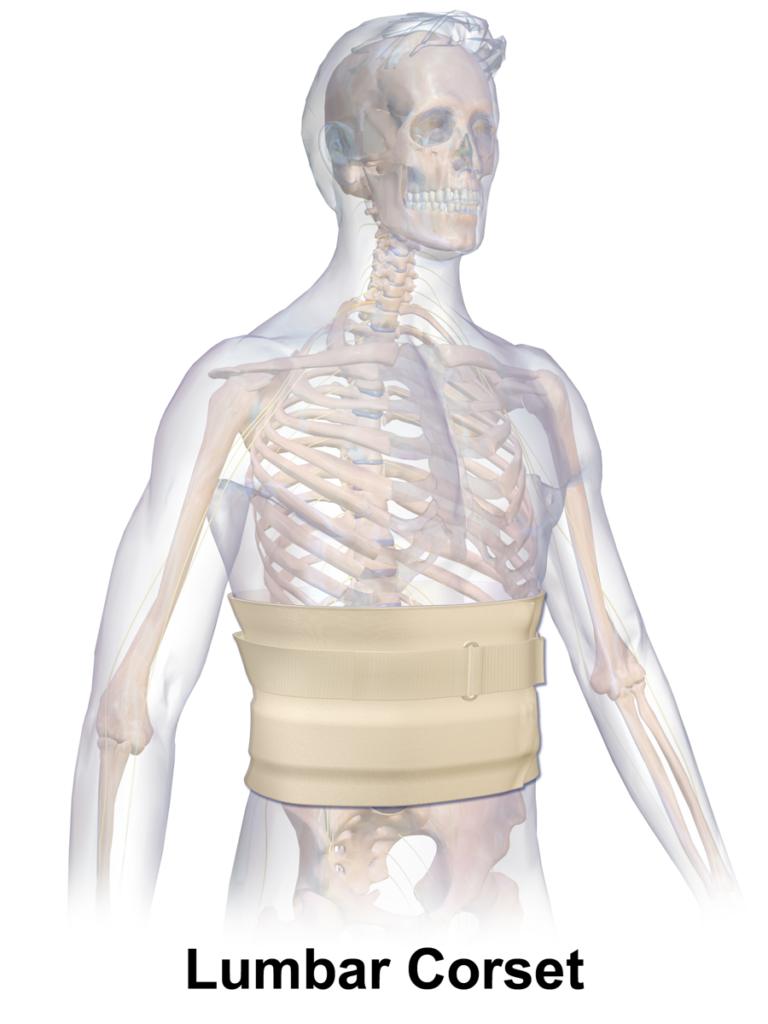
Illustration: BruceBlaus, CC BY-SA 4.0, via Wikimedia Commons
- Wear a thin, seamless cotton shirt under the brace
- Keep the brace off your incision dressing unless told otherwise, or pad it as instructed
- Check your skin daily for redness, blisters, or sores, especially over bony areas
- Keep your skin clean and dry, and avoid lotions under the brace
- Call your surgeon if your incision is red, swollen, warm, draining, or if you have a fever
Clean the brace as the instructions say. Many soft braces can be hand-washed and air-dried. Rigid braces are usually wiped down.
Daily Life With a Back Brace After Surgery
Getting In and Out of Bed
Use the log-roll method: roll onto your side, drop your legs over the edge, and push up with your arms. This avoids twisting and bending your back.
Sitting
Choose a firm chair with armrests and a good backrest. Avoid low couches and recliners that are hard to get out of. Stand up and walk briefly every 30 to 60 minutes. Our article on wearing a back brace while sitting has more seating tips.
Walking
Walking is usually encouraged soon after surgery. Start with short, frequent walks and build up as your surgeon advises. If your balance is shaky, a cane or walker can help. Our guide on how to use a walking stick correctly explains safe technique, and our rollator vs. walker comparison can help if you need more support.
Bending, Lifting and Twisting
Most surgeons ask patients to avoid bending, lifting, and twisting, often summed up as “no BLT,” for several weeks. Common lifting limits are very light, such as nothing heavier than a gallon of milk, but follow your surgeon’s exact limits.
Driving
Many surgeons ask patients not to drive for a period after spine surgery, especially while taking opioid pain medicine. Ask your surgeon when it is safe.
Showering
Ask whether you can remove the brace to shower. Some patients need to keep it on or use a shower chair. A long-handled sponge and a handheld showerhead can help you avoid bending.
Sleeping
Your surgeon will tell you whether to sleep in the brace. Many patients can remove it in bed. Sleep on your back with a pillow under your knees, or on your side with a pillow between your knees.
Weaning Off Your Back Brace
When your surgeon says it is time to stop wearing the brace, the change can feel strange at first. Your back muscles may feel weak or tired. To make the switch easier:
- Follow the schedule your surgeon gives you, which may involve gradually reducing wear time
- Start physical therapy if prescribed, to rebuild core and back strength
- Keep walking daily
- Avoid heavy lifting until your surgeon clears you
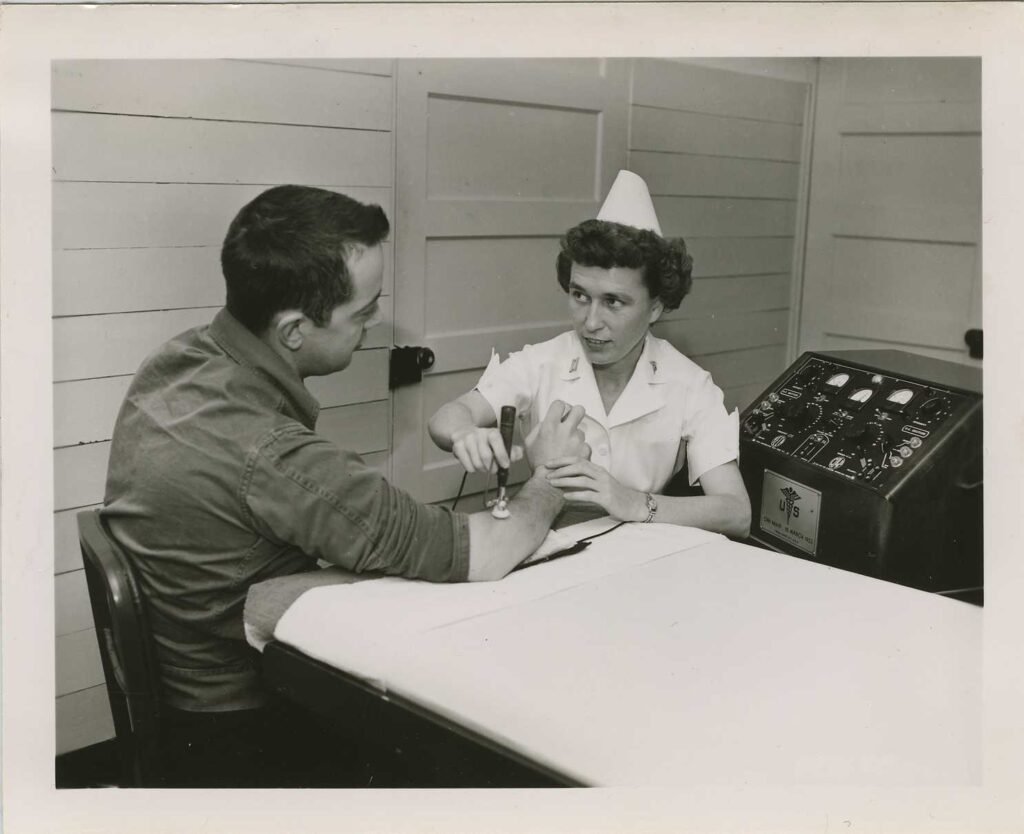
Photo: National Museum of Health and Medicine, CC BY 2.0, via Wikimedia Commons
Physical therapy is a key part of recovery after spine surgery. A therapist can guide safe exercises and help you return to work and normal activities.
Can You Buy Your Own Back Brace After Surgery?
If your surgeon prescribed a specific brace, use that one. Do not swap it for an over-the-counter brace without asking, because the support level may be very different.
If your surgeon says a brace is optional, or suggests a soft support for comfort, an over-the-counter lumbar brace may be fine. Our guide to the best lumbar support belt compares elastic, pulley, and rigid options, and our back brace size chart guide explains how to measure. Medicare Part B may cover a back brace when it is medically necessary and ordered by a doctor, so ask your surgeon’s office before buying one yourself.
Questions to Ask Your Surgeon About Your Brace
Before you leave the hospital, ask your surgical team these questions so you know exactly what to do at home:
- Do I need a back brace after surgery, and why?
- Should I wear it all the time, or only when I am up and moving?
- Can I take it off to sleep, shower, or sit?
- How tight should it be, and how do I know if it fits correctly?
- How long will I need to wear it?
- What activities should I avoid while wearing it?
- Who do I call if it rubs, breaks, or stops fitting?
The American Academy of Orthopaedic Surgeons’ spinal fusion overview explains that fusion eliminates motion between vertebrae while most fusions involve only small segments of the spine and do not significantly limit motion. Understanding your procedure can help you make sense of your surgeon’s bracing advice.
When to Call Your Surgeon
Contact your surgeon promptly if you have:
- Fever, chills, or signs of infection at the incision
- New or worsening numbness, tingling, or weakness in your legs
- Loss of bladder or bowel control (seek emergency care)
- Severe pain that is not controlled by your medicine
- Calf pain, swelling, or shortness of breath, which can be signs of a blood clot (seek emergency care)
- A brace that no longer fits, cracks, or rubs your skin raw
Frequently Asked Questions
Do you always need a back brace after surgery?
No. Whether you need a brace depends on your surgery and your surgeon. Many discectomy and laminectomy patients do not need one, and research on routine bracing after lumbar fusion shows little difference in outcomes.
How long do you wear a back brace after spinal fusion?
If a brace is prescribed, it is often worn for about 6 to 12 weeks, but your surgeon will set the exact time based on your procedure and healing.
Can I sleep without my back brace after surgery?
Many patients can, but some cannot. Ask your surgeon, because the answer depends on your surgery.
Does wearing a back brace after surgery help fusion?
Research so far, including a 2024 meta-analysis of 362 patients, found no significant difference in fusion rates between patients who wore a brace and those who did not.
Can I take my back brace off to shower?
Ask your surgeon. Some patients can remove it to shower, while others need to keep it on or follow special instructions.
What happens if I do not wear my brace as instructed?
If your surgeon prescribed a brace for a specific reason, such as a fracture or weak bones, skipping it could increase risk. Always follow your surgeon’s instructions or talk to them before changing your plan.
The Bottom Line
A back brace after surgery can limit movement, ease pain, and remind you to protect your spine while you heal. But research on routine bracing after lumbar fusion, including a 2024 meta-analysis, shows it may not change pain, function, or fusion rates much. That is why practice varies so widely among surgeons.
The most important rule is simple: follow your own surgeon’s instructions on whether to wear a brace, how long, and when to stop. Use safe movement habits, care for your skin, walk daily, and stick with physical therapy. If you have questions about your brace, ask your surgical team rather than guessing. For background on how braces work, see our explainer on what a back brace does.
This article is for general information only and is not medical advice. Always follow the instructions of your surgeon and care team after spine surgery.

Hi, I’m Mamon, the content creator behind this blog. I share my experience in blogging, WordPress, SEO, and affiliate marketing through honest product reviews, in-depth buying guides, and practical how-to articles. Every piece of content is thoroughly researched and written to help readers make informed decisions.
Leave a Reply