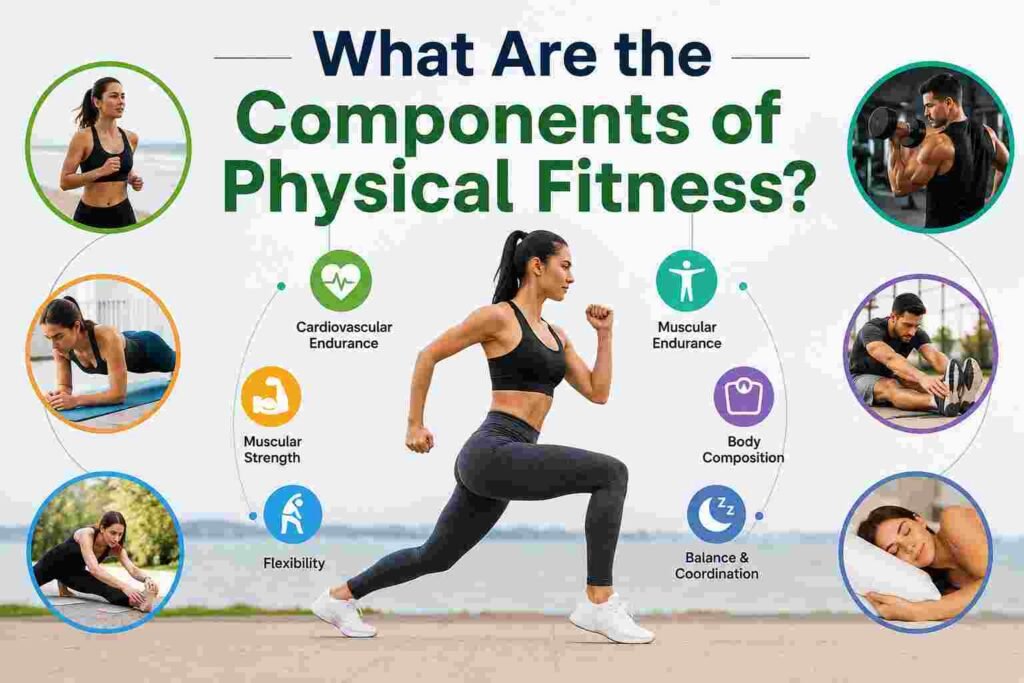
Most people think “fitness” just means going to the gym or running a few miles. But physical fitness is really made up of several distinct parts, and each one plays a different role in how your body works. If you have ever wondered what are the component of physical fitness, the short answer is that fitness breaks down into health-related and skill-related components — and training all of them gives you a body that is strong, capable, and built to last.
This guide walks through every component in detail, explains why each one matters, and shows you exactly how to test and improve it, whether you are just starting out or training for a specific sport.
Quick answer: The components of physical fitness are the specific measurable parts of overall fitness. They fall into two groups: health-related components (cardiovascular endurance, muscular strength, muscular endurance, flexibility, and body composition) that affect everyday health, and skill-related components (agility, balance, coordination, power, reaction time, and speed) that affect performance in sports and physical tasks.
What Are the Components of Physical Fitness?
Physical fitness is not one single thing you either have or don’t have. It’s a combination of separate physical qualities that work together. Exercise scientists and organizations like the American College of Sports Medicine (ACSM) generally split these qualities into two categories: health-related components of physical fitness and skill-related components of physical fitness.
Health-related components connect directly to your long-term health and your risk of chronic disease. These are the ones doctors and public health groups, including the CDC and the World Health Organization (WHO), focus on most because they affect how well your heart, lungs, muscles, and metabolism function day to day.
Skill-related components connect more to performance — how well you move, react, and coordinate your body. Athletes train these heavily, but they matter for everyday coordination too, like catching yourself before a fall or reacting quickly in traffic.
Both categories matter. Health-related fitness keeps you well; skill-related fitness helps you move through the world efficiently and safely.
The 5 Health-Related Components of Physical Fitness
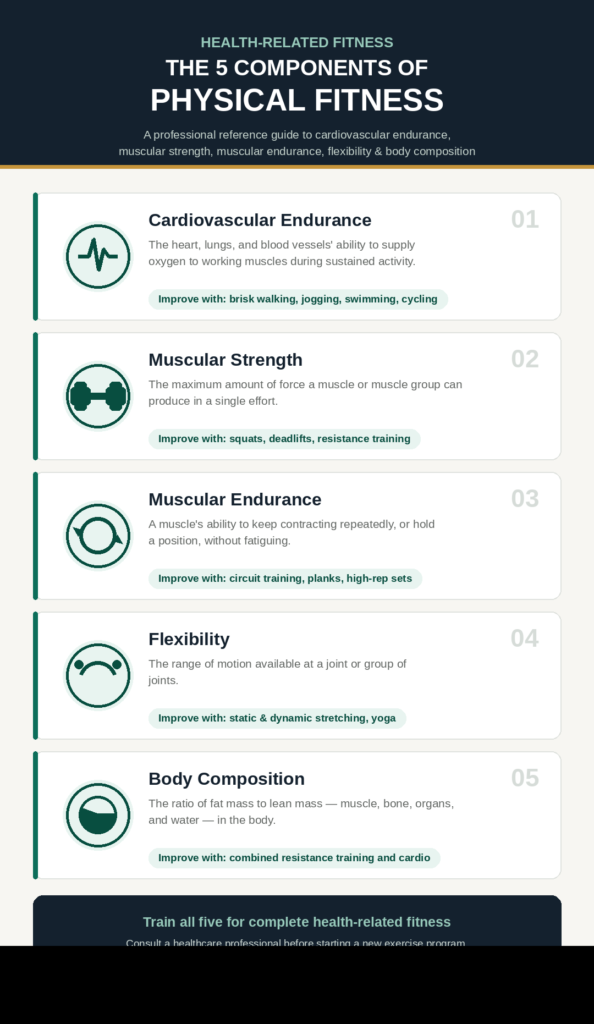
These five components of physical fitness are the foundation of any well-rounded exercise and fitness routine. Public health guidelines, including the CDC Physical Activity Guidelines, recommend a mix of aerobic exercise and resistance training precisely because no single workout develops all five at once.
1. Cardiovascular Endurance
Definition: Cardiovascular endurance, also called cardiorespiratory fitness or aerobic endurance, is your heart, lungs, and blood vessels’ ability to supply oxygen to working muscles during sustained physical activity.
Why it matters: This is often considered the most important health-related component because it’s closely tied to heart disease risk, blood pressure, and overall life expectancy. The American Heart Association links good cardiovascular endurance to a lower risk of stroke and heart disease.
Benefits:
- Lowers resting heart rate and blood pressure
- Improves lung capacity and oxygen use (VO₂ max)
- Reduces risk of type 2 diabetes and heart disease
- Boosts energy levels and reduces fatigue
Examples: Jogging, brisk walking, swimming, cycling, rowing, dancing, and hiking.
Exercises to improve it:
- Brisk walking for 30 minutes, 5 days a week
- Interval training (alternating fast and slow paces)
- Swimming laps
- Cycling, either outdoors or on a stationary bike
Common mistakes: Doing the same steady-pace cardio every session without progression, skipping warm-ups, and increasing intensity too fast, which raises injury risk.
2. Muscular Strength
Definition: Muscular strength is the maximum amount of force a muscle or muscle group can produce in a single effort.
Why it matters: Strength protects your joints, supports bone density, and makes daily tasks like carrying groceries or climbing stairs easier. It becomes even more important with age, since muscle mass naturally declines over time without resistance training.
Benefits:
- Builds and preserves lean muscle
- Supports bone health and reduces fracture risk
- Improves posture and joint stability
- Raises resting metabolic rate
Examples: Squats, deadlifts, bench press, leg press, and overhead press.
Exercises to improve it:
- Bodyweight squats and push-ups for beginners
- Progressive resistance training with dumbbells or barbells
- Compound lifts like squats and deadlifts for overall strength
Common mistakes: Lifting with poor form to move heavier weight, never progressing the load, and training the same muscle group every day without recovery.
3. Muscular Endurance
Definition: Muscular endurance is a muscle’s ability to keep contracting repeatedly, or hold a position, without giving out.
Why it matters: This is what lets you hold a plank, finish a long hike, or do repeated tasks like shoveling snow without your muscles failing. It’s distinct from strength — endurance is about how long a muscle can keep working, not how much force it can produce once.
Benefits:
- Delays muscle fatigue during daily activity and exercise
- Supports better posture over long periods (sitting, standing, walking)
- Complements strength training for balanced fitness
Examples: Push-ups, sit-ups, bodyweight squats, planks, and pull-ups done for high repetitions.
Exercises to improve it:
- Circuit training with lighter weights and higher reps (15–25 reps per set)
- Planks and wall sits for core and lower-body endurance
- High-repetition bodyweight training
Common mistakes: Using weight so light there’s no real challenge, rushing through reps instead of controlling form, and stopping before real fatigue sets in.
4. Flexibility
Definition: Flexibility is the range of motion available at a joint or group of joints.
Why it matters: Good flexibility reduces injury risk, improves movement quality, and helps counter the stiffness that comes from sitting for long stretches. The Mayo Clinic notes that regular stretching can help maintain the ability to move joints through their full range of motion.
Benefits:
- Reduces muscle tightness and joint stiffness
- Improves posture and movement efficiency
- Lowers risk of strains during exercise
- Supports better recovery between workouts
Examples: Toe touches, hamstring stretches, shoulder stretches, and yoga poses.
Exercises to improve it:
- Static stretching (holding a stretch for 30–60 seconds) after workouts
- Dynamic stretching (moving stretches like leg swings) before workouts
- Yoga or Pilates sessions, 2–3 times a week
Common mistakes: Stretching cold muscles before any warm-up, bouncing during a stretch instead of holding it steady, and skipping stretching altogether.
5. Body Composition
Definition: Body composition is the ratio of fat mass to lean mass (muscle, bone, organs, and water) in your body.
Why it matters: Body composition gives a more useful picture of health than body weight alone, since two people at the same weight can have very different amounts of fat and muscle. It’s linked to metabolic health, joint stress, and disease risk.
Benefits:
- Better indicator of health than weight or BMI alone
- Tracks progress in strength and fat-loss programs
- Linked to lower risk of metabolic conditions like type 2 diabetes
Examples of assessment methods: Skinfold calipers, bioelectrical impedance scales, DEXA scans, and underwater weighing.
Typical ranges: A healthy body fat percentage is generally lower for men (roughly 10–20%) than for women (roughly 18–28%), though healthy ranges vary by age and individual factors.
Exercises to improve it:
- A combination of resistance training (to build lean muscle) and cardiovascular exercise (to manage body fat percentage)
- Consistent, sustainable nutrition habits alongside exercise
Common mistakes: Focusing only on the number on the scale, relying on extreme diets instead of sustainable habits, and ignoring strength training while doing cardio only.
Health-Related Fitness Components Comparison
| Component | Main Focus | Best Assessed By | Improved Mainly Through |
|---|---|---|---|
| Cardiovascular Endurance | Heart, lungs, blood vessels | 1-mile walk/run, VO₂ max test | Aerobic exercise |
| Muscular Strength | Maximum force output | 1-rep max tests | Resistance training |
| Muscular Endurance | Sustained muscle contractions | Push-up/sit-up test | High-rep circuit training |
| Flexibility | Joint range of motion | Sit-and-reach test | Stretching, yoga |
| Body Composition | Fat-to-lean mass ratio | BMI, skinfold, bioelectrical impedance | Combined diet and exercise |
Skill-Related Components of Physical Fitness
While health-related components keep your body functioning well, skill-related components determine how efficiently you move and perform. These matter most for athletes, but they show up in everyday life too — think of catching your balance on an icy sidewalk or reacting quickly to a car braking ahead of you.
- Agility: The ability to change direction quickly and efficiently, important in sports like basketball, tennis, and soccer.
- Balance: The ability to keep your body’s center of mass over its base of support, whether standing still or moving.
- Coordination: The ability to use different body parts together smoothly and accurately, like hand-eye coordination in catching a ball.
- Power: The ability to combine strength and speed, such as in a jump or a sprint start.
- Reaction Time: How quickly you respond to a stimulus, like starting a sprint after hearing the starting gun.
- Speed: The ability to move your body, or part of it, quickly across a distance.
These skill-related components are especially important for athletes, since sports performance often depends on quick, coordinated, and powerful movement rather than just health markers alone. That said, older adults also benefit from training balance and coordination specifically, since these qualities help prevent falls.
Health-Related vs. Skill-Related Components
| Category | Components | Primary Purpose | Who Benefits Most |
|---|---|---|---|
| Health-Related | Cardiovascular endurance, muscular strength, muscular endurance, flexibility, body composition | Long-term health and disease prevention | Everyone |
| Skill-Related | Agility, balance, coordination, power, reaction time, speed | Movement performance and efficiency | Athletes, older adults (balance/coordination) |
Why Are the Components of Physical Fitness Important?
Understanding the importance of physical fitness components helps explain why a well-rounded routine beats doing just one type of exercise.
- Better overall health: Balanced fitness supports heart health, healthy blood pressure, and strong bones.
- Disease prevention: The CDC and WHO both link regular physical activity to lower rates of heart disease, type 2 diabetes, and certain cancers.
- Easier daily activities: Carrying groceries, climbing stairs, and playing with kids all draw on strength, endurance, and flexibility together.
- Sports performance: Skill-related components like agility and power directly affect how well someone performs in competitive sports.
- Mental health: Physical activity is associated with reduced symptoms of anxiety and depression and improved mood.
- Healthy aging: Maintaining strength, balance, and flexibility as you age helps prevent falls and preserves independence.
How to Assess Physical Fitness
A basic fitness assessment gives you a starting point and a way to track progress over time. Here are some common, low-cost tests:
- Push-up test: Measures upper-body muscular endurance by counting max push-ups with good form.
- Sit-up test: Measures core muscular endurance over a set time, often one minute.
- BMI (Body Mass Index): A simple height-to-weight ratio used as a general screening tool, though it doesn’t distinguish fat from muscle.
- Waist circumference: A quick way to estimate abdominal fat, which is linked to higher health risk.
- Sit-and-reach test: Measures flexibility of the hamstrings and lower back.
- 1-mile walk/run test: Measures cardiovascular endurance based on completion time.
- VO₂ max overview: VO₂ max measures the maximum amount of oxygen your body can use during intense exercise, and it’s considered one of the best indicators of cardiovascular fitness, though it usually requires lab or specialized equipment to measure precisely.
These fitness assessment tools work best when repeated every few months, using the same conditions each time, so you can see real trends rather than one-off numbers.
How to Improve Every Component
You don’t need a complicated plan to start improving physical fitness. Here are beginner-friendly starting points for each component:
- Cardiovascular endurance: Start with 20–30 minutes of brisk walking, 3–5 times a week, and gradually add jogging intervals.
- Muscular strength: Begin with bodyweight exercises (squats, push-ups) twice a week, then add resistance as they get easier.
- Muscular endurance: Add circuit-style workouts with lighter weights and higher reps, resting only briefly between sets.
- Flexibility: Stretch major muscle groups after each workout, and consider a weekly yoga or mobility session.
- Body composition: Combine consistent resistance training and cardio with a sustainable, balanced eating pattern rather than restrictive dieting.
- Skill-related components: Add sport-specific drills, footwork ladders, or balance exercises (like standing on one leg) two to three times a week.
Expert Tip: Fitness recommendations should be individualized. What works for one person’s schedule, joints, and goals may not suit another. If you have a chronic condition, are new to exercise, or are returning after an injury, check with a healthcare professional before starting a new program.
Common Mistakes
- Focusing only on cardio and ignoring strength training
- Skipping warm-ups and cool-downs
- Doing the same routine for months without progression
- Chasing weight loss on the scale instead of tracking body composition
- Ignoring flexibility and mobility work
- Overtraining without enough rest or recovery
- Comparing personal progress to someone else’s fitness level
- Using poor form to lift heavier weights
- Setting unrealistic short-term goals
- Skipping professional guidance when starting out with a chronic health condition
- Not tracking progress with any fitness assessment
Frequently Asked Questions
What are the 5 components of physical fitness? The 5 health-related components of physical fitness are cardiovascular endurance, muscular strength, muscular endurance, flexibility, and body composition.
What are the 11 components of physical fitness? The 11 components combine the 5 health-related components (cardiovascular endurance, muscular strength, muscular endurance, flexibility, body composition) with 6 skill-related components (agility, balance, coordination, power, reaction time, speed).
Why is flexibility important? Flexibility keeps joints moving through their full range of motion, reduces injury risk, and supports better posture and movement quality in daily life and exercise.
Which component is most important? No single component is “most important” for everyone; the right emphasis depends on individual goals. That said, cardiovascular endurance is often prioritized first because of its strong link to heart health and longevity.
How often should I exercise? General guidelines, including CDC Physical Activity Guidelines, suggest at least 150 minutes of moderate aerobic activity per week, plus muscle-strengthening activity on two or more days a week, though individual needs vary.
Can walking improve cardiovascular endurance? Yes. Brisk walking is a recognized form of aerobic exercise and can meaningfully improve cardiovascular endurance, especially for beginners.
What is body composition? Body composition describes the proportion of fat mass versus lean mass (muscle, bone, organs, water) that makes up total body weight.
How do athletes train different fitness components? Athletes typically combine sport-specific skill work (agility drills, reaction training) with health-related fitness training (strength and cardio) tailored to the specific physical demands of their sport.
What is the difference between muscular strength and endurance? Muscular strength is the maximum force a muscle can produce in one effort, while muscular endurance is how long a muscle can keep contracting or holding a position before fatiguing.
How long does it take to improve physical fitness? Noticeable improvements in cardiovascular endurance and strength can often be seen within 4–8 weeks of consistent training, though timelines vary by starting fitness level, consistency, and individual factors.
One exercise worth adding to that routine is the high knee, which builds both cardiovascular endurance and coordination at once. See our guide on what high knee exercise is and its benefits for how to add it to your workouts.
Conclusion
Physical fitness isn’t a single skill — it’s a set of components that each need attention. The 5 components of physical fitness (cardiovascular endurance, muscular strength, muscular endurance, flexibility, and body composition) form the foundation of long-term health, while skill-related components like agility, balance, and coordination round out performance and everyday movement quality.
The best approach is to assess where you stand, set realistic goals for each component, and build a routine that touches all of them over time. If you have any chronic health conditions or are new to exercise, check with a healthcare professional before starting so your plan fits your specific needs.

Hi, I’m Mamon, the content creator behind this blog. I share my experience in blogging, WordPress, SEO, and affiliate marketing through honest product reviews, in-depth buying guides, and practical how-to articles. Every piece of content is thoroughly researched and written to help readers make informed decisions.
Leave a Reply