Roll your ankle once and you know how fast a normal day can turn into limping, swelling, and worry about doing it again. Ankle sprains are extremely common. The American Academy of Orthopaedic Surgeons has estimated that about 25,000 ankle sprains happen every day in the U.S. A good ankle brace for a sprained ankle can protect the joint while the ligaments heal, help you get back to walking and sports sooner, and lower the chance of a repeat sprain.
This guide compares 9 ankle braces for sprained ankles sold on Amazon in the U.S. It covers stirrup braces for fresh, swollen sprains, hinged and strapped braces for returning to sports, and soft compression supports for mild sprains. It explains who each brace suits, what the listings and buyer ratings say, and how to pick the right type for your sprain grade. If you want general sports and everyday ankle braces, see our main guide to the best ankle braces. None of the models below are repeated from that guide.
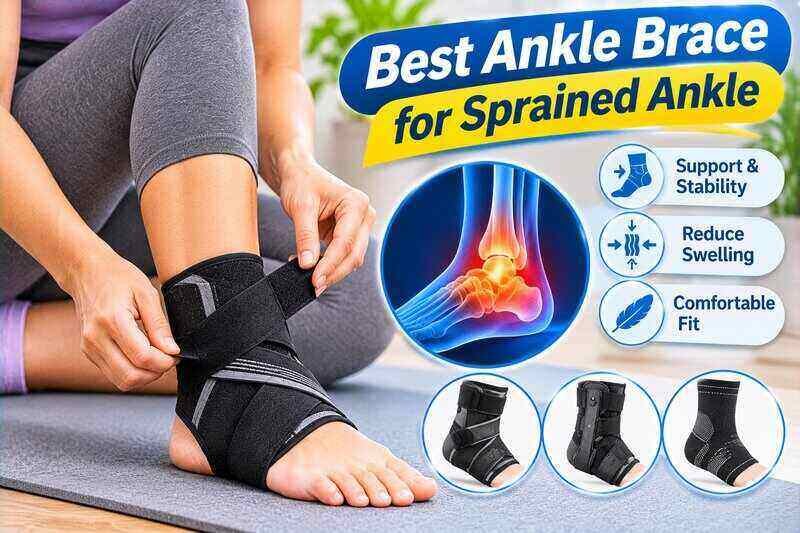
Best Ankle Brace for Sprained Ankle: Picks at a Glance
- Best overall for a fresh sprain: Aircast Air-Stirrup, a semi-rigid stirrup with air cells
- Best for repeat sprains: Aircast AirSport, protects against inversion and eversion
- Best hinged brace for sports: Ultra Zoom, side-to-side stability with natural up-and-down motion
- Best for moderate sprains in court sports: Zamst A1, with 3-way straps
- Best premium compression support: Bauerfeind MalleoTrain Plus, a knit support with massage pads and a figure-8 strap
- Best lightweight pick for return to play: Aircast A60, with 60-degree side stabilizers and one strap
- Best budget one-size brace: Mueller Adjustable Ankle Stabilizer, fits men’s shoe sizes 3 to 13
- Best drugstore pick: FUTURO Performance Ankle Stabilizer, with firm side stabilizers
- Best lace-up option: Mueller The ONE Premium Ankle Brace
Ankle Brace for Sprained Ankle Comparison Table
| Model | Brace type | Key feature | Best sprain stage |
|---|---|---|---|
| Aircast Air-Stirrup | Semi-rigid stirrup | Pre-inflated air cells | Fresh Grade I to III sprain |
| Aircast AirSport | Semi-rigid shell | ATF cross strap, air cells | Recovery and repeat sprains |
| Ultra Zoom | Hinged soft shell | Hinge allows up-and-down motion | Return to sports |
| Zamst A1 | Strapped with stays | 3-way straps | Mild to moderate sprain, sports |
| Bauerfeind MalleoTrain Plus | Knit compression + strap | Massage pads, figure-8 strap | Mild to moderate sprain, swelling |
| Aircast A60 | Low-profile with stays | 60-degree stabilizers | Prevention and return to play |
| Mueller Adjustable Ankle Stabilizer | Neoprene with straps | One size fits most | Mild sprain, everyday wear |
| FUTURO Performance Ankle Stabilizer | Strapped with stays | Firm side stabilizers | Mild sprain, everyday wear |
| Mueller The ONE Premium | Lace-up | Adjustable lace-up fit | Mild sprain, sports |
Ratings come from retail listing data and change often, so check the current listing before you buy.
How We Chose These Ankle Braces
We did not run hands-on lab tests. Instead, we compared each brace using information that matters most for a sprain:
- Brace type and support level, matched to sprain grades I to III
- Manufacturer details on stays, shells, straps, and intended uses
- Research on bracing, including a large trial on severe sprains and a prevention trial in high school basketball players
- Fit and practicality, such as sizing range, left or right design, washability, and how well the brace fits in a shoe
We also left out every brace already reviewed in our main ankle brace guide, so this list gives you new options. Prices and ratings change often, so always check the current listing before you buy.
1. Aircast Air-Stirrup Ankle Support Brace

Photo Amazon
The Aircast Air-Stirrup is one of the most widely used braces for fresh ankle sprains, and it is the same brace type tested in a major U.K. trial on severe sprains (more on that below). It uses two contoured semi-rigid shells that sit on each side of the ankle, lined with pre-inflated Duplex air cells. The listing says the air cells provide pulsating compression to support circulation and reduce swelling, and that the brace resists inversion (rolling outward) more than taping while leaving normal up-and-down motion virtually unrestricted.
It is designed for acute ankle injuries, Grade I to III sprains, chronic instability, and post-operative care. Because the shells are low-profile, most people can wear it inside a sneaker with the laces loosened. Buyers often mention that it helped them walk with less pain within days of the injury.
Pros:
- Semi-rigid shells limit the rolling motion that causes sprains
- Air cells add gentle compression for swelling
- Suitable for Grade I to III sprains, per the listing
- Low profile fits inside many shoes
- Adjustable heel pad for a custom fit
Cons:
- Bulkier than soft braces, so you may need roomier shoes
- Plastic shells can feel warm in summer
- Sizing is left- or right-specific, so order carefully
2. Aircast AirSport Ankle Support Brace

Photo Amazon
The Aircast AirSport is built for people who keep spraining the same ankle. It combines a semi-rigid shell with dynamic air cell compression and an adjustable cross strap over the anterior talofibular ligament (ATF), the ligament most often injured in a classic outward ankle roll. The listing says the shell protects against both inversion and eversion, so it covers inward and outward rolls.
It also includes integrated forefoot and shin wraps, and the brand says it can be worn barefoot or in shoes.
Pros:
- ATF cross strap targets the most commonly sprained ligament
- Protects against inward and outward rolls
- Air cells for compression and comfort
- Lighter and more flexible than a full stirrup
- Universal design for men and women
Cons:
- More parts to adjust than a simple sleeve
- Left- and right-specific versions
- Less rigid than the Air-Stirrup for a brand-new, severe sprain
3. Ultra Zoom Ankle Brace

Photo Amazon
The Ultra Zoom is a hinged ankle brace with a soft shell. The hinge lets your ankle move freely up and down for running and jumping, while the shell blocks side-to-side rolling. The brand describes it as a stabilizing brace for sprained ankles, repeated rolling, and ankle instability, with a low-profile fit for athletic shoes. It is a popular choice for basketball and volleyball players.
One detail that sets it apart is a custom fit: the brand explains that a home hair dryer can be used to heat-mold the shell to your ankle. It is listed as FSA/HSA eligible and comes with a one-year manufacturer warranty. Several reviewers who had tried other sports braces said the Zoom gave them better support during cutting and pivoting.
Pros:
- Hinge allows natural up-and-down motion for sports
- Blocks side-to-side rolling
- Heat-moldable for a personal fit
- Fits inside most athletic shoes
- FSA/HSA eligible with a one-year warranty
Cons:
- Higher price than soft braces
- Works best with low-cut shoes and loosened laces
- More than many people need for a mild sprain
4. Zamst A1 Ankle Brace

Photo Amazon
The Zamst A1 is a mid-level sports brace designed for mild to moderate lateral ankle sprains. It uses 3-way straps, including a dual inversion strap and a stirrup strap, along with anatomically shaped stays to stabilize the joint during landings and turns. The materials are thin and breathable, so it fits well in court and running shoes.
It is left- and right-specific and comes in small to extra-large. Zamst recommends choosing the larger size if you fall between two sizes. Note that our main ankle brace guide covers the stronger Zamst A2-DX for high-grade sprains.
Pros:
- Targets mild to moderate lateral sprains
- 3-way strap system mimics taping
- Thin, breathable, and low-profile
- Left- and right-specific for a closer fit
Cons:
- Not strong enough for a fresh, severe sprain
- One reviewer found it less effective for hiking
- Need to buy the correct side
5. Bauerfeind MalleoTrain Plus Ankle Brace
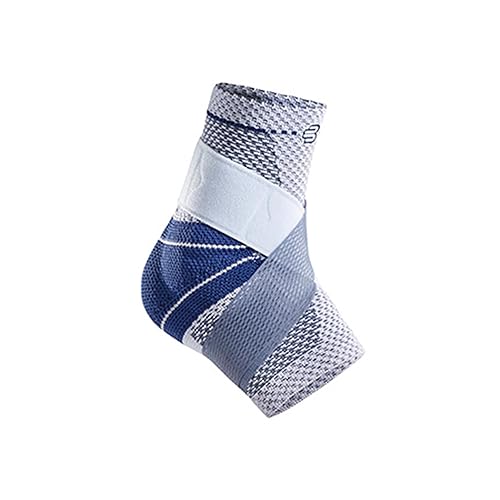
Photo Amazon
The Bauerfeind MalleoTrain Plus is a premium knit support with an adjustable strap system. It has two padding zones on the inner and outer ankle that support the joint and help circulation as you move. The strap can be tightened or loosened for firmer or gentler support, and the brand presents it as an alternative to athletic taping.
It is intended to help prevent twisting and support sprained ankles, with listed uses for slight sprains, moderate swelling, and mild to moderate ligament injuries. It is made in Germany, machine washable on a gentle cycle, and sized by ankle circumference across six sizes. The brand advises choosing the larger size for gentler compression and the smaller for firmer compression.
Pros:
- Medical-grade knit with massage-effect pads for swelling
- Adjustable figure-8 strap for extra stability
- Machine washable and keeps its elasticity
- Comfortable for all-day wear
- Listed as FSA/HSA eligible
Cons:
- Premium price
- Less protection than a semi-rigid brace for a severe sprain
- Six sizes by ankle measurement, so measure carefully
6. Aircast A60 Ankle Support Brace

Photo Amazon
The Aircast A60 is a lightweight, low-profile brace for mild support. It has side stabilizers angled at 60 degrees that protect the ankle’s weakest point and help guard against sprains and rollovers, while still allowing normal up-and-down movement. A single hook-and-loop strap replaces laces, so it goes on quickly.
The fabric is breathable and waterproof, and you can rinse it with cool water. It is sized by shoe size. For example, the Medium fits men’s shoe sizes 7.5 to 11.5 and women’s 9 to 13.
Pros:
- Very light and low-profile
- 60-degree stabilizers help prevent rolling
- Quick single-strap closure
- Waterproof and easy to rinse
- Sized by shoe size
Cons:
- Mild support, not for fresh moderate or severe sprains
- Some buyers find it hard to put on
7. Mueller Adjustable Ankle Stabilizer

Photo Amazon
The Mueller Adjustable Ankle Stabilizer is a budget-friendly brace that fits most adults in one size: men’s shoe sizes 3 to 13 and women’s 4 to 14. It uses a patented strap system for firm, even support and a neoprene and Hydramesh fabric that holds warmth. It fits either ankle and is low-profile enough for athletic shoes.
Mueller recommends it to help support weak, sprained, or arthritic ankles. One long-term reviewer noted that the semi-hard stays become softer over time, so heavy users may need to replace it more often.
Pros:
- Low price
- One size fits most adults, either foot
- Adjustable straps for custom compression
- Neoprene warmth can ease stiffness
- One-year warranty
Cons:
- Neoprene can feel hot
- Stays may soften with long-term use
- Less support than semi-rigid braces
8. FUTURO Performance Ankle Stabilizer

Photo Amazon
The FUTURO Performance Ankle Stabilizer is a common drugstore pick in the U.S. It has firm side stabilizers to help prevent ankle rolling and reduce re-injury risk, along with adjustable straps for customizable compression. The fabric is breathable and moisture-wicking, and the brace is designed to lift and support the arch.
It fits the left or right ankle and adjusts to ankle sizes of about 8 to 10 inches (20.3 to 25.4 cm).
Pros:
- Easy to find in U.S. drugstores
- Firm side stabilizers
- Adjustable straps and arch support
- Breathable fabric
- Fits either foot
Cons:
- Narrower size range than some braces
- Not for moderate or severe fresh sprains
- Fewer ratings than other top picks
9. Mueller The ONE Premium Ankle Brace

Photo Amazon
The Mueller The ONE Premium Ankle Brace is a lace-up option. Lace-up braces are the type tested in a large high school basketball study that found fewer acute ankle injuries in braced players. The ONE uses a lace-up closure for an adjustable fit and is listed for sprains and multi-sport use.
It is light, at about 0.37 pounds, and hand wash only. Lace-up braces take longer to put on than slip-on supports, so they are best for sports and planned activity rather than quick daily wear.
Pros:
- Lace-up design for a snug, custom fit
- Lace-up braces have strong prevention research
- Lightweight
- Good for sports and return to play
Cons:
- Takes longer to put on
- Hand wash only
- Less detailed product information than other picks
How to Choose the Best Ankle Brace for a Sprained Ankle
Match the Brace to Your Sprain Grade
| Sprain grade | What happened | Brace that usually fits |
|---|---|---|
| Grade I (mild) | Ligament stretched, mild swelling, can walk | Compression support or light strapped brace |
| Grade II (moderate) | Ligament partly torn, more swelling and bruising | Strapped, lace-up, or semi-rigid brace |
| Grade III (severe) | Ligament fully torn, hard to bear weight | Semi-rigid stirrup or a boot, guided by a doctor |
A doctor or physical therapist can grade your sprain. If you cannot put weight on the ankle, get it checked for a fracture before choosing a brace.
Know the Main Brace Types
- Semi-rigid stirrup braces (Air-Stirrup) give the most side-to-side control for fresh, swollen sprains.
- Hinged braces (Ultra Zoom) allow up-and-down motion for sports while blocking rolling.
- Strapped braces (Zamst A1, AirSport, FUTURO) use straps that mimic taping.
- Lace-up braces (Mueller The ONE) give a snug, adjustable fit for sports.
- Compression supports (MalleoTrain Plus) suit mild sprains and swelling.
Our guide on how ankle braces work explains each type in more detail.
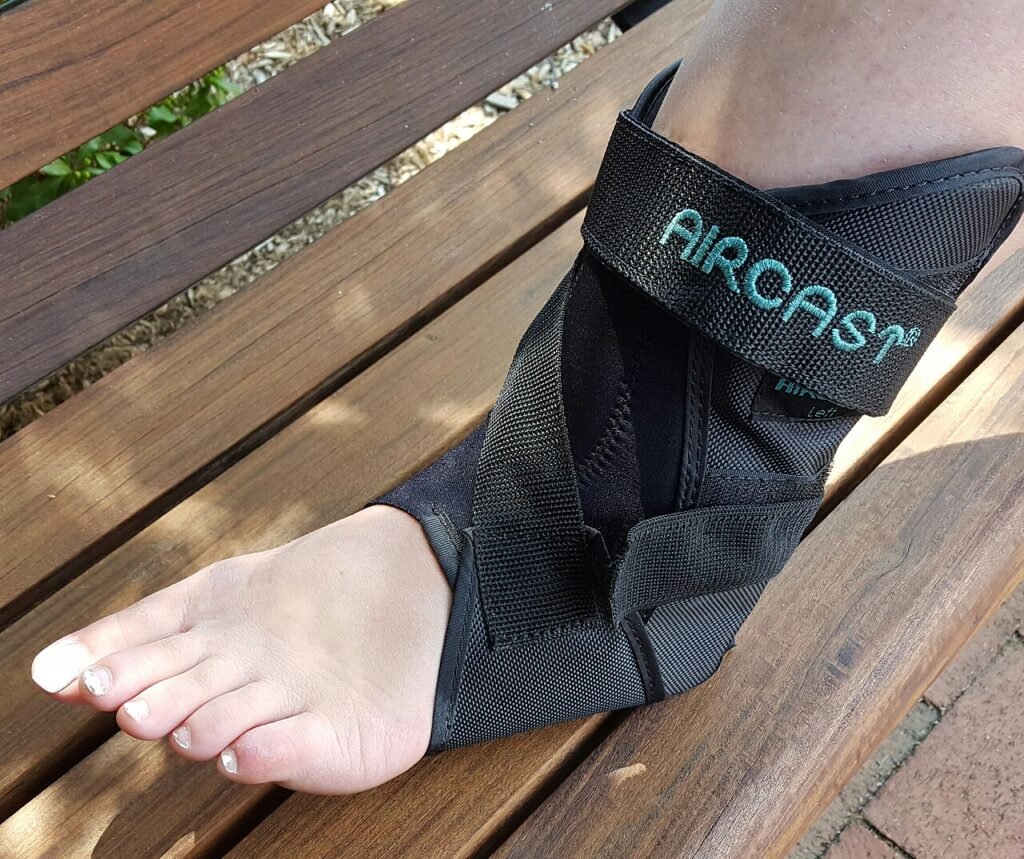
Photo: Whoisjohngalt, CC BY-SA 4.0, via Wikimedia Commons
Check Fit and Shoe Compatibility
Most sprain braces are sized by shoe size or ankle circumference. A brace that is too loose will not stabilize the joint, and one that is too tight can cut off circulation. Bulkier braces may need a half size larger shoe or loosened laces. See our guide on how to wear an ankle brace with shoes for fitting tips, and our review of the best shoes for ankle support if you need footwear that works with a brace.
Left, Right, or Universal?
Some braces (Air-Stirrup, AirSport, Zamst A1, MalleoTrain Plus, A60) are made for one side. Others (Mueller, FUTURO) fit either foot. Double-check before ordering.
What the Research Says About Ankle Braces for Sprains
Bracing for Recovery
In the Collaborative Ankle Support Trial, published in The Lancet in 2009, 584 people with severe ankle sprains from eight U.K. emergency departments were given a tubular compression bandage, an Aircast brace, a Bledsoe boot, or a 10-day below-knee cast. Ankle function was 8% better with the Aircast brace than with the compression bandage, though there was little difference in pain, symptoms, and activity. A short period in a below-knee cast did best overall, while the Bledsoe boot offered no advantage over the bandage.
The takeaway: for a severe sprain, a semi-rigid brace like the Air-Stirrup offers more than a simple elastic wrap, and some people may benefit from brief immobilization chosen by a doctor.
Bracing for Prevention
A randomized trial of high school basketball players, published in the American Journal of Sports Medicine in 2011, followed 1,460 players from 46 high schools. Players assigned to wear lace-up ankle braces had 27 acute ankle injuries, compared with 78 in the unbraced group, about a 68% lower risk. The braces helped players with and without a history of ankle injury, and the researchers found no rise in knee injuries.
Watch: A Physical Therapist’s Top Ankle Braces for Sprains
In the video below, a physical therapist reviews three types of ankle braces for sprains and explains who each one suits.
How to Wear an Ankle Brace for a Sprained Ankle
- Wear a thin sock under the brace to protect your skin.
- Put the brace on before your shoe and line up the stays or shells with the ankle bones.
- Tighten from the bottom up, starting with the straps nearest the foot.
- Check circulation. Your toes should stay warm and pink, without tingling.
- Loosen your shoe laces fully before slipping your foot in.
- Recheck the fit after 15 to 20 minutes of walking, since swelling can change.
How Long Should You Wear a Brace After a Sprain?
There is no single timeline, but many people use a brace:
- Days 1 to 3: Rest, ice, compression, and elevation, with a supportive brace or wrap for walking as advised.
- Weeks 1 to 6: A brace during daily activity while the ligament heals, with gentle range-of-motion exercises.
- Return to sports: A brace during practice and games, often for several months, especially if you have sprained the ankle before.
A brace protects the ankle, but it does not rebuild strength or balance. Pair it with rehab exercises such as ankle circles, balance work, and calf raises. If your ankle is broken rather than sprained, see our guide on how to exercise with a broken ankle.
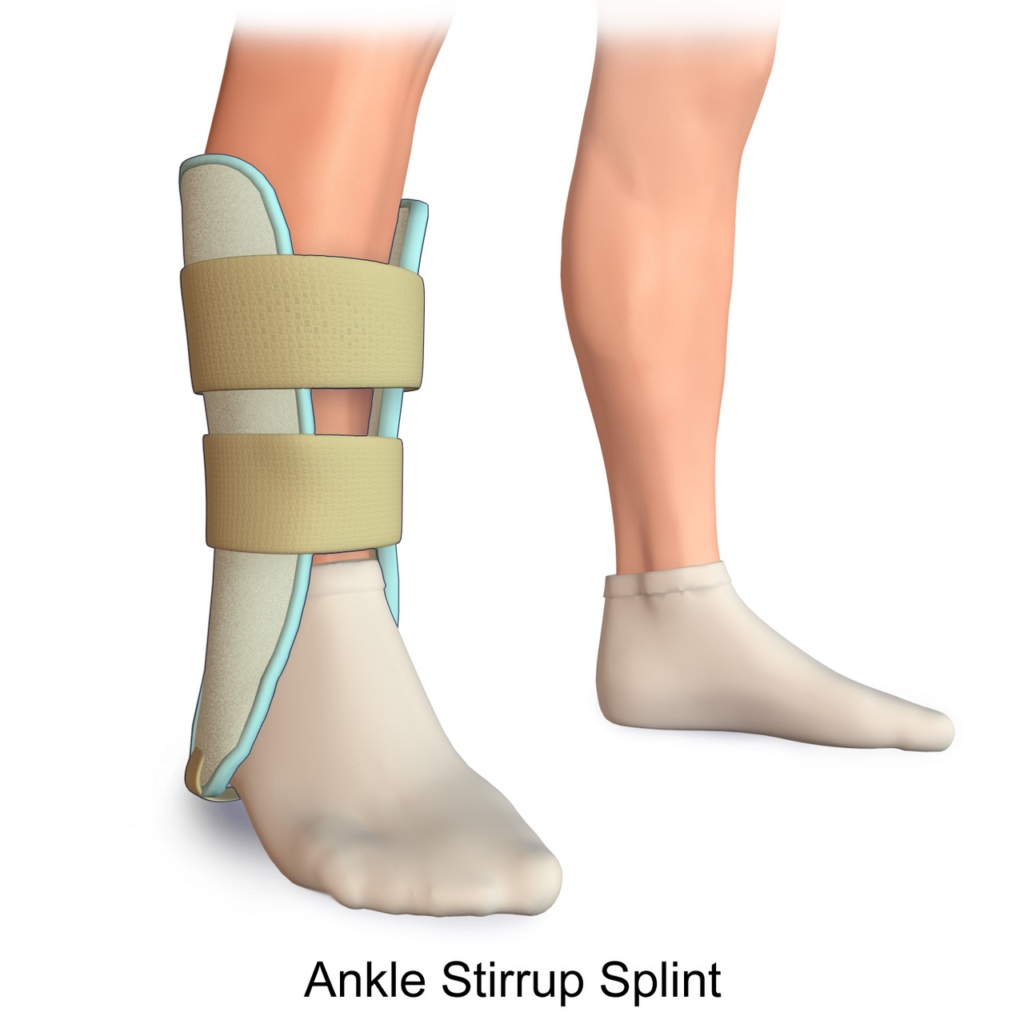
Image: BruceBlaus (Blausen.com staff), CC BY 3.0, via Wikimedia Commons
Best Ankle Brace for a Sprained Ankle by Activity
| Your main activity | Brace type to look for | Picks from this list |
|---|---|---|
| Walking and daily errands | Light strapped or compression brace | Mueller Adjustable, FUTURO Performance, MalleoTrain Plus |
| Working on your feet all day | Supportive but breathable brace | MalleoTrain Plus, Aircast AirSport |
| Basketball and volleyball | Hinged, strapped, or lace-up brace | Ultra Zoom, Zamst A1, Mueller The ONE |
| Running and field sports | Low-profile brace with side stays | Aircast A60, Zamst A1 |
| Hiking and uneven ground | Firmer brace with high-top boots | Aircast AirSport, Aircast Air-Stirrup |
| First days after a bad sprain | Semi-rigid stirrup | Aircast Air-Stirrup |
Ankle Brace vs. Taping vs. Elastic Wrap
| Option | Support | Pros | Cons |
|---|---|---|---|
| Elastic wrap or tubular bandage | Light | Cheap, good for early swelling | Little control of rolling, loosens quickly |
| Athletic tape | Moderate to firm at first | Custom fit, light | Loosens during activity, needs skill, single use |
| Lace-up or strapped brace | Moderate | Reusable, adjustable, strong prevention research | Takes time to put on |
| Semi-rigid or hinged brace | Firm | Best control of rolling | Bulkier, costs more |
Tape is popular with athletic trainers, but it needs to be reapplied for every session and can loosen as you sweat. A reusable brace is often more practical for everyday athletes. For fresh, severe sprains, the CAST trial results favor a semi-rigid brace over a simple tubular bandage.
Common Mistakes When Using an Ankle Brace for a Sprain
- Choosing a sleeve for a moderate or severe sprain. Soft compression supports help swelling but do little to stop rolling. Use a strapped, lace-up, or semi-rigid brace when the ligament is partly or fully torn.
- Buying the wrong size or side. Many sprain braces are left- or right-specific and sized by shoe size or ankle measurement. Measure first.
- Tightening too much. A brace that leaves your toes cold, numb, or tingling is too tight. Loosen it and recheck.
- Skipping rehab. A brace protects the joint but does not restore balance or strength. Without exercises, the risk of a repeat sprain stays high.
- Stopping the brace too soon for sports. Ligaments take weeks to months to regain strength, so many athletes keep bracing during play for the rest of the season.
- Wearing worn-out braces. Straps lose stretch and stays soften over time. Replace a brace that no longer feels firm.
Simple Rehab Exercises to Pair With Your Brace
Once pain allows, and with your doctor or physical therapist’s approval, these simple moves help rebuild the ankle:
- Ankle alphabet: Sit with your leg out and trace the letters A to Z with your big toe. Do this once or twice a day to restore motion.
- Towel stretch: Loop a towel around the ball of your foot and gently pull your toes toward you for 30 seconds. Repeat 3 times.
- Resistance band moves: Push your foot down, up, in, and out against a light band, 10 to 15 reps each way.
- Calf raises: Rise up onto your toes and lower slowly. Start with both feet, then progress to the injured side alone.
- Single-leg balance: Stand on the injured leg near a counter for 30 seconds. Make it harder by closing your eyes or standing on a pillow.
Balance training matters most for preventing repeat sprains. Many athletes use a brace and balance exercises together during the first season back.
When to See a Doctor
Get medical care for an ankle injury if you:
- Cannot put weight on the foot or take four steps
- Have pain directly over the ankle bones or the outer edge of the foot
- Notice a deformity, numbness, or cold, pale toes
- Have severe swelling or bruising that keeps getting worse
- Still have pain or instability after a few weeks
- Keep spraining the same ankle
These can be signs of a fracture, a severe ligament tear, or chronic ankle instability that needs a doctor or physical therapist.
Frequently Asked Questions
What is the best type of ankle brace for a sprained ankle?
It depends on the sprain grade. Semi-rigid stirrup braces like the Aircast Air-Stirrup suit fresh, moderate to severe sprains. Strapped, hinged, or lace-up braces suit return to activity, and compression supports suit mild sprains.
Is a brace better than an elastic wrap for a sprained ankle?
For severe sprains, research favors a semi-rigid brace. In the CAST trial, ankle function was 8% better with an Aircast brace than with a tubular compression bandage.
Should I wear an ankle brace to bed?
Most people do not need to wear a brace while sleeping unless a doctor advises it. Some people with a fresh sprain wear a stirrup brace at night for protection, so ask your provider.
Can I walk on a sprained ankle with a brace?
Many people with Grade I and II sprains can walk with a brace as pain allows. If you cannot bear weight, see a doctor to rule out a fracture.
Do ankle braces prevent repeat sprains?
Yes, research supports this. In a large high school basketball study, players wearing lace-up braces had about 68% fewer acute ankle injuries.
Are ankle braces covered by FSA or HSA?
Many ankle braces are FSA/HSA eligible, including some listed here. Check the listing and your plan.
What is the best brace for a high ankle sprain?
A high ankle sprain affects the ligaments above the ankle joint and often heals more slowly than a typical outer ankle sprain. Doctors frequently use a walking boot or a firm semi-rigid brace at first. Ask your provider which support is right before buying a brace.
How tight should an ankle brace be for a sprain?
It should feel snug and supportive without pain, numbness, or tingling. You should be able to slide a finger under the straps, and your toes should stay warm and pink.
Can I drive with an ankle brace on?
If the sprain is on your right ankle, a bulky brace can affect how you use the pedals. Only drive if you can brake firmly and safely, and check your provider’s advice first.
Do I need a brace for a mild sprain?
Not always. Many mild sprains heal with rest, ice, compression, elevation, and early gentle movement. A light brace can still help you walk more comfortably and protect the ankle during activity.
Conclusion
The best ankle brace for a sprained ankle depends on how badly you are hurt and what you want to get back to. For a fresh, swollen sprain, the Aircast Air-Stirrup gives the most protection. For repeat sprains, the Aircast AirSport targets the most commonly injured ligament. Athletes may prefer the hinged Ultra Zoom, the strapped Zamst A1, or a lace-up like the Mueller The ONE, while the Bauerfeind MalleoTrain Plus, Mueller, and FUTURO braces suit milder sprains and everyday wear.
Whichever you choose, measure carefully, wear it during activity, and pair it with rehab exercises. For more options, see our main guide to the best ankle braces.
This article is for general information and is not medical advice. See a doctor for severe ankle injuries or if you cannot bear weight.
Related Review Articles
- Best Ankle Braces Comparison and Reviews
- Best Shoes for Ankle Support
- Best Knee Braces Comparison and Reviews

Hi, I’m Mamon, the content creator behind this blog. I share my experience in blogging, WordPress, SEO, and affiliate marketing through honest product reviews, in-depth buying guides, and practical how-to articles. Every piece of content is thoroughly researched and written to help readers make informed decisions.
Leave a Reply