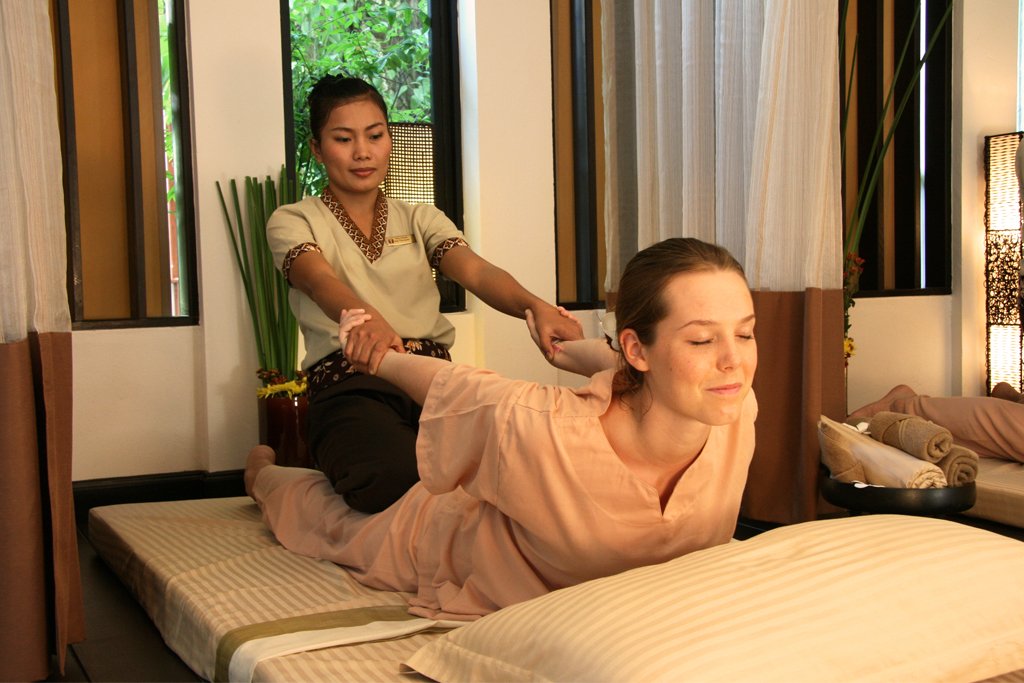
Photo: Tara Angkor Hotel / Wikimedia Commons (CC BY 2.0)
Imagine a massage where you stay fully clothed, lie on a padded floor mat, and get gently stretched into shapes that feel like yoga, without doing any of the work yourself. That is Thai massage. Often called “lazy person’s yoga,” it blends rhythmic pressure along the body with assisted stretches to loosen muscles and improve flexibility.
Thai massage has roots that go back centuries, and in 2019 UNESCO added Nuad Thai, traditional Thai massage, to its list of the world’s intangible cultural heritage. Today it is offered at spas and clinics across the U.S. This guide explains what Thai massage is, how a session works, the main Thai massage benefits backed by research, and who should be careful.
Key Takeaways
- Thai massage combines pressure, compression, and assisted yoga-like stretches. You stay fully clothed, and no oil is used.
- Sessions usually take place on a floor mat and last 60 to 120 minutes.
- A systematic review of six controlled studies found pain reductions of 25% to 80% after Thai massage for chronic pain.
- Benefits may include less pain, less muscle tension, better flexibility, and lower anxiety.
- People with osteoporosis, recent surgery, blood clots, or pregnancy should check with a doctor first.
What Is Thai Massage?
Thai massage, known in Thailand as nuad thai or nuad boran, is a traditional bodywork practice. It draws on ideas from traditional Thai medicine, Buddhist practice, and Indian Ayurvedic and yoga traditions. Practitioners believe energy flows along lines in the body called sen. Pressing and stretching along these lines is thought to restore balance.
In modern terms, Thai massage works on muscles, fascia, and joints through:
- Pressure: The therapist uses palms, thumbs, elbows, forearms, knees, and feet.
- Compression: Rhythmic rocking pressure along the legs, back, and arms.
- Assisted stretching: The therapist moves your body into stretches for the hips, hamstrings, back, and shoulders.
- Joint mobilization: Gentle movement of the joints through their range of motion.
UNESCO describes Nuad Thai as part of Thailand’s traditional medicine and notes that it is practiced to treat and prevent illness and to promote well-being. You can read more on the UNESCO Nuad Thai listing.
A Brief History of Nuad Thai
Tradition credits the origins of this practice to Jivaka Kumar Bhaccha, a physician said to have treated the Buddha more than 2,000 years ago. Many Thai practitioners still honor him as the “Father Doctor” at the start of a session.
The practice was passed down mainly by word of mouth and through temples. In the 1830s, under King Rama III, healing knowledge was carved into stone tablets at Wat Pho, a famous temple in Bangkok. The temple’s diagrams of energy lines and pressure points are still studied today, and Wat Pho runs one of Thailand’s best-known massage schools.
In 2019, UNESCO added Nuad Thai to its Representative List of the Intangible Cultural Heritage of Humanity. The listing recognizes it as a living tradition that is taught, practiced, and passed on across generations.
How Is Thai Massage Different From Western Massage?
| Feature | Thai massage | Swedish or Western massage |
|---|---|---|
| Clothing | Fully clothed in loose, comfortable clothes | Undressed to comfort level, under a sheet |
| Oil or lotion | None | Usually yes |
| Surface | Padded floor mat (sometimes a table) | Massage table |
| Main techniques | Pressure, compression, assisted stretching | Gliding strokes, kneading |
| Your role | Passive, but you move into different positions | Mostly lying still |
| Feel | Active, energizing, and stretching | Soothing and flowing |
| Typical length | 60 to 120 minutes | 60 to 90 minutes |
Many people describe Thai massage as both relaxing and energizing. You may leave feeling looser and more alert rather than sleepy.
What Happens During a Thai Massage?
Before the Session
The therapist asks about your health, injuries, and comfort with stretching. Wear loose, stretchy clothing, or change into clothes the spa provides.
The Typical Flow
Every therapist has a style, but a full session often follows this order:
- Step 1: Feet and legs. The session usually starts at the feet. The therapist presses along the soles and legs with palms and thumbs.
- Step 2: Leg and hip stretches. Your legs are bent, rotated, and stretched to open the hips and hamstrings.
- Step 3: Abdomen and arms. Gentle pressure may be applied to the belly and along the arms and hands.
- Step 4: Side-lying work. You lie on your side while the therapist works on the hips, back, and shoulders.
- Step 5: Back and face-down stretches. Lying face down, you may get pressure along the back and stretches that gently arch the spine.
- Step 6: Seated stretches. Many sessions end with you sitting up for shoulder, neck, and back stretches.
- Step 7: Head and face. A calming finish often includes light pressure on the scalp and face.
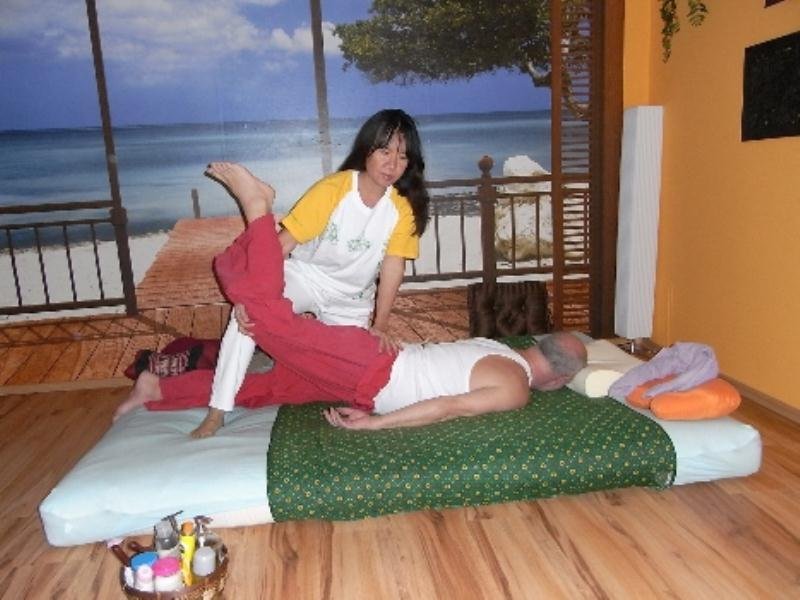
Photo: Sopacha / Wikimedia Commons (CC BY-SA 3.0)
How Does It Feel?
Thai massage can feel firm and intense at times, especially during deep stretches or pressure on tight muscles. It should never feel sharp or painful. Speak up if a stretch goes too far. A skilled therapist adjusts every movement to your flexibility.
Thai Massage Benefits: What the Research Says
Research on Thai massage is smaller than for Swedish massage, but results are encouraging.
Chronic Pain Relief
A 2015 systematic review looked at controlled trials of traditional Thai massage for chronic pain. Six studies met the criteria. Every study found that pain dropped from before to after treatment, with reductions ranging from 25% to 80%. Thai massage was also linked to better function, less perceived muscle tension, more flexibility, and lower anxiety. Pain relief appeared to last for up to 15 weeks in some studies.
The review authors called for more research comparing Thai massage with control treatments over the long term, so these results are promising but not final.
Summary of Thai Massage Benefits
| Benefit | What the evidence suggests |
|---|---|
| Less chronic pain | Pain dropped 25% to 80% across six studies |
| Less disability | Improved function in daily activities |
| Less muscle tension | Reported improvement in perceived tension |
| Better flexibility | Assisted stretches improved range of motion |
| Lower anxiety | Improvements reported in the review |
| Longer-lasting relief | Some benefits held for up to 15 weeks |
Other Possible Benefits
- Energy and alertness: Many people feel refreshed rather than drowsy afterward.
- Better posture awareness: Stretching tight hips and shoulders may help you notice how you sit and stand.
- Stress relief: Like other forms of massage, the focused, quiet time can be calming.
- Headache relief: Some small studies have looked at Thai massage for tension-type headaches, with positive early results.
Watch: A Licensed Massage Therapist Explains Thai Massage
In this short Cleveland Clinic video, licensed massage therapist DeBorah Hill explains what Thai massage is and what to expect:
Who Is Thai Massage Best For?
| Good fit | Consider another style |
|---|---|
| People with tight hips, hamstrings, or back | People with fragile bones or osteoporosis |
| Desk workers who feel stiff | Anyone recovering from recent surgery |
| Athletes and active adults | People who dislike being moved or stretched |
| Anyone who prefers to stay clothed | Those with severe joint instability |
| People who find Swedish massage too passive | People with acute injuries |
Safety: Who Should Be Careful?
Thai massage involves strong stretches and pressure, so it carries more risk than gentle massage for some people. Talk to your doctor first if you:
- Have osteoporosis or low bone density
- Had recent surgery, a fracture, or a joint replacement
- Have a herniated disc or other spine problems
- Have a history of blood clots or take blood thinners
- Are pregnant, and look for a therapist trained in prenatal Thai massage
- Have high blood pressure that is not well controlled
- Have heart disease
- Have hypermobile joints
Always tell your therapist about any health conditions, and ask them to skip any stretch that feels wrong.
How to Prepare for a Thai Massage
- Wear loose clothing: Yoga pants and a T-shirt work well.
- Eat lightly: Avoid a large meal for at least an hour or two before.
- Hydrate: Drink water during the day.
- Share your goals: Mention tight areas and how flexible you are.
- Agree on intensity: Tell the therapist if you want gentle or firm work.
- Breathe: Slow breathing helps your body relax into each stretch.
Photo: Mattes / Wikimedia Commons (public domain)
Thai Massage vs. Other Massage Types
| Massage type | Pressure | Stretching | Clothing | Best for |
|---|---|---|---|---|
| Thai massage | Moderate to firm | Yes, a lot | Clothed | Flexibility and tension |
| Swedish massage | Light to moderate | Little | Undressed, draped | Relaxation |
| Deep tissue massage | Firm | Little | Undressed, draped | Chronic knots |
| Shiatsu | Moderate | Some | Usually clothed | Pressure point work |
| Sports massage | Moderate to firm | Some | Varies | Athletes |
Can You Get Thai Massage Benefits at Home?
You cannot fully copy Thai massage at home because it relies on a trained partner to move your body. However, you can get some of the same effects:
- Stretching routines: Gentle yoga poses like child’s pose, figure-four stretch, and seated twists open the same areas.
- Partner stretching: A partner can assist gentle hamstring and hip stretches, as long as you move slowly and communicate.
- Massage chairs with stretch programs: Some chairs include stretch modes that recline and gently extend the body. See our best massage chair under $1,000 roundup.
- Gym massage chairs: Learn how to make the most of them with our guide to using massage chairs at Planet Fitness.
- Massage guns for tight spots: Use one on low to warm up muscles before stretching. Compare options in our best massage gun guide.
- Handheld massagers: A long-handled device helps you reach your back between sessions. See our best handheld back massager review.
For tips on using devices safely, read our guide on how to use a personal massager.
How to Find a Qualified Thai Massage Therapist in the U.S.
- Check licensing: Most U.S. states regulate massage therapists. Ask for proof of a state license.
- Ask about Thai training: Many therapists take extra courses in Thai massage, sometimes in Thailand.
- Read reviews: Look for comments on professionalism and communication.
- Ask questions: A good therapist will explain the session and ask about your health first.
What to Do After Your Session
- Move slowly: Sit up gradually, since deep stretches can leave you a little light-headed.
- Drink water: It is a simple comfort habit after any bodywork.
- Stay gently active: A short walk helps you keep the looseness you gained.
- Skip intense exercise: Give stretched muscles a day before heavy training.
- Notice how you feel: Mild soreness for a day is normal. Sharp pain or numbness is not, so contact a doctor if that happens.
Common Myths About This Practice
- Myth: You need to be flexible. The therapist adjusts every stretch to your range of motion. Stiff people often benefit most.
- Myth: It is the same as yoga. You do not hold poses yourself. The therapist moves your body while you relax.
- Myth: It always hurts. Pressure can feel firm, but good sessions should never be painful.
- Myth: It cracks your back. Practitioners use stretches and pressure, not forceful spinal adjustments.
- Myth: It is only for athletes. Office workers, older adults, and beginners can all enjoy a gentle session.
How Often Should You Get a Thai Massage?
For general well-being, many people book a session every few weeks. For chronic pain, some studies used a series of sessions over several weeks. Let your body, schedule, and budget guide you, and talk with your therapist about a plan.
Frequently Asked Questions
What is Thai massage good for?
It is often used to ease muscle tension, improve flexibility, and relieve chronic pain such as back pain. Many people also find it relaxing and energizing.
Do you wear clothes during a Thai massage?
Yes. You stay fully clothed in loose, comfortable clothing.
Does Thai massage hurt?
It can feel intense during deep stretches or firm pressure, but it should not be painful. Tell your therapist if anything hurts.
How long does a Thai massage last?
Most sessions last 60 to 120 minutes. A 90-minute session is common.
Is Thai massage the same as Thai yoga massage?
Yes. “Thai yoga massage” is another name, used because of the yoga-like stretches.
Can Thai massage help back pain?
Studies on chronic pain, including back pain, show promising pain reductions. See a doctor first if you have a disc problem or recent injury.
Is Thai massage safe during pregnancy?
Ask your doctor first, and choose a therapist trained in prenatal techniques. Many stretches are not suitable during pregnancy.
What should I wear to a Thai massage?
Wear soft, loose clothing that lets you bend and stretch, such as yoga pants or sweatpants and a T-shirt. Avoid jeans, belts, and jewelry. Many U.S. spas provide loose cotton pants and a top if you prefer to change.
Is Thai massage good for beginners?
Yes. Ask for a gentle session and tell your therapist that it is your first time. They will keep stretches within a comfortable range.
Conclusion
Thai massage is a centuries-old practice that combines pressure, compression, and assisted stretching while you stay fully clothed. Research suggests Thai massage benefits include meaningful pain relief, less muscle tension, better flexibility, and lower anxiety, with some effects lasting for weeks.
If you want a massage that leaves you feeling looser and more energized, Thai massage is worth trying. Choose a licensed, trained therapist, share your health history, and speak up during stretches so every session stays safe and comfortable.
Health note: This article is for general information only and is not medical advice. Talk to your doctor before getting a Thai massage if you have a health condition, injury, or are pregnant.

Hi, I’m Mamon, the content creator behind this blog. I share my experience in blogging, WordPress, SEO, and affiliate marketing through honest product reviews, in-depth buying guides, and practical how-to articles. Every piece of content is thoroughly researched and written to help readers make informed decisions.
Leave a Reply