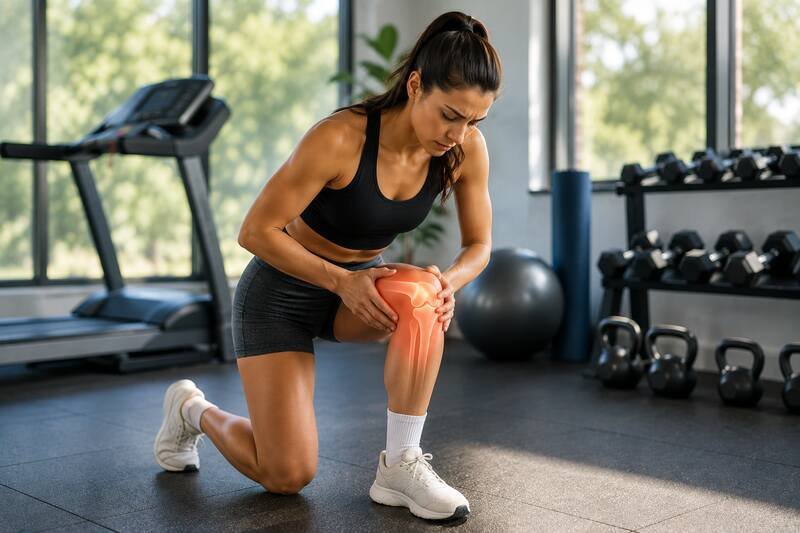
Learning how to save your knees during exercise starts with understanding how much force those joints handle daily. Even level walking puts about 1.5 times your body weight through each knee with every step. That load climbs to three or four times your body weight when you’re on the stairs. Knees are remarkably durable. Still, the repeated stress of a poorly planned workout routine can wear them down and contribute to conditions like arthritis. The good news is that most knee injuries during exercise are preventable. This guide walks through the habits, exercise choices, and gear that make the biggest difference.
Key Takeaways
- Walking puts roughly 1.5 times your body weight through your knees, and stairs increase that to three to four times. Warming up and pacing your workouts matters.
- Low-impact machines like ellipticals, rowers, and recumbent bikes put less stress on the joint than running or jumping.
- Strengthening the quadriceps and hamstrings helps those muscles absorb shock that would otherwise land on the knee joint.
- Deep squats, full lunges, and prolonged weight-machine use can aggravate the knees if your form or dosage isn’t right.
- The right shoes and a varied workout routine both reduce repetitive strain on the same knee structures.
How Much Force Do Your Knees Really Absorb?
Before getting into specific tips, it helps to understand why the joint is so vulnerable in the first place. According to health data on joint loading, the force on your knees during normal walking is about 1.5 times your body weight. That means a 160-pound person sends roughly 240 pounds of pressure through each knee with every step. Climbing or descending stairs multiplies that load to three or four times body weight. Higher-impact movements like running, jumping, and deep knee bends increase the load further still. This is exactly why warming up, choosing low-impact exercises, and building supporting muscle matter as much as they do.
Always Warm Up Before You Start
One of the simplest ways to protect your knees during exercise is a proper warm-up. Warming up increases blood flow to your joints and muscles and prepares your tendons and ligaments for more demanding movement. Skipping this step and jumping straight into a run or a heavy lifting session leaves your knees vulnerable to strain. Spend the first 5 to 10 minutes of any workout on dynamic movement rather than static stretching alone.
Useful warm-up movements include arm circles, torso rotations, knee lifts, hip circles, lateral lunges, and light jumping jacks. These dynamic stretches get your muscles and joints firing before you ask them to handle real load. That said, listen to your body during warm-up too. Sharp pain before your main workout has even started is a sign to scale back, not push harder.
Choose Low-Impact Exercises When Possible
Not every exercise treats your knees equally. Deep squats, full lunges, and hurdle stretches can pile excessive pressure onto the joint. This is especially true if your form is off or you’re carrying extra weight. If you’re working toward weight loss and your knees are already sensitive, running and plyometrics may do more harm than good. Wait until your joints and supporting muscles are stronger. Swimming, rowing, cycling, and using an elliptical trainer burn plenty of calories while keeping the movement smooth and controlled.
Low-impact machines like a rowing machine, elliptical trainer, or recumbent bike are worth building into a regular routine. If you’re comparing options, our guide on what burns more calories on a treadmill versus an elliptical breaks down the differences. Research has also shown that moderate use of low-impact machines like an elliptical can support blood flow to knee cartilage. It can also strengthen the muscles around the joint over time.
Be Careful With Weight Machines and Deep Knee Bends
Weight machines are one more piece of how to save your knees during exercise worth getting right. They’re popular because they’re straightforward and relatively safe for beginners. The tradeoff is that machines often lock your joints into a fixed path of motion. This can place uneven stress on the knee if used heavily or for long stretches. Machines are a reasonable starting point while you’re learning proper form. Transitioning toward natural movement patterns like wall sits, hip bridges, and step-ups tends to be gentler on the knee long term.

Strengthen the Muscles That Support Your Knees
Most people focus their attention on the knee joint itself and overlook the muscles surrounding it. That’s a mistake, since strong quadriceps, hamstrings, calves, and glutes absorb shock that would otherwise land directly on the joint. According to Harvard Health’s guide to strengthening knees and hips, strong muscles around a joint can take over some of its shock-absorbing responsibilities. Closed-chain exercises like squats, where your feet stay planted, are especially effective for building that support. Just as important, work your quadriceps and hamstrings equally. Muscles work in opposing pairs, and an imbalance between them can itself become a source of strain.
Wear the Right Shoes
Footwear is an easy piece of how to save your knees during exercise to overlook. It plays a bigger role in knee health than most people realize. Shoes that lack cushioning or stability force your knees to compensate for impact that the shoe should be absorbing. Look for a shoe that’s lightweight enough to avoid restricting your movement. It should still offer a solid shock-absorbing sole and enough structure to keep your foot stable. If your shoes are more than a year old or worn unevenly on the tread, it’s usually time to replace them. Worn cushioning no longer protects the joint the way it did when new.
Vary Your Workout Routine
Another overlooked part of how to save your knees during exercise is simple variety. Repeating the same exercises day after day concentrates stress on the same knee structures every single session. Try alternating a low-impact cardio day with a strength day and a swim or rowing session. This spreads the workload across different muscle groups and movement patterns. This variety gives overworked tissues time to recover while still keeping you active most days of the week. It also tends to reduce boredom, making it easier to stick with a routine long enough to see real strength gains.
Signs You’re Overloading Your Knees Mid-Workout
Part of learning how to save your knees during exercise is recognizing warning signs before they turn into a real injury. A dull ache that fades within a day of a hard workout is usually just normal fatigue. Sharp pain during a movement, swelling within a few hours, or a knee that feels unstable are different matters entirely. These are signals to stop and reassess rather than push through. Clicking or popping without pain is common and usually harmless. Clicking paired with pain or swelling is worth mentioning to a doctor.
Body weight also plays a direct role in how much load your knees absorb during exercise. Because walking alone sends about 1.5 times your body weight through the joint, even modest weight changes shift that number meaningfully. This is one more reason low-impact cardio, paired with strength training, is often recommended for weight loss when the knees are sensitive. It reduces the joint’s workload while you build the muscle that will eventually support higher-impact activity again.
Watch: Tips for Preventing Knee Pain When Exercising
This video from a hospital wellness team covers practical ways to protect your knees during a workout.
Consider a Knee Brace for Extra Support
If you have a history of knee pain or a previous injury, a supportive brace can add stability while you build strength. Braces aren’t a substitute for the habits above. They can, however, be a useful bridge while you work on warm-ups, low-impact conditioning, and strength training. Our guide on the best knee braces compares popular options if you think a brace might help your routine.
Related Health and Fitness Guides
Curious whether your treadmill habit is part of the problem? If you’re deciding between cardio machines, our comparison of treadmill versus elliptical calorie burn can help. And if you already deal with occasional knee pain, our roundup of the best knee braces is worth a look.
Frequently Asked Questions
What’s the single most important habit for how to save your knees during exercise?
If you can only adopt one habit, make it a proper warm-up. It’s the simplest change with the biggest impact on how prepared your joints are for the load ahead.
How can I save my knees during exercise if I already have knee pain?
Focus on low-impact activities like swimming, cycling, or using an elliptical. Talk to a doctor or physical therapist before continuing higher-impact workouts. Strengthening the muscles around the knee is usually part of the recovery plan.
Are squats bad for your knees?
Not inherently. Squats performed with good form can actually strengthen the muscles that support your knees. Deep squats with poor form or too much added weight are where the risk increases.
What’s the best low-impact cardio for knee health?
Swimming, rowing, cycling, and elliptical training are generally considered gentle on the knees while still providing an effective cardiovascular workout.
How long should I warm up before exercising to protect my knees?
Five to ten minutes of dynamic movement, like leg swings and hip circles, is usually enough to prepare your joints.
Do knee braces actually help during exercise?
They can provide added stability and confidence for people with a history of knee pain or injury. Braces work best alongside strength training rather than as a standalone fix.
Is running bad for my knees?
Running itself isn’t inherently damaging for most healthy knees. Poor footwear, worn-out shoes, or a sudden increase in mileage can increase the risk of strain. Building mileage gradually helps.
Which muscles should I strengthen to protect my knees?
Quadriceps, hamstrings, calves, and glutes all play a role in supporting the knee joint. Working them in balance, rather than favoring one muscle group, is key.
Should I avoid weight machines completely?
Not necessarily. They’re a reasonable option for beginners learning proper form. Relying on them exclusively for a long time can limit natural movement patterns that support the knee.
When should I see a doctor about knee pain from exercise?
If pain persists beyond a few days of rest, causes swelling, or affects your ability to bear weight, see a doctor.
Low-impact, joint-friendly cardio moves are worth adding to that routine too. Our guide on what high knee exercise is and its benefits covers one that is easy on the knees when done with proper form.
Bottom Line
Knowing how to save your knees during exercise comes down to a handful of consistent habits. Warm up properly, favor low-impact movement, strengthen the surrounding muscles, and wear shoes that actually support your feet. None of these changes require giving up the workouts you enjoy. They do require paying attention to how your knees respond over time. Small adjustments now can spare you a much bigger setback later.

Hi, I’m Mamon, the content creator behind this blog. I share my experience in blogging, WordPress, SEO, and affiliate marketing through honest product reviews, in-depth buying guides, and practical how-to articles. Every piece of content is thoroughly researched and written to help readers make informed decisions.
Leave a Reply