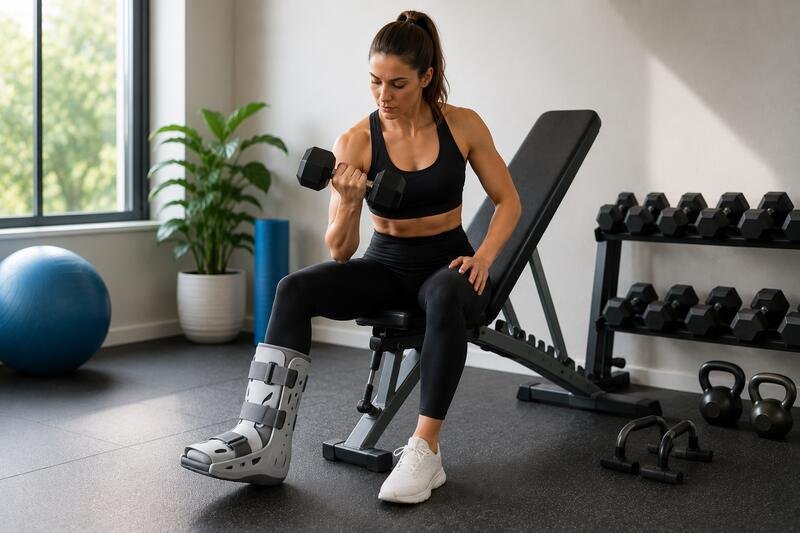
With a broken ankle, avoid weight-bearing activity like biking, dancing, running, climbing stairs, or jogging. Putting weight through the joint can slow healing or worsen the fracture. So how do you exercise with a broken ankle without risking further injury? Concentrating on upper-body workouts performed while seated or lying down is the safest approach. It keeps all the load off your ankle joint entirely. This guide walks through eight upper-body exercises, when it’s safe to add lower-body movement back in, and what recovery typically looks like. As always, check with your doctor or physical therapist before starting any exercise routine during recovery.
Key Takeaways
- Upper-body exercises done seated or lying down are the safest way to stay active. They put zero weight through the injured joint.
- Good options include seated bench presses, pull-ups, shoulder presses, lat pull-downs, seated bicep curls, and traditional crunches.
- Stationary cycling and swimming can work too, but only once your doctor confirms your cast or boot situation allows it.
- Weight-bearing timelines vary widely by fracture type. A walking boot might come at 2 weeks for a simple fracture, or after months of non-weight-bearing recovery following surgery.
- A standard cast should never be submerged in water. Swimming requires either a waterproof cast or medical clearance to go without one.
Why Upper-Body Workouts Are the Safest Choice
The short answer to how to exercise with a broken ankle is to stay entirely upper body until you’re cleared otherwise. A broken ankle needs to stay unloaded while the bone heals. That rules out most lower-body and weight-bearing exercise. Upper-body strength training sidesteps that problem entirely. Seated or lying-down positions keep your full body weight off the injured ankle. You can still work your chest, back, shoulders, arms, and core. This is exactly how to exercise with a broken ankle without setting your recovery back. Pick movements that don’t require your legs to bear any load.
Different Ways to Exercise With a Broken Ankle
Here’s a quick reference table of the exercises covered below, plus the equipment and target muscles for each.
| No. | Type of Exercise | Equipment Needed | Best for Strengthening |
| 1 | Seated Bench Press | Chest press machine | Pectoral muscles, biceps, triceps, and deltoids |
| 2 | Pull-Ups | Pull-up bar | Shoulder, back, and arm muscles |
| 3 | Shoulder Presses | Shoulder press machine or dumbbells | Triceps, shoulders, and traps |
| 4 | Lat Pull-Downs | Pull-down machine | Shoulder girdle, arm, forearm, and upper back muscles |
| 5 | Seated Bicep Curls | Weight bench and dumbbells | Bicep muscles |
| 6 | Traditional Crunches | Workout mat | Abdominal muscles |
| 7 | Stationary Bike (with clearance) | Exercise bike | Hamstrings, calves, glutes, and quadriceps |
| 8 | Swimming (with clearance) | Swimming pool | Shoulders, hamstrings, abs, glutes, forearms, and back |
 How to Exercise With a Broken Ankle: 8 Upper-Body Workouts
Working your upper body more intensely is the best exercise with a broken ankle. Do all of these in a lying or seated position, and stop immediately if you feel pain in your ankle.
1. Seated Bench Press
Also called a chest press, this workout targets the pectoral muscles, biceps, deltoids, and triceps.
Step 1: Adjust the machine. Sit with your back flat against the backrest. Set the seat height so the handles line up with your mid-chest, and choose a comfortable starting weight.
Step 2: Start working out. Place your feet on the footrests or floor, about shoulder-width apart. Grab the handles and push outward, keeping your back flat against the backrest. Extend your arms without locking your elbows.
Step 3: Return to start. Pause for a couple of seconds with your arms extended. Bend your elbows slowly and pull the handles back toward you. Repeat.
2. Pull-Ups
This exercise strengthens your back, shoulders, and arms using just a pull-up bar.
Step 1: Position yourself. Stand below the bar and grasp it with your palms facing forward, hands about shoulder-width apart.
Step 2: Pull yourself up. Curve your back slightly and pull yourself up until your chin reaches the bar. Pause and exhale.
Step 3: Lower yourself. Slowly lower back down while inhaling, until your elbows are straight. Repeat.
3. Seated Overhead Dumbbell Press
Also known as a shoulder press, this targets your traps, triceps, and shoulders.
Step 1: Sit on a bench. Sit with your back flat against the backrest and your feet directly under your knees.
Step 2: Get the dumbbells. Hold a dumbbell in each hand and bring them up to shoulder height, elbows in line with your wrists.
Step 3: Press up. Press the dumbbells toward the ceiling without locking your elbows. Pause, then lower them back to chin level. Repeat for as many reps as you can manage.
4. Lat Pull-Downs
These strengthen your arms, forearms, shoulder girdle, and upper back.
Step 1: Get positioned. Sit upright with a slight arch in your lower back, feet on the floor, legs tucked under the thigh pads. Adjust the bar or seat height as needed.
Step 2: Pull down. Grip the bar a little wider than shoulder-width. Pull it down toward your chest, keeping your upper torso still.
Step 3: Return to start. Slowly straighten your arms to bring the bar back up. Aim for 8 to 12 reps.
5. Seated Bicep Curls
Also called seated arm curls, this exercise strengthens the bicep without putting any strain on your ankle.
Step 1: Sit down. Sit on the edge of a chair or workout bench with your back straight. Grab two dumbbells, or matched-weight household items like water bottles.
Step 2: Curl. Let your arms hang by your sides, then curl the weights toward your shoulders, elbows tucked close to your body. Pause before lowering. Repeat.
6. Traditional Crunches
These work your abdominal muscles from a lying-down position.
Step 1: Lie flat. Lie on a mat with your feet hip-width apart and knees bent. Tuck your hands under your head or cross your arms over your chest.
Step 2: Lift. Lift your upper body using your abs, bringing your shoulders and head off the mat. Lower back down. Repeat for several reps.
7. Stationary Bike, With Medical Clearance
A stationary bike can be a reasonable option if your doctor confirms your specific fracture and cast or boot situation allows it. This low-impact cardio can support muscle strength and joint flexibility elsewhere in the body while your ankle heals. It isn’t appropriate for every fracture, so don’t try it without checking first.
8. Swimming, With Medical Clearance
Swimming isn’t a weight-bearing activity, which makes it appealing during recovery. The buoyancy of water takes pressure off an injured limb. You can swim using mainly your arms while your legs stay relatively passive. That said, swimming only works safely once your doctor clears it. It also depends heavily on what’s protecting your ankle at the time. More on that below.
When Can You Add Weight-Bearing Exercise Back In?
Part of learning how to exercise with a broken ankle is knowing when the rules change. There’s no single answer here. Recovery timelines vary a lot depending on the type of fracture. According to a podiatrist-reviewed breakdown of recovery times, a simple, non-displaced fracture might move into a walking boot around 2 weeks. Normal shoes often follow by 6 to 8 weeks. A fracture that required surgery usually stays non-weight-bearing for several weeks longer, often 2 to 8 weeks. It then progresses gradually in a boot. Only your doctor or surgeon can tell you when your ankle is ready for weight-bearing exercise, based on your X-rays. Rushing this step is one of the most common ways people re-injure a healing fracture.
Can You Swim With a Cast or Boot?
This is worth addressing directly, since it’s easy to get wrong. A standard plaster or fiberglass cast should never be submerged in water. These materials are porous, so they get soggy and heavy when wet. Trapped moisture against your skin also raises the risk of infection. If you want to swim during recovery, you generally need one of two things. Either a cast specifically designed to be waterproof, or medical clearance to swim without any cast or boot at all. A standard walking boot also isn’t designed to get wet. Always ask your care team which category your situation falls into before getting in the water.
Watch: Upper-Body Exercises for an Injured Ankle
This video from a doctor walks through additional exercises you can do safely while wearing a boot, echoing Cleveland Clinic’s guide to upper-body workouts for an injured foot.
Do Broken Ankles Ever Heal Fully?
Yes, in the great majority of cases. The timeline depends heavily on the severity of the fracture and your age. A straightforward, non-displaced fracture that doesn’t need surgery often reaches full activity within 8 to 12 weeks. A fracture requiring surgical repair, such as a bimalleolar break, typically needs 3 to 4 months before light activity. A full return to sport takes 4 to 6 months. Complex fractures involving multiple bones, sometimes called trimalleolar or pilon fractures, can take 6 to 12 months for full activity. Functional recovery, like strength and balance, can keep improving for a year or more after that. Bone healing on an X-ray is only part of the picture. Regaining full strength and stability typically requires months of physical therapy on top of that.
Support Your Ankle During and After Recovery
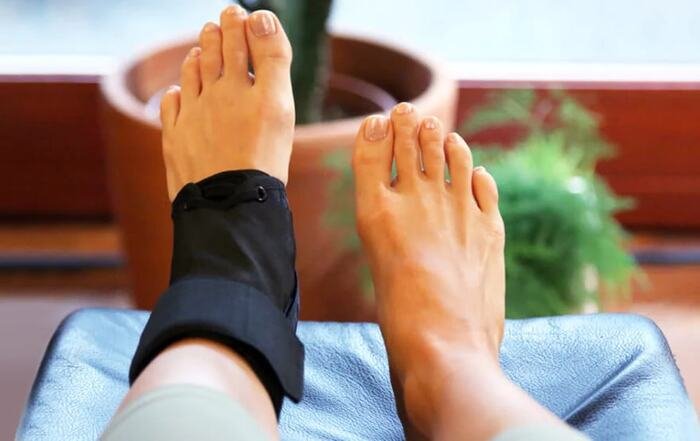
Once your doctor clears you to bear weight again, an ankle brace can add stability while the surrounding muscles regain their strength. Our guide on how ankle braces work explains what to look for. Our comparison of the best ankle braces can help you pick one for your recovery stage. If you’ll be wearing a brace with regular shoes, our guide on how to wear an ankle brace with shoes covers fit.
Frequently Asked Questions
Can you go to the gym with a broken ankle?
Yes, but limit yourself to upper-body workouts done in a lying or seated position. Wait for your doctor’s clearance before attempting anything that puts weight on the ankle.
Is walking a good way to exercise with a fractured ankle?
No. Walking on a fractured ankle is a weight-bearing activity that can worsen the injury and delay healing. Stay off it until your doctor says otherwise.
What’s the best way to learn how to exercise with a broken ankle without gym equipment?
Traditional crunches need only a mat. Seated bicep curls work fine with household items like water bottles instead of dumbbells.
How soon can I start upper-body exercise after breaking my ankle?
Most people learning how to exercise with a broken ankle can start light upper-body work within the first week or two. Always confirm timing with your doctor first, especially if you had surgery.
Can I use resistance bands instead of weights?
Yes. Resistance bands work well for seated rows, bicep curls, and shoulder presses. They’re also easier to manage than dumbbells if crutches affect your balance.
Will upper-body training help my overall recovery?
Indirectly, yes. Staying active supports circulation, mood, and overall fitness. This can make the transition back to full activity smoother.
Is it normal to lose leg strength while my ankle heals?
Yes. Muscle loss in the injured leg during immobilization is common and expected. Physical therapy after your cast or boot comes off typically addresses this directly.
When should I call my doctor during recovery?
Call if you notice increasing pain, new swelling, numbness, or a change in skin color. A cast or boot that suddenly feels too tight or too loose is also worth a call.
Bottom Line
Knowing how to exercise with a broken ankle comes down to picking movements that keep weight off the joint. Seated bench presses, pull-ups, shoulder presses, lat pull-downs, seated bicep curls, and traditional crunches all fit that bill. Stationary cycling and swimming can join the routine once your doctor confirms they fit your specific fracture and cast situation. Recovery timelines vary widely, from weeks for a simple fracture to closer to a year for a complex one. Let your care team guide when it’s safe to add weight-bearing exercise back in.

Hi, I’m Mamon, the content creator behind this blog. I share my experience in blogging, WordPress, SEO, and affiliate marketing through honest product reviews, in-depth buying guides, and practical how-to articles. Every piece of content is thoroughly researched and written to help readers make informed decisions.
Leave a Reply