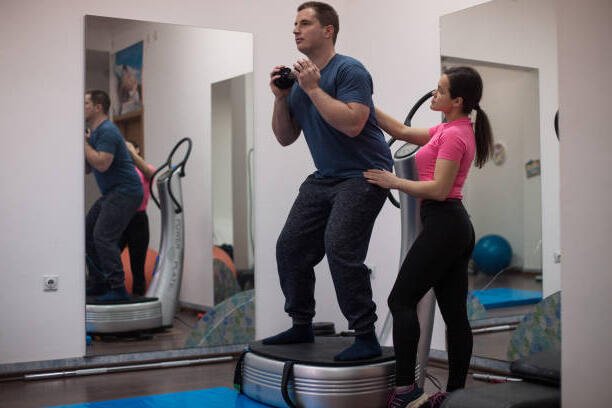
The best speed on vibration plate for weight loss is 20 to 30 Hz for most people, paired with active movements like squats or lunges rather than passive standing. Beginners should start lower, around 10 to 15 Hz, and work up over a couple of weeks. That range isn’t arbitrary: it’s where research and manufacturer guidance consistently converge for maximizing muscle activation and calorie burn without pushing joints past what’s comfortable.
What the frequency dial actually changes, how much it really affects weight loss, and what the evidence says about vibration training compared to walking or traditional exercise are all questions worth answering honestly, since a lot of marketing around these machines overstates what any single setting can do. Below is a complete, corrected breakdown.
Key Takeaways
- 20 to 30 Hz is the frequency range most consistently linked to weight loss goals on a vibration plate, according to fitness and vibration-training sources.
- According to WebMD, standing on a vibration plate burns about as many calories as walking at 2.2 mph; adding squats can raise that closer to running at 6.5 mph.
- A 2019 systematic review found whole-body vibration led to fat loss in some trials, but results on body fat percentage were mixed, and researchers called for more rigorous studies.
- Speed alone doesn’t determine results. Amplitude, session length, active movement, and consistency all matter as much as the Hz number.
What “Speed” Actually Means on a Vibration Plate
Vibration plates measure intensity mainly through frequency, expressed in Hertz (Hz), which is how many times the platform oscillates per second. A plate set to 10 Hz moves ten times a second; a plate set to 30 Hz moves thirty times a second. Many manufacturers label this a “speed level” instead of showing the actual Hz number, which makes comparing machines or following generic advice harder than it should be. Amplitude, or how far the plate physically travels with each cycle, is the other half of the equation, and the two together determine how much force reaches your muscles.
Consumer vibration plates typically range from about 5 Hz up to 45 or 50 Hz. Broadly, lower frequencies (5 to 15 Hz) are associated with circulation, relaxation, and gentle muscle activation. Mid-range frequencies (20 to 30 Hz) are where most sources point for weight loss and general fitness, since this band produces strong motor unit activation without excessive joint strain. Higher frequencies (30 to 40+ Hz) are generally reserved for more advanced strength and power training, and tend to fatigue muscles quickly.
The Best Speed on Vibration Plate for Weight Loss
For weight loss specifically, 20 to 30 Hz is the range that shows up most consistently across vibration-training guidance. At this setting, the plate produces enough muscle contraction to meaningfully raise energy expenditure during a session, especially when paired with dynamic movements. Here’s a practical breakdown by experience level:
- Beginners: Start at 10 to 15 Hz for 5 to 10 minutes to let your body adapt to the sensation. Keep sessions short and stop if you feel dizzy or overly fatigued.
- Building up: After a week or two, move into the 15 to 20 Hz range, still keeping sessions to around 10 to 15 minutes, 2 to 3 times a week.
- Weight loss focus: Once you’re comfortable, 20 to 30 Hz for 15 to 20 minutes, 3 to 5 times a week, combined with active exercises like squats, lunges, and planks, is the setting most consistently associated with weight loss goals.
- Advanced users: Some experienced users push toward 30 to 40 Hz for shorter, more intense intervals, but this isn’t necessary for weight loss and increases the importance of good form and joint care.
The setting alone won’t do the work. Standing passively, even at a high frequency, produces far less benefit than actively moving through squats, lunges, or planks while the plate vibrates.
What the Research Actually Says About Weight Loss
It’s worth being direct here, since a lot of vibration plate marketing exaggerates the fat-burning claims. According to WebMD, simply standing on a vibration plate burns roughly the same number of calories as walking at 2.2 miles per hour, a slow pace. The calorie burn increases meaningfully when you add movement: performing weighted half-squats on a vibration plate has been compared to running at around 6.5 miles per hour in terms of muscle demand. That’s a real, useful effect, but it depends entirely on staying active during the session rather than standing still.
On the research side, a 2019 systematic review published in the Journal of Musculoskeletal and Neuronal Interactions looked at seven trials involving 280 people and found that vibrating plates appeared to lead to meaningful fat loss in several studies. The data on body fat percentage specifically was less clear-cut: one study found participants didn’t lose much body fat overall, but gained 2.2% in fat-free (muscle) mass after 24 weeks of training. Another found vibration plates outperformed a traditional aerobic and resistance program specifically at lowering visceral fat, the fat stored deep in the belly that’s linked to heart disease risk.
According to the Mayo Clinic, whole-body vibration can offer some fitness and health benefits, but comprehensive research is still lacking, and it’s not clear whether it matches the benefits of exercise you actively engage in, like walking, biking, or swimming. The honest summary: vibration training at the right frequency can support weight loss, particularly when combined with a reduced-calorie diet and active movement, but it isn’t a standalone replacement for a full exercise routine.
Vibration Plate vs. Other Weight Loss Methods
It helps to see where vibration training actually fits compared to more established weight loss methods, rather than treating it as a category of its own.
Compared to brisk walking, a 30-minute walk at a solid pace generally burns more total energy than a comparable vibration plate session, even an active one. Where vibration training earns its place is efficiency and joint-friendliness: a 15 to 20 minute session at 20 to 30 Hz with active movements can deliver a meaningful muscle stimulus in less time and with less impact on your joints than an equivalent higher-impact cardio session. That makes it a reasonable option for people managing joint pain, recovering from certain injuries, or simply short on time, rather than a faster path to the same result.
Compared to traditional strength training, vibration plates add a neuromuscular challenge through instability and rapid muscle contraction, but they don’t replace the progressive overload you get from lifting increasingly heavier weights over time. Some research has found vibration plates specifically better than traditional aerobic and resistance training at reducing visceral fat, which is a notable, narrow advantage rather than a blanket one.
The most evidence-backed approach isn’t choosing one method over another. Combining a 15 to 20 minute vibration session at the 20 to 30 Hz range with regular walks, strength training, and attention to diet produces more consistent results than relying on the vibration plate alone, according to the sources examined here.
Factors That Matter as Much as Speed
Frequency gets the most attention, but a few other variables have just as much influence on your results:
- Amplitude. How far the plate physically moves changes the intensity even at the same Hz setting. A higher amplitude at a moderate frequency can feel more demanding than a low amplitude at a higher frequency.
- Active vs. passive positions. Squats, lunges, and planks recruit far more muscle than simply standing still, which is where most of the extra calorie burn comes from.
- Session length and frequency per week. 15 to 20 minutes, 3 to 5 times a week, is a reasonable target once you’re past the beginner stage. More isn’t automatically better; consistency matters more than any single long session.
- Diet. Every source that takes vibration training seriously pairs it with a calorie-appropriate diet. The machine can support a calorie deficit; it doesn’t create one on its own.
- Form. Keep a soft bend in your knees rather than locking them, which reduces how much vibration force transmits straight up into your joints and spine.
Who Should Be Cautious
Most healthy adults tolerate vibration plate training well, but check with a doctor first if you’re pregnant, have a pacemaker or other implanted medical device, have uncontrolled cardiovascular disease, have had recent surgery, or have a condition like severe osteoporosis or a clotting disorder. Even without a specific condition, start at a lower frequency than you think you need, and increase gradually rather than jumping straight to 30 Hz on your first session.
Frequently Asked Questions
What Hz should I use on a vibration plate to lose weight?
20 to 30 Hz is the range most consistently associated with weight loss, once you’re past the beginner adjustment period. Start lower, around 10 to 15 Hz, if you’re new to vibration training.
Is a higher frequency always better for weight loss?
No. Frequencies above 30 to 40 Hz mainly benefit strength and power training, not weight loss, and can be harder to sustain for a full session. The 20 to 30 Hz range balances muscle activation with sustainability.
How long should a vibration plate session be for weight loss?
15 to 20 minutes, 3 to 5 times a week, is a reasonable target once you’ve built up from shorter beginner sessions. Total weekly consistency matters more than any single session’s length.
Does standing still on a vibration plate burn calories?
Yes, but modestly, roughly comparable to a slow 2.2 mph walk. Adding active exercises like squats significantly increases the calorie and muscle demand compared to passive standing.
Can a vibration plate replace my regular workouts?
Not according to the current evidence. Comprehensive research is still limited, and health authorities like the Mayo Clinic note it’s unclear whether whole-body vibration matches the benefits of exercise like walking, cycling, or swimming. It works best as a supplement to a broader fitness routine and a calorie-appropriate diet.
Conclusion
The best speed on vibration plate for weight loss sits at 20 to 30 Hz for most people, built up gradually from a lower starting point if you’re new to the equipment. That frequency, combined with active movements rather than passive standing, a calorie-appropriate diet, and a consistent 3 to 5 sessions a week, is what the evidence actually supports, not the vague “burn fat fast” claims that circulate around this equipment. For more on selecting the right machine or getting the most from your sessions, see our guide to choosing a whole body vibration machine, our core exercises for a vibration plate, or browse our full vibration machines category for more guides.

Hi, I’m Mamon, the content creator behind this blog. I share my experience in blogging, WordPress, SEO, and affiliate marketing through honest product reviews, in-depth buying guides, and practical how-to articles. Every piece of content is thoroughly researched and written to help readers make informed decisions.
Leave a Reply