

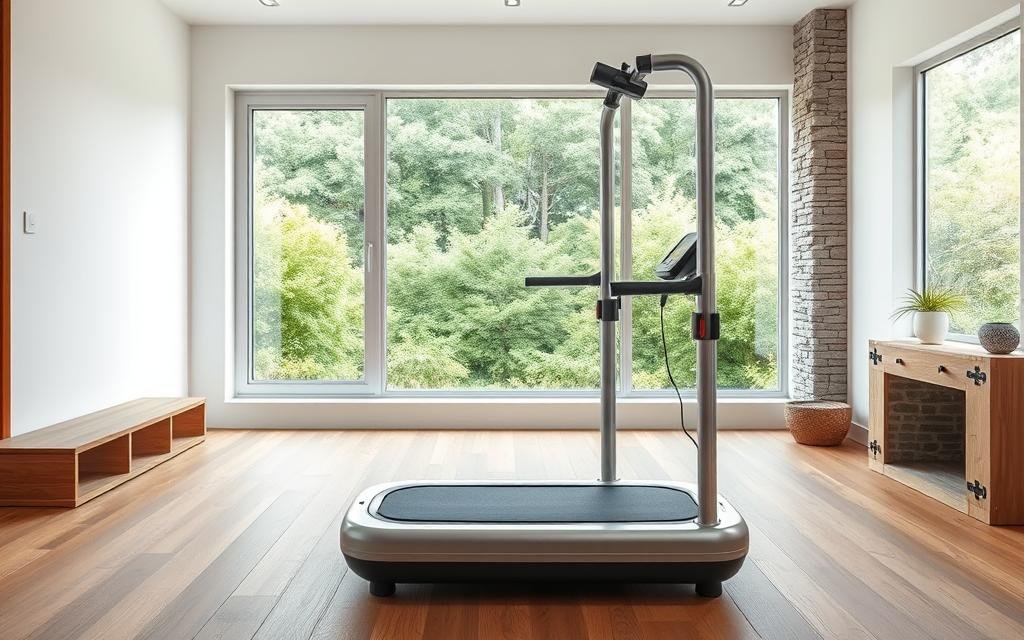

Whole body vibration machines are a fitness tool worth understanding on its own terms, not as a shortcut. They offer a different kind of workout for people looking for low-impact options. When you use these machines, they send mechanical energy through your body, causing your muscles to contract and relax dozens of times a second.
These machines aren’t a full replacement for regular exercise, and the research on them is more mixed than it’s sometimes made out to be. But for people with limited mobility or time, they can be a reasonable addition to a routine. This guide covers what the evidence actually supports, where it’s still uncertain, and how to use one safely.
Key Takeaways
- Whole body vibration machines transmit mechanical vibration that causes rapid, involuntary muscle contractions.
- Sessions typically run 10-30 minutes, three to four times a week, per commonly cited protocols.
- The evidence on fat loss and muscle mass is mixed: some reviews show modest benefits, while a larger 2025 meta-analysis found no significant overall effect on body fat when used alone.
- The clearest, most consistent benefit across studies is improved muscle strength and power, not weight loss.
- It’s a supplement to exercise, not a substitute — and it isn’t appropriate for everyone (see the safety section below).
Understanding Whole Body Vibration Technology
Whole body vibration technology uses a platform that vibrates rapidly, causing your muscles to contract and relax as a reflex response — a phenomenon sometimes called the tonic vibration reflex. This happens automatically, without you consciously flexing, and researchers measure it using electromyography (EMG) to confirm the muscle activation is real.

How Vibration Machines Work
- The platform vibrates at a set frequency and amplitude
- This triggers rapid, reflexive muscle contractions throughout the body
- Combined with static or dynamic exercises, this adds load to a standard movement
Types of Vibration Platforms
| Platform Type | Motion | Typical Frequency Range |
|---|---|---|
| Oscillating (seesaw) | Side-to-side, pivoting | 3-15 Hz |
| Linear (vertical) | Straight up and down | 20-50 Hz |
| Tri-planar | Combined multi-directional | 10-35 Hz |
Frequency and Amplitude Settings
Frequency (vibrations per second, in Hz) and amplitude (how far the platform moves) both affect intensity. Most training studies use frequencies in roughly the 6-13 Hz to 20-50 Hz range depending on platform type and goal, with lower frequencies and higher amplitudes generally used for reflex/balance training and higher frequencies for muscle activation. Manufacturer manuals vary, so following the specific settings recommended for your machine and goal matters more than chasing a single “ideal” number.
Whole Body Vibration Machine Benefits for Weight Loss and Muscle Building
Vibration training is genuinely well-studied for one thing in particular: muscle strength and power. A 2024 meta-analysis of 21 randomized controlled trials in healthy women found significant improvements in leg strength, leg press performance, and jump performance compared to non-exercise control groups, though the advantage over active exercise control groups was smaller and limited mainly to jump performance.
Weight loss and fat reduction are less clear-cut. An earlier 2019 systematic review of seven trials with 280 participants found a significant amount of fat loss from whole-body vibration, but no significant change in overall body fat percentage in studies under six months. A larger and more recent 2025 meta-analysis of 20 randomized trials with 585 participants found that vibration training alone did not significantly reduce body mass, BMI, or fat mass overall — though it did find a modest fat-percentage reduction specifically in adults 50 and older. Taken together, the honest summary is: strength and power gains are well-supported, but vibration training alone is not a reliable weight-loss tool.
- Best-supported: improvements in leg strength and power
- Mixed evidence: fat loss and body composition changes, more pronounced in adults 50+
- Least supported: vibration training as a standalone substitute for cardio or a calorie-deficit diet
Vibration training tends to work best as an addition to a normal exercise and eating routine, not a replacement for either.
Impact on Body Composition and Fat Reduction
Whole body vibration training (WBVT) has been studied for its effects on visceral (deep abdominal) fat, muscle mass, and metabolic rate, with results that vary by study population and duration.
Visceral Fat Reduction
Some individual studies report reductions in visceral fat with WBVT, which is notable because visceral fat is linked to cardiovascular risk. However, this isn’t a settled finding across the field — the more recent, larger meta-analysis referenced above found no significant overall fat-mass reduction when looking across a broader set of trials, so any visceral-fat-specific benefit should be treated as a promising but unconfirmed signal rather than an established effect.
Muscle Performance
This is where the evidence is strongest. The 2024 meta-analysis of 748 women across 21 trials found statistically significant improvements in knee extension strength, leg press strength, ankle plantar flexion strength, and countermovement jump height with WBVT compared to doing nothing, with the benefit growing when training continued for 12 weeks or more.
Metabolic Rate Changes
Some research suggests WBVT may modestly affect how efficiently the body uses energy, but well-controlled data on resting metabolic rate changes specifically is limited. This is an area where the mechanism is plausible but the evidence isn’t yet strong enough to make specific numeric claims.
Exercise Techniques and Workout Programs
A common starting protocol is three sessions a week, around 15-20 minutes each, combining static holds and dynamic movements on the platform. If you’re building a home routine, our guide on choosing a whole body vibration machine covers what to look for before you buy.
- Push-ups on the platform
- Step-ups with controlled movement
- Plank holds for core strength
- Bodyweight squats
- Reverse lunges
- Calf raises
If you’re specifically training a target area, our guide on vibration machine exercises for your stomach walks through core-focused routines, and our piece on the best speed settings on a vibration plate covers how frequency choice affects your session.
- Start with 3 sessions per week
- Keep each session to about 15-20 minutes to start
- Follow your specific machine’s recommended frequency range rather than a one-size-fits-all number
- Increase intensity gradually as your body adapts
Pairing vibration training with traditional resistance training tends to produce better results than using either approach alone, according to several of the trials in the meta-analyses above.
Health Benefits Beyond Weight Loss
Beyond muscle strength, WBVT has been studied for bone density, circulation, and back pain — with varying degrees of evidence behind each.
Bone Density
Vibration training has shown promise for bone health, particularly in postmenopausal women and older adults at risk of osteoporosis, where it may help support bone mineral density alongside standard care. It is not a replacement for medical treatment of osteoporosis.
Blood Circulation
The rapid, repeated muscle contractions during vibration training are thought to support blood flow, similar in principle to how any muscle activity aids circulation. The evidence here is more preliminary than for muscle strength, so it’s best understood as a plausible secondary benefit rather than a primary reason to use the machine.
Back Pain
Some studies suggest vibration training may help with muscle strength and mobility in people with chronic low back pain, though results vary by individual and study design. If back pain is your main concern, it’s worth exploring options built specifically for that, like our guide on the benefits of using an inversion table, alongside any advice from your doctor or physical therapist.
Safety Considerations and Contraindications
Whole body vibration isn’t appropriate for everyone. The following groups should avoid it or use it only under medical guidance:
- Pregnant women
- People with pacemakers or other implanted cardiac devices
- People with epilepsy or seizure disorders
- People with severe or poorly controlled diabetes
- People with recent injuries, spinal cord injuries, or acute back problems
- People with significant balance problems or a high fall risk
Older adults and people who are overweight can generally use vibration training but should start at low intensity and build up gradually to protect joints. Children and people with still-growing bones should avoid it until more research is available. Always check with a doctor before starting, especially if you have an existing health condition.
FAQ
What is a whole body vibration machine?
A whole body vibration machine has a platform that vibrates rapidly, causing your muscles to contract and relax reflexively many times per second while you stand, sit, or perform exercises on it.
How do whole body vibration machines work for weight loss?
The evidence for weight loss specifically is mixed — some smaller reviews found modest fat-loss effects, while a larger 2025 meta-analysis found no significant overall reduction in body mass or fat mass from vibration training alone. It’s better supported as a strength-training tool than a weight-loss tool.
Are whole body vibration machines effective for muscle building?
Yes, this is the best-supported benefit. Meta-analyses show significant improvements in leg strength and power, particularly with 12+ weeks of consistent use.
What types of vibration platforms are available?
The two main types are oscillating platforms, which pivot side to side, and linear (vertical) platforms, which move straight up and down. Each engages muscles somewhat differently.
Can whole body vibration help improve bone density?
Some research suggests it may support bone mineral density, particularly in postmenopausal women, but it should complement rather than replace standard osteoporosis care.
How often should I use a whole body vibration machine?
A common starting point is 3 sessions a week for 15-20 minutes, adjusted based on your goals and how your body responds. Check with a doctor first if you have any health conditions.
Are there safety considerations for using whole body vibration machines?
Yes — it isn’t recommended for pregnant women, people with pacemakers, epilepsy, severe diabetes, recent injuries, or significant balance problems. Start at low intensity and check with a doctor if you’re unsure.
Can whole body vibration replace traditional exercise?
No. The evidence supports it as a supplement to a regular exercise routine, not a substitute for cardio, strength training, or a healthy diet.
What’s the difference between frequency and amplitude in vibration machines?
Frequency is how many vibrations happen per second (measured in Hz); amplitude is how far the platform moves with each vibration. Both affect training intensity, and the right combination depends on your platform type and goal.
Can whole body vibration help with back pain?
Some studies suggest potential benefits for muscle strength and mobility in people with chronic low back pain, but results vary and it should be discussed with a doctor or physical therapist rather than used as a first-line treatment.
This article is for general educational purposes and isn’t a substitute for individualized medical advice. Talk to a doctor before starting whole body vibration training, especially if you have a heart condition, are pregnant, or have any of the conditions listed in the safety section above.
Sources
- Disability and Rehabilitation (2019) — systematic review and meta-analysis of whole body vibration and fat mass reduction (7 trials, 280 participants)
- International Journal of Obesity (2025) — systematic review and meta-analysis of WBVT on body mass, BMI, and fat mass (20 RCTs, 585 participants)
- NCBI/PMC — meta-analysis of whole-body vibration training on muscle performance in healthy women (21 RCTs, 748 participants)
- Mayo Clinic — Whole-body vibration: An effective workout? (expert answers)


Hi, I’m Mamon, the content creator behind this blog. I share my experience in blogging, WordPress, SEO, and affiliate marketing through honest product reviews, in-depth buying guides, and practical how-to articles. Every piece of content is thoroughly researched and written to help readers make informed decisions.