

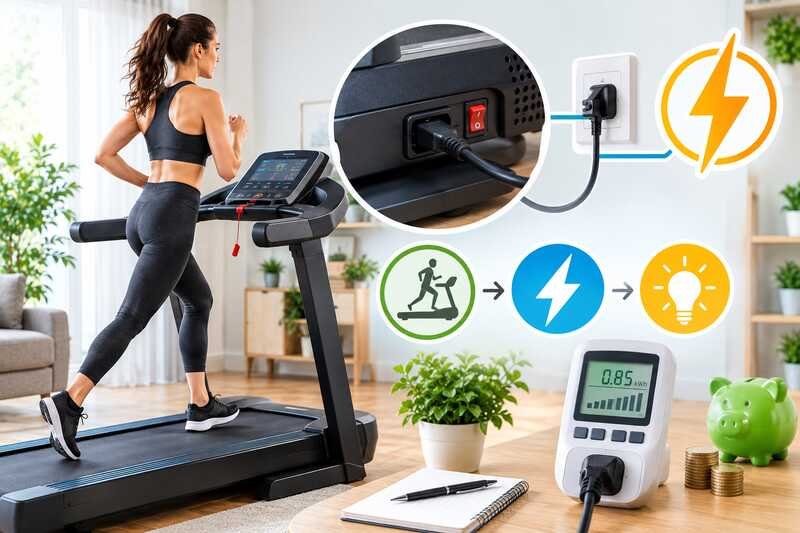

How much electric does a treadmill use? Most home treadmills draw between 300 and 1,500 watts while you are actually walking or running on them, with 600 to 700 watts being typical for a moderate-speed workout. That works out to only a few dollars a year for most households, even with regular use.
The exact number depends on your treadmill’s motor size, your speed and incline, how much you weigh, and how many hours a month you actually use it. This guide breaks down real wattage data from independent testing and walks through how to calculate your own electricity cost step by step. It also compares treadmills to other cardio equipment and shares practical ways to use less power without cutting your workouts short.
Key Takeaways
- Most home treadmills use 300 to 1,500 watts, with 600 to 700 watts typical during a moderate walk or jog.
- Running a treadmill for 3 hours a week costs most U.S. households roughly $10-$15 a year at current electricity rates.
- Motor horsepower, speed, incline, and your body weight all affect how much electric a treadmill uses.
- Manual treadmills use little to no electricity, while commercial models can draw 1,000-2,500 watts.
- Eco mode, auto power-off, and basic maintenance can meaningfully cut a treadmill’s electricity use.


Understanding Treadmill Power Consumption Basics
When you plug in your treadmill, knowing how much power it uses helps you budget for it and spot problems early. Power usage depends on a handful of electrical specs that are worth understanding before you dig into the numbers.
Today’s treadmills usually use between 500 and 1,500 watts at the motor’s rated capacity, though most home treadmills draw closer to 600-700 watts during a typical workout. A 30-minute session at that rate uses around 300-350 watt-hours.
Average Wattage Requirements
Several things affect how much power your treadmill draws. Here is a look at typical wattage needs:
- Moderate speed usage: 600-700 watts
- High-intensity workouts: up to 1,500 watts
- Standby mode: a few watts or less
Voltage and Amperage Specifications
| Electrical Specification | Typical Home Treadmill Value |
|---|---|
| Voltage | 120 volts |
| Amperage | Up to 20 amps |
| Typical wattage range | 500-1,500 watts |
Power Rating Terminology
A few basic electrical terms make it easier to understand your treadmill’s specs:
- Volts (V): electrical pressure
- Amps (A): electrical current
- Watts (W): rate of electricity use at any given moment
- Kilowatt-hours (kWh): total energy used over time, and the unit your electric bill is based on
How Much Electric Does a Treadmill Use in Real Numbers?
Independent wattage testing gives a clearer picture than manufacturer specs alone. One measured test of a 2 HP treadmill using a plug-in energy monitor found consumption climbing steadily with speed:

| Treadmill Speed | Measured Wattage |
|---|---|
| Idle (belt not moving) | about 4 watts |
| 1 mph (slow walk) | 96 watts |
| 3 mph (walking pace) | 244 watts |
| 5 mph (brisk walk/light jog) | 372 watts |
| 7 mph (jogging) | 496 watts |
| 10 mph (running) | 712 watts |
Using the U.S. average residential electricity rate of about 16.5 cents per kWh reported by the U.S. Energy Information Administration, here is roughly how much electric a treadmill uses over a year at different activity levels:
| Usage Level | Weekly kWh | Estimated Annual Cost |
|---|---|---|
| Light (1.5 hrs/week, walking pace) | about 0.4 kWh | roughly $3-$5 |
| Moderate (3 hrs/week, mixed pace) | about 1.5 kWh | roughly $10-$15 |
| Heavy (5+ hrs/week, running) | about 3 kWh | roughly $20-$26 |
Even the heaviest home use case costs less than a single streaming subscription per year. Knowing this can take some of the guesswork out of deciding how much electric a treadmill uses compared with other home appliances.
What Affects How Much Electric a Treadmill Uses
Several factors change how much electricity your treadmill pulls during a workout, and understanding them helps you predict your own costs more accurately.
Motor Size and Horsepower
The motor is the core of your treadmill’s energy use. Home treadmill motors usually range from 1.5 to 4.0 continuous horsepower. A bigger motor does not necessarily run at full power all the time, but it does raise your ceiling for high-intensity use.
- 1.5-2.0 HP motors: best for walking and light jogging
- 2.5-3.0 HP motors: suited to regular running and interval workouts
- 3.5-4.0 HP motors: built for frequent, high-speed running and heavier users
If you are shopping for a new machine, our best treadmill under $1,000 buying guide lists motor specs for each model side by side.
Speed and Incline Settings
Faster speeds and steeper inclines both demand more power from the motor. Running at 10 mph draws noticeably more electricity than a 3 mph walk. Adding incline increases the load further, because the motor has to work harder to keep the belt moving.
User Weight and Workout Duration
Heavier users require more motor effort to maintain the same speed, which raises power draw somewhat. Workout duration matters more in practice: a 60-minute session simply uses twice the electricity of a 30-minute one at the same pace.
| User Weight | Relative Energy Impact |
|---|---|
| Under 150 lbs | Lower power draw |
| 150-200 lbs | Moderate power draw |
| Over 200 lbs | Higher power draw |
How to Calculate How Much Electric Your Treadmill Uses
Working out your own cost only takes a few steps:
- Find your treadmill’s wattage (check the manual or the motor’s rating plate, usually 300-1,500 watts)
- Estimate how many hours you use it each month
- Multiply watts by hours, then divide by 1,000 to get kilowatt-hours (kWh)
- Multiply that by your local electricity rate, shown on your utility bill
Here is a worked example using a typical 600-watt treadmill:
| Treadmill Specification | Value |
|---|---|
| Wattage | 600 watts |
| Monthly usage | 20 hours |
| Electricity rate | $0.165 per kWh (U.S. average) |
| Monthly electricity cost | about $1.98 |
Your actual cost will vary with your motor size, workout intensity, and local electricity rates, which range widely by state. Pairing an efficient treadmill with a sensible workout routine keeps both your energy bill and your fitness goals on track. Our 4-week treadmill plan for weight loss is a good place to start.
How Much Electric Different Types of Treadmills Use
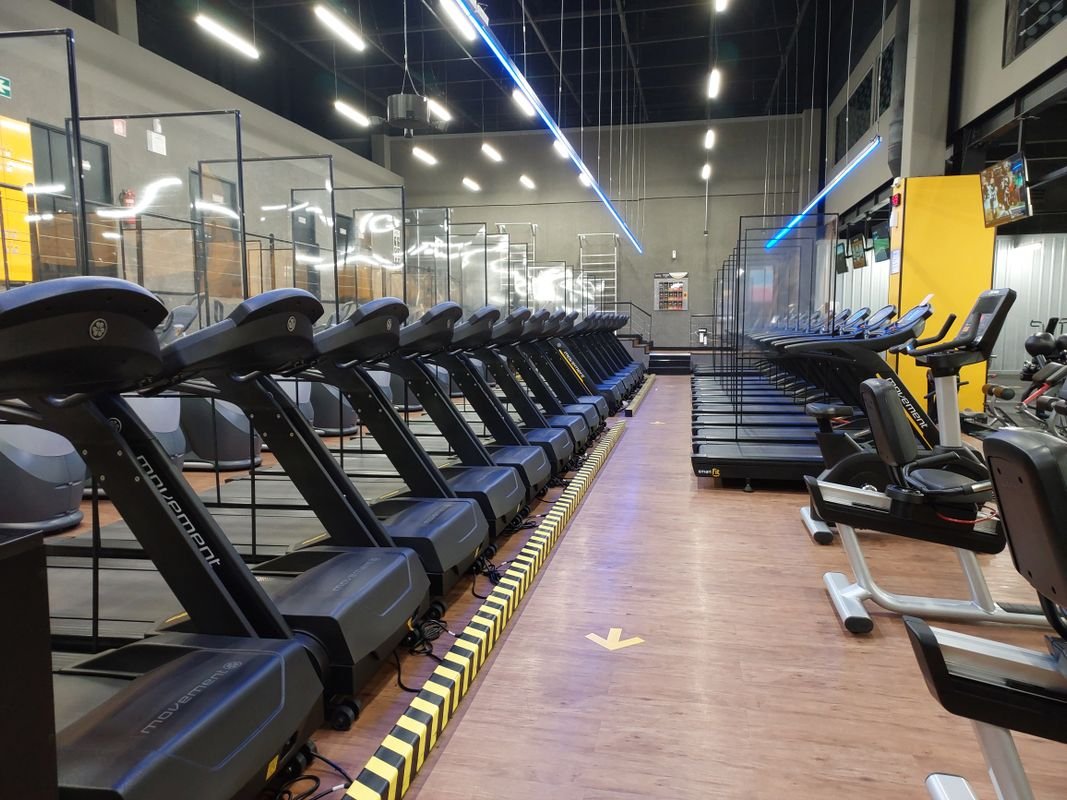

Not all treadmills draw the same amount of power. The type of machine you choose has a bigger impact on your electricity use than almost any other single factor.
- Manual treadmills: little to no electricity, since you power the belt yourself
- Home motorized treadmills: the most common type, drawing 500-1,500 watts
- Commercial treadmills: built for gyms, often 1,000-2,500 watts due to stronger motors
- Under-desk treadmills: lower speeds keep power draw modest, typically under 400 watts
- Foldable treadmills: generally similar wattage to standard home models, just smaller motors
| Treadmill Type | Typical Watts |
|---|---|
| Manual treadmill | 0-10 watts |
| Home motorized treadmill | 500-1,500 watts |
| Commercial treadmill | 1,000-2,500 watts |
If your main goal is walking rather than running, our best treadmill for walking guide highlights lower-power models that still hold up well over years of daily use.
How a Treadmill’s Electricity Use Compares to Other Cardio Machines
If you are weighing a treadmill against other home cardio equipment, electricity use is worth a quick look alongside calories burned and space requirements. Stationary bikes and ellipticals generally draw less power than treadmills at a comparable effort level, mainly because they don’t need a motor to move a belt under your feet.
| Equipment | Typical Wattage Range |
|---|---|
| Treadmill (motorized) | 300-1,500 watts |
| Exercise bike | 0-50 watts (most models need no outlet at all) |
| Elliptical | 0-50 watts (self-powered on most home models) |
That gap exists because most home exercise bikes and ellipticals rely on your own pedaling motion rather than a motor. As a result, a treadmill will almost always be the higher-electricity option among the three. Calories burned may matter more to your decision than electricity use, and our comparison of what burns more calories, a treadmill or an elliptical, breaks down the fitness side of that trade-off.
Energy-Efficient Features to Look For
Newer treadmills increasingly build energy efficiency into the motor and control board, not just the marketing copy.
Power-Saving Motors
Some modern treadmills adjust power delivery in real time based on your effort instead of running the motor at a fixed rate. As one example, SOLE Fitness reports that its TT8 model has a maximum input power of just 100 watts, well below the typical 600-700 watt range.
Eco-Friendly Settings
Look for treadmills with built-in eco settings that automatically scale power to your speed and effort rather than running at a constant draw. These settings quietly cut electricity use during warm-ups, cool-downs, and rest intervals without you having to adjust anything manually.
Automatic Power-Off Functions
Auto-off features cut power after a set period of inactivity, which prevents a treadmill from silently drawing electricity in standby mode for hours between workouts. Combined with a smart plug that fully cuts power at the outlet, this is one of the simplest ways to reduce a treadmill’s electricity footprint.
Tips to Reduce How Much Electric a Treadmill Uses
None of these tips require sacrificing your workout quality; they just trim the waste around it.
- Use eco mode or interval settings when your treadmill offers them
- Unplug or use a smart plug to fully cut power when the treadmill is not in use
- Keep the belt and motor clean and properly lubricated, since a well-maintained machine works less hard for the same speed
- Choose realistic speeds and inclines rather than maxing out settings you don’t need
- Favor shorter, higher-intensity workouts over long sessions at a barely-elevated pace, since they often burn similar calories in less total machine time
You may also be comparing a treadmill against other cardio equipment for your energy budget as well as your fitness goals. Our guide on exercise bike versus treadmill for weight loss covers how the two compare on more than just calories burned.
Watch: How Much Electricity Does a Treadmill Really Use?
This video walks through a real-world breakdown of treadmill power draw and what it means for your electric bill.

Frequently Asked Questions
Costs and Usage
How much electric does a treadmill use per month?
For a typical home treadmill used 3 hours a week, expect roughly 6-8 kWh per month, which costs about $1-$1.50 at the U.S. average electricity rate.
Does incline increase electricity use a lot?
Yes, noticeably. Running the motor against a steep incline takes more effort than flat walking, so it draws more watts. That difference is still small in dollar terms over a typical workout, though.
Do treadmills use electricity when turned off?
Most use a small amount of standby power if left plugged in, similar to a TV or microwave clock. Unplugging or using a smart plug eliminates this entirely.
Choosing a Treadmill
Are manual treadmills a good way to avoid electricity costs?
Manual treadmills use little to no electricity, since you power the belt with your own steps. They typically feel different underfoot, though, and are not the best fit for every workout style.
Is a higher horsepower motor always going to cost more to run?
Not necessarily. A larger motor has more available power, but it only draws as much electricity as the workout demands. A 3.0 HP motor used for gentle walking won’t cost more than a 1.5 HP motor pushed to its limit.
Do commercial-grade home treadmills use much more electricity?
Commercial treadmills generally use more power than standard home models, because of their larger, more durable motors. For most home users, though, the extra cost is still modest compared with other household appliances.
Will an older treadmill use more electricity than a new one?
Often yes. Older motors and worn belts tend to run less efficiently, so an aging treadmill can draw more power to hit the same speed. A newer model with a well-maintained motor and a properly lubricated belt typically runs more efficiently.
Does treadmill electricity use affect my home’s overall energy bill much?
For most households, no. Even daily treadmill use typically adds only a few dollars a month to an electric bill, far less than heating, cooling, or a water heater.
Conclusion
How much electric does a treadmill use? For most households, the honest answer is: not very much. A typical home treadmill draws 600-700 watts during a workout, and even frequent use rarely adds more than $10-$25 a year to an electric bill. Motor size, speed, incline, and workout duration all play a role, but eco settings, auto power-off, and basic maintenance can trim your usage further without changing how effective your workouts are. If you are still choosing your first machine, two guides can help. Our best treadmill under $500 and how much a treadmill weighs guides can help you find a model that fits your space, budget, and energy goals.


Hi, I’m Mamon, the content creator behind this blog. I share my experience in blogging, WordPress, SEO, and affiliate marketing through honest product reviews, in-depth buying guides, and practical how-to articles. Every piece of content is thoroughly researched and written to help readers make informed decisions.