

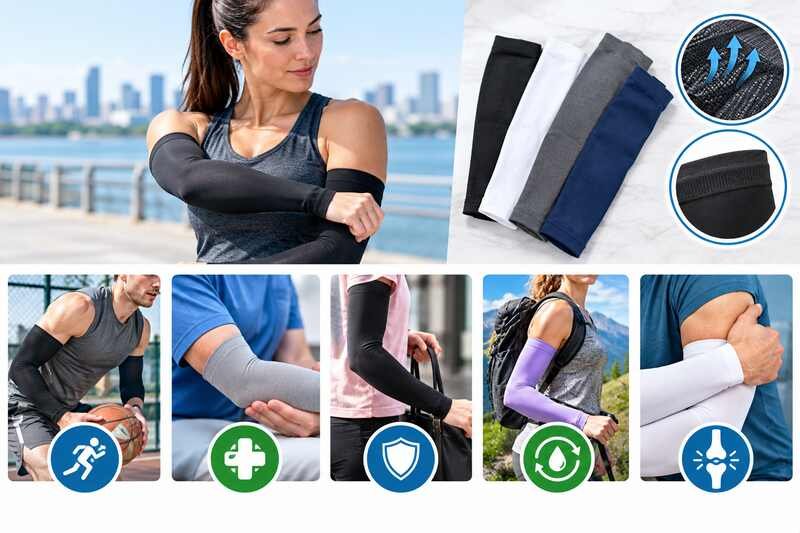

Compression arm sleeves are a common question for anyone new to sports recovery gear. The short answer to what are compression arm sleeves used for is that they apply steady, graduated pressure to the arm. That pressure supports blood flow, reduces swelling, and helps muscles feel less fatigued during and after activity. They are made of stretchy, snug-fitting material and are worn by athletes, people who sit or stand for long stretches, and some medical patients managing circulation issues.
Compression arm sleeves are used by athletes, medical patients, and everyday wearers who want more comfort during activity or travel. The pressure they apply helps move blood back toward the heart. That is part of why they are associated with better circulation and less muscle fatigue during longer efforts.
This guide covers exactly what are compression arm sleeves used for. It also covers what the research actually says about their benefits, how to pick the right size and compression level, and when it makes sense to check with a doctor before wearing one.
Key Takeaways
- Compression arm sleeves apply graduated pressure that supports venous blood flow back toward the heart
- Research on muscle soreness reduction is directionally positive but still rated as low-certainty evidence by researchers
- Compression levels are measured in mmHg, and the right level depends on whether the goal is everyday comfort, athletic use, or a doctor-directed medical need
- Proper sizing matters, since a sleeve that is too tight or too loose will not deliver the intended graduated pressure
- People with certain circulation or heart conditions should talk to a doctor before wearing compression garments


Understanding Compression Arm Sleeves and Their Function
Compression arm sleeves, including simpler designs like an elbow compression sleeve, are used in sports, general wellness, and in some medical settings. They apply targeted pressure to the arm rather than compressing the whole limb evenly. That targeted approach is what people mean when they ask what compression arm sleeves are used for in a training or recovery context.
They are worn to help reduce the feeling of muscle fatigue and to support the arm during repetitive movement. Wearing one also encourages blood flow back toward the heart during and after activity.
Key Components of Compression Sleeves
Compression sleeves are defined by three things: the material, the compression gradient, and the intended use. Most use a blend of nylon and spandex or similar stretch fabric that applies gentle, even pressure along the arm. Graduated designs apply slightly more pressure at the lower end of the sleeve and slightly less higher up. This is the same principle used in medical compression stockings for the legs.
How Compression Technology Works
Graduated compression works by narrowing the diameter of the veins slightly. That narrowing increases the speed of blood flowing back toward the heart and reduces pooling in the limb. A 2023 study in the Journal of Sport and Health Science measured this effect directly in basketball players. Researchers found that compression garments increased venous flow velocity and muscle blood flow at rest, with the effect coming from faster blood movement rather than any change in vein size. Most of that specific research looked at leg compression, but it supports the same basic mechanism used in arm sleeves.

What Are Compression Arm Sleeves Used For: Primary Benefits
The honest answer to what are compression arm sleeves used for depends on who is wearing one. For athletes, the sleeves mostly reduce the feeling of muscle fatigue during repetitive motion and support recovery afterward. For people who sit or stand for long periods, they reduce the achy, heavy feeling that comes from blood pooling in the limb. For some medical patients, they are used under a doctor’s direction to manage swelling.
The research on muscle soreness specifically is more mixed than most product marketing suggests. A 2026 systematic review and meta-analysis in Frontiers in Physiology pooled multiple studies on post-exercise compression garments. The effect on soreness at 24 hours was directionally favorable to compression, but the researchers rated the overall certainty of that evidence as very low due to wide variation between individual studies. In plain terms, compression may help some people feel less sore, but the science is not settled enough to call it guaranteed.
A commonly repeated claim is that compression sleeves work by flushing out lactic acid after exercise. That explanation does not hold up well against current exercise science. Lactate is normally cleared from the muscle within roughly an hour of finishing exercise. Delayed-onset muscle soreness has more to do with small-scale damage to muscle fibers than with lactic acid buildup. The more accurate way to describe the sleeve’s role is supporting circulation and reducing the feeling of heaviness, rather than clearing a specific waste product.
Some other benefits people report from wearing compression arm sleeves include:
- A steadier, more supported feeling during repetitive arm movement
- Less noticeable swelling in the hands and forearms after long periods of activity or travel
- A warmer, more stable feeling around the elbow and forearm during outdoor activity
- Mild sun protection on exposed skin during long outdoor workouts
Who Should Use Compression Arm Sleeves
What are compression arm sleeves used for in different settings? The answer depends on who is wearing one. Athletes in sports involving repetitive arm motion are the most common users. Baseball, tennis, cycling, and CrossFit-style training are all typical examples. Office workers and frequent travelers sometimes wear them during long flights or long desk days too, since sitting still for hours can leave the arms and hands feeling heavy and swollen.
Some medical patients also use compression sleeves. The most common case is people recovering from lymphedema following cancer treatment or surgery, where a doctor prescribes a specific compression level as part of ongoing care. That use case is different from an athletic sleeve bought off the shelf, since medical-grade compression is fitted and monitored by a clinician.
When to Use Caution or Avoid Compression Sleeves
Compression sleeves are not right for everyone. People with peripheral arterial disease should avoid compression garments unless a doctor specifically approves it. Compressing a limb with reduced arterial blood flow can make that problem worse rather than better. The same caution applies to anyone with uncontrolled heart failure, since compression changes how much blood returns to the heart at once.
Stop wearing a sleeve and check with a doctor if it causes numbness, tingling, increased pain, or a change in skin color. These can be signs the compression is too tight or not appropriate for your circulation. A sleeve should never be worn directly over broken skin, a rash, or an active infection.
How to Choose the Right Compression Arm Sleeve
Choosing the right compression arm sleeve comes down to fit, material, and compression level. What are compression arm sleeves used for if the fit is wrong? Not much. A poorly sized sleeve will not deliver the graduated pressure it is meant to provide, no matter how good the material is.
Measuring for the Perfect Fit
Measure your arm at its widest point, usually around the upper forearm or bicep depending on the sleeve’s design. Check that measurement against the manufacturer’s size chart rather than guessing from a general size label. Also consider the sleeve’s length. A sleeve that stops short of covering the intended area will not apply even, graduated pressure across the whole limb.
Material Considerations
Look for a moisture-wicking, breathable blend if the sleeve will be worn during exercise. A sleeve that traps heat and sweat is both uncomfortable and more likely to slip during activity. For all-day wear, a softer, slightly thicker material tends to hold its shape better over long periods.
Compression Level Selection
Compression garments are graded in mmHg, and the right level depends on the goal. Lighter compression, in the 15 to 20 mmHg range, is generally used for everyday comfort and mild swelling. A firmer 20 to 30 mmHg range is the most common choice for athletic and general circulation support. Anything above 30 mmHg is typically a doctor-directed medical-grade compression rather than an off-the-shelf athletic product, and it should be fitted and monitored accordingly.


| Compression Level | mmHg | Typical Use |
|---|---|---|
| Light | 15-20 | Everyday comfort, mild swelling, travel |
| Firm | 20-30 | Athletic use, general circulation support |
| Medical-grade | 30-40+ | Doctor-directed management of swelling or vein conditions |
If you are also comparing full-length options rather than a simple sleeve, our buying guide to the best elbow compression sleeves breaks down specific models by fit and support level. Athletes who track training load may also want to pair a compression routine with a heart rate monitor. Watching how recovery days affect resting heart rate over time can help confirm whether a routine is actually working.
Proper Care of Your Compression Sleeves
Compression sleeves lose their effectiveness gradually as the elastic fibers break down. Care matters more here than with ordinary athletic wear. Following a few basic habits keeps the graduated compression working as intended for longer.
Here are some tips to keep in mind:
- Wash your compression sleeves in cold or lukewarm water to prevent shrinkage and damage to the elastic fibers
- Avoid harsh detergents, bleach, or fabric softeners, since they can degrade the fabric and compromise the compression properties
- Store your compression sleeves loosely rolled or laid flat to prevent stretching, deformation, or damage
- Inspect your compression sleeves regularly for signs of wear, and replace them once the fabric feels looser than when new

Here is a summary of the care guidelines in table format:

| Care Tip | Why It Matters |
|---|---|
| Wash in cold or lukewarm water | Prevents shrinkage and damage to elastic fibers |
| Avoid harsh detergents and bleach | Preserves fabric and compression properties |
| Store loosely rolled or laid flat | Prevents stretching, deformation, or damage |
| Inspect and replace as needed | Ensures the graduated compression still works as intended |
People who are already tracking circulation-related health metrics at home, such as with a blood pressure monitor, may find it useful to note whether comfort improves on days a compression sleeve is worn. That kind of personal tracking is a useful observation, though it is not a substitute for a clinical measurement.
Frequently Asked Questions
Q: What are compression arm sleeves used for besides sports?
Beyond athletics, they are commonly used during long flights or long desk days to reduce the heavy, swollen feeling that comes with sitting still. Some medical patients also use them for managing swelling under a doctor’s guidance.
Q: How tight should a compression arm sleeve feel?
It should feel snug and supportive without causing numbness, tingling, or noticeable discomfort. If it leaves deep indentations in the skin after removal, or causes your fingers to feel cold, it is too tight for your arm.
Q: Can compression arm sleeves be worn all day?
Light to firm compression sleeves can usually be worn for extended periods, but it is worth taking breaks and checking your skin periodically. Medical-grade compression should only be worn on the schedule a doctor recommends.
Q: Do compression arm sleeves actually reduce muscle soreness?
The current research is directionally positive but far from conclusive. A recent meta-analysis rated the evidence as low-certainty, so a sleeve may help some people feel less sore without being a guaranteed fix. Soreness relief is just one benefit among several, alongside the more consistently observed circulation support.
Q: Is a bigger compression number always better?
No. Higher mmHg numbers are meant for specific medical needs and should generally be doctor-directed. For everyday and athletic use, the light to firm range is usually the right starting point.
Q: Do compression arm sleeves help with recovery between workouts, not just during them?
Some people wear sleeves after training rather than during it, specifically to support circulation while the muscles recover. The same low-certainty research on soreness applies here too, so think of it as one small supporting habit rather than the main driver of recovery.
Conclusion
So, what are compression arm sleeves used for in practice? Mostly supporting circulation, reducing the heavy or fatigued feeling in the arms during repetitive activity, and helping some people feel less sore after exercise, though that last benefit is still being studied. They are a low-risk addition to a training or recovery routine for most healthy adults, as long as the fit and compression level match the actual goal.
People with circulation or heart conditions should check with a doctor before adding one to their routine. For everyone else, picking the right size and compression level, and taking care of the sleeve once you have it, is what determines whether it actually delivers the support it promises.


Hi, I’m Mamon, the content creator behind this blog. I share my experience in blogging, WordPress, SEO, and affiliate marketing through honest product reviews, in-depth buying guides, and practical how-to articles. Every piece of content is thoroughly researched and written to help readers make informed decisions.