

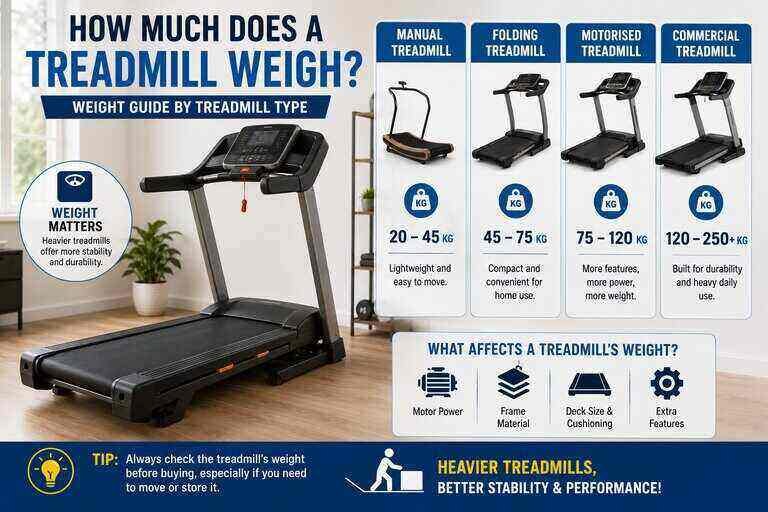

How much does a treadmill weigh is one of the first questions worth answering before you buy one. It matters most if you live in an apartment, plan to move it upstairs, or need it to fit through a narrow doorway. The honest answer is that it depends heavily on the type. Weight ranges from under 60 pounds for a compact folding model to well over 300 pounds for a commercial-grade machine. This guide breaks down the real numbers by category and explains what actually drives the difference.
Key Takeaways
- Treadmill weight ranges from about 60 pounds for compact folding models to 400+ pounds for commercial machines.
- The motor, frame, and deck size are the three biggest contributors to overall weight.
- Not all “manual” treadmills are light. Curved, self-powered manual treadmills are often heavier than motorized ones.
- A treadmill’s own weight and its maximum user weight capacity are two different numbers. Mixing them up leads to bad buying decisions.
- Most homes can support a treadmill’s floor load without reinforcement, but heavier commercial units are worth double-checking.
How Much Does a Treadmill Weigh? Quick Answer by Type
Treadmill weight varies more than most shoppers expect. The table below gives a realistic range for each common category.
| Treadmill Type | Typical Weight |
| Under-desk / compact folding | 55 – 80 lbs |
| Budget home models | 150 – 250 lbs |
| Mid-range folding models | 200 – 285 lbs |
| Commercial-grade models | 250 – 400+ lbs |
| Curved, manual (non-motorized) | 300+ lbs |
Averaged across every category, a treadmill weighs roughly 200 pounds. That single number hides a lot of variation. The type matters more than the average once you’re actually shopping.
How Much Does a Treadmill Weigh? Real Models Compared
Category averages only answer how much does a treadmill weigh in general terms. Looking at specific models, compiled from manufacturer specs and Garage Gym Reviews’ weight comparisons, makes the range easier to picture.
| Model | Category | Approximate Weight |
| Goplus 2-in-1 under-desk treadmill | Under-desk | 70 lbs |
| ProForm City L6 | Budget/compact | 125 lbs |
| Exterra TR150 | Budget folding | 109 lbs |
| Sole F63 | Mid-range folding | 254 lbs |
| ProForm Pro 9000 | Mid-range folding | 250 lbs |
| Nautilus Folding Motorized | Mid-range folding | 285 lbs |
| NordicTrack Commercial 1750 | Commercial-grade | 339 lbs |
Notice how wide the spread is even within a single price tier. Two folding treadmills marketed to the same shopper can differ by more than 100 pounds. Motor size and deck construction are usually why.

What Actually Makes a Treadmill Heavy
A handful of components account for nearly all the weight difference between models.
- Frame. A heavier steel frame handles more impact and lasts longer. It also adds noticeably more weight than a lighter aluminum or composite build.
- Motor. Higher continuous horsepower (CHP) motors are built for daily heavy use. They weigh more than the smaller motors found in budget or under-desk models.
- Deck and belt. A longer, wider running surface built to handle incline changes adds real weight, sometimes 30 to 40 pounds on its own.
- Touchscreen and electronics. Larger built-in displays, common on newer interactive models, add several extra pounds compared to a simple LED readout.
Manual Treadmills: Lighter Isn’t Always True
Most articles claim manual treadmills are automatically the lightest option, but that’s only true for one type. Basic manual incline treadmills, the flat, budget-friendly kind with no motor, typically weigh 45 to 65 pounds. They’re light because they skip the motor, the electronics, and most of the frame reinforcement a motorized deck needs.
Curved manual treadmills are a completely different machine. These self-powered models are popular for HIIT and sprint training. They use a heavy-duty curved steel deck that the runner’s own stride powers. According to BarBend’s treadmill weight research, curved manual treadmills often weigh 300 pounds or more. That’s heavier than most mid-range motorized machines. If you’re comparing “manual” options while shopping, always check which type you’re actually looking at.
Treadmill Weight vs. Maximum User Weight Capacity
These are two separate numbers, and confusing them is one of the most common shopping mistakes. The treadmill’s own weight is simply how much the machine weighs empty. The maximum user weight capacity is different. It’s how much weight the belt, deck, and motor are rated to safely support during use. A heavier machine often, though not always, supports a higher user weight capacity. A beefier frame and motor typically go hand in hand with a higher capacity rating.
Running a motorized treadmill above its rated user capacity puts extra strain on the motor. That strain can shorten its lifespan considerably. Most home treadmills list a capacity between 250 and 300 pounds. Heavier-duty and commercial models rate higher, often up to 400 pounds.
Can Your Floor Handle It?
For most homes, a standard treadmill isn’t a structural concern. Typical residential floor framing is built to support far more than a single piece of exercise equipment. Combined weight matters more than most people assume, though. A 250-pound treadmill plus a 200-pound user concentrates roughly 450 pounds onto a footprint of around 15 square feet. Older homes or converted spaces like attics deserve a second look before you commit to a heavy commercial unit. Placing a heavier machine on an upper floor or in an older building calls for a little more caution. A quick check with a contractor is a reasonable precaution rather than an overreaction.
Lightest and Heaviest Options Worth Knowing
If portability is your top priority, look at under-desk and compact folding treadmills in the 55 to 80-pound range. They’re the easiest to store, carry, and tuck into a closet between workouts. Several models even include built-in wheels specifically so one person can reposition them without help.
On the other end, curved manual treadmills and full commercial units in the 300 to 400-pound range are built for the opposite priority: stability and daily punishment rather than portability. These are usually a poor fit for anyone who needs to move the machine regularly. They’re an excellent choice, though, for a dedicated space where the treadmill stays put for years.
Watch: Moving a Heavy Treadmill Upstairs
This video from a professional moving company shows the technique for getting a heavy treadmill around a tight stairwell corner. It’s useful context once you know your machine’s weight.

How to Move a Heavy Treadmill Safely
Once you know roughly how much your treadmill weighs, moving it safely comes down to a few basics.
- Fold it first if possible. A folded deck is easier to angle through doorways and around corners.
- Use a furniture dolly. Rolling a heavy machine is far safer than carrying it, especially for anything over 150 pounds.
- Get a second person. Anything approaching 200 pounds or more should never be a solo lift.
- Clear the path first. Measure doorways and stairwells against your treadmill’s dimensions before you start moving it.
Why Treadmill Weight Matters When Shopping Online
Buying a treadmill without seeing it in person makes knowing how much does a treadmill weigh more important, not less. Product listings can make two machines look nearly identical in photos while hiding a 100-pound difference in the specs table. Before adding a treadmill to your cart, check three things. Look at the shipping weight, the assembled weight, and the maximum user capacity. These are often listed separately. Shipping weight in particular tends to run higher than assembled weight, since it includes the packaging.
Delivery method is worth checking too. Many treadmills over 200 pounds ship via freight carrier rather than a standard parcel service, which usually means curbside delivery only. Budget for moving the box yourself, or ask about room-of-choice delivery. Otherwise, it may show up on a pallet in your driveway.
Choosing the Right Weight for Your Space
A lighter, compact treadmill makes sense for an apartment or a shared workout corner. It also suits anyone who needs to store the machine between sessions. A heavier, commercial-grade model makes more sense for a dedicated home gym or frequent daily use. It also holds up better for households with multiple users at different weights. There’s no universally “right” weight. The right choice depends on how often you’ll move it and where it will live. How hard you plan to push it matters too.
Related Treadmill Guides
Moving a treadmill you already own? NordicTrack owners relocating a machine can also check our guide on how to disassemble a NordicTrack treadmill for moving. Still shopping? Our guides to the best treadmills under $1,000 and the best treadmills under $500 can help you compare lighter, budget-friendly models.
Frequently Asked Questions
How much does a treadmill weigh once it’s in the shipping box, versus assembled?
Shipping weight typically runs 10 to 20 pounds heavier than the assembled machine, since it includes packaging materials and protective foam.
How much does a treadmill weigh on average?
Averaged across all types, a treadmill weighs roughly 200 pounds. The real range runs from about 60 pounds to over 400 pounds, depending on the category.
How much does a folding treadmill weigh compared to a non-folding one?
Folding treadmills generally weigh less than fixed-frame commercial models. The difference has more to do with motor and deck size than the folding mechanism itself.
Are manual treadmills always lighter than motorized ones?
No. Basic manual incline treadmills are light, often under 65 pounds. Curved manual treadmills built for sprint training, though, can weigh 300 pounds or more.
Does a heavier treadmill mean better quality?
Often, yes. Extra weight usually comes from a sturdier frame and a stronger motor. Both tend to improve durability and stability during workouts.
What’s the average weight limit for a treadmill?
Most home treadmills support 250 to 300 pounds of user weight, while commercial-grade models often support up to 400 pounds.
Can one person move a treadmill alone?
A compact, under-100-pound model can sometimes be moved solo. Anything heavier is safer and easier with a second person and a furniture dolly.
Do I need to reinforce my floor for a treadmill?
Most homes don’t need reinforcement for a standard treadmill. Heavier commercial units on upper floors or in older buildings are worth checking with a contractor first.
Why do commercial treadmills weigh so much more?
They use larger continuous-horsepower motors and heavier steel frames. Their bigger decks are built to handle daily, high-intensity use without breaking down.
Does treadmill weight affect shipping cost?
Yes. Heavier machines typically cost more to ship and may require freight delivery rather than standard parcel shipping.
Is a lighter treadmill less durable?
Not necessarily, though it often trades some sturdiness for portability. A well-built lightweight model can still hold up fine for moderate, regular use.
If you own a NordicTrack model specifically, see our step-by-step guide to resetting a NordicTrack treadmill for troubleshooting display or calibration issues.
Bottom Line
How much does a treadmill weigh really depends on which type you’re looking at, from a 55-pound under-desk model to a 400-pound commercial machine. Knowing the weight range for your category helps you plan for moving day and check your floor’s capacity. It also helps you avoid confusing the machine’s own weight with its user weight limit. Match the weight to your space and how you’ll actually use it. The rest of the buying decision gets much easier from there.


Hi, I’m Mamon, the content creator behind this blog. I share my experience in blogging, WordPress, SEO, and affiliate marketing through honest product reviews, in-depth buying guides, and practical how-to articles. Every piece of content is thoroughly researched and written to help readers make informed decisions.