

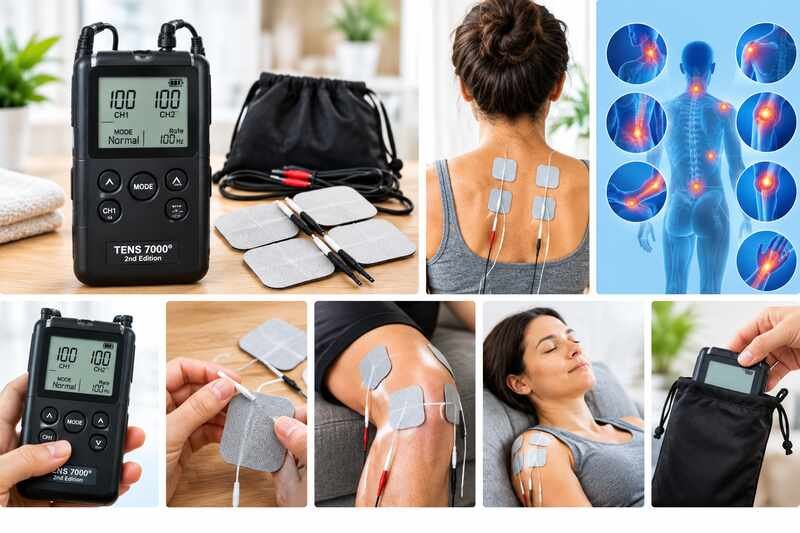

This TENS 7000 review looks at one of the best-known over-the-counter TENS units on the U.S. market. Powered by a single 9-volt battery, the TENS 7000 is a compact, dual-channel device. Many physical therapists and physicians recommend it for everyday pain management. It is not a prescription-only tool. Most U.S. shoppers can buy it directly online, which is part of why it has stayed popular for so long.
Below, we cover how the device works and what comes in the box. We also walk through its five therapy modes, who it tends to work best for, what the research actually says about TENS therapy, and who should avoid it.
How the TENS 7000 Works
TENS stands for transcutaneous electrical nerve stimulation. The TENS 7000 sends mild electrical impulses through electrode pads placed on the skin near the area of pain. According to Cleveland Clinic, researchers believe this stimulation works in one of two ways. It may block pain signals from reaching the brain, or it may trigger the body to release more endorphins, its natural pain-relieving chemicals.
Treatment can be run on demand or as a timed session lasting up to sixty minutes. Relief does not always stop the moment the device is turned off. Many users report pain relief that lasts longer than the treatment itself, sometimes by several hours. This varies quite a bit from person to person. It also depends on the mode used and the type of pain being treated.
What’s Included With the TENS 7000
The TENS 7000 second edition ships as a complete kit rather than just the base unit. The standard package includes:
- 1 TENS 7000 stimulator unit
- 1 sturdy belt clip
- 2 pairs of 45-inch lead wires
- 1 pack of 4 self-adhesive, reusable electrode pads
- 1 9-volt battery
- A hard plastic carrying case
- A quick-start guide and full instruction manual
Each of the two channels controls two electrode pads. That means all four included pads can be used at once for a two-channel session, or split across two separate treatment areas. The starter electrode pads are good for multiple sessions. Replacement pads from the inTENSity or TENS 7000 brands are widely available once the originals wear out.
The unit itself is backed by a one-year manufacturer warranty. It is also supported by Roscoe Medical, the company behind the TENS 7000 brand. Anyone who runs into a defective unit or a missing part generally has an easy path to a replacement within that first year.
The Five Therapy Modes, Explained Simply


One of the reasons this device keeps coming up in any TENS 7000 review is its five built-in modes. Each one suits a slightly different type of pain:
- Burst (B): Delivers stimulation in short bursts rather than a steady stream. Many users find this the most comfortable setting for everyday aches.
- Normal (N): A continuous, steady stream of stimulation at a fixed pulse rate and width. This is the most straightforward mode and a common starting point for first-time users.
- Modulation (M): Automatically varies the pulse rate and width throughout the session. This can help prevent the skin and nerves from adapting to the stimulation, which sometimes happens with a constant signal.
- Strength-Duration 1 (SD1): Gradually increases intensity while decreasing pulse width, then reverses. This cycles automatically over roughly 10 seconds.
- Strength-Duration 2 (SD2): Works like SD1 but cycles across a wider range. This gives a stronger contrast between the high and low points of each cycle.
Intensity on both channels is adjusted with two separate control knobs. Each side of the body being treated can receive a different strength of stimulation this way. The device also includes a compliance meter. It stores up to 60 sessions of usage data, recording up to 999 hours total, which can be useful for anyone tracking how consistently they are using the unit.
Product Specs at a Glance
- Channels: Dual channel, for use with 2 or 4 electrodes
- Pulse amplitude: Adjustable, 0-100 mA into a 500-ohm load, per channel
- Waveform: Asymmetrical bi-phasic rectangular pulse
- Pulse rate: 2-150 Hz, adjustable in 1 Hz steps
- Pulse width: 50-300 microseconds, adjustable in 10-microsecond steps
- Timer: Adjustable in 5-minute increments from 5 to 60 minutes, or continuous
- Dimensions: Roughly 4 inches long by 2.4 inches wide by 1 inch tall
- Weight: About 5.3 ounces, battery included
- Power source: One 9-volt heavy-duty battery
- Voltage: 0-50V into a 500-ohm load, with a built-in safety amplitude cap
- Regulatory status: FDA-listed Class II medical device
- Warranty: 1 year
These numbers matter more than they might seem at first glance. The wide pulse rate range, from 2 to 150 Hz, is what lets the five modes feel so different from one another in practice. A low pulse rate around the 2 Hz end tends to feel like a slow, deep tapping. A high rate closer to 150 Hz feels more like a steady buzz. Being able to fine-tune both the rate and the width gives users more control over comfort than a simpler, single-mode device would.
Who the TENS 7000 Tends to Work Best For
Most reviews of the TENS 7000 point to the same general use cases. These are everyday muscle and joint pain issues that respond well to at-home management. Common applications include:
- Lower back, shoulder, neck, and foot pain
- Muscle spasms and general muscle soreness
- Support during post-surgical recovery, alongside a doctor’s guidance
- Maintaining range of motion during recovery from an injury
Anyone managing chronic low back pain may also want to read our guide on which physiotherapy is best for you. A TENS unit is often used alongside, not instead of, hands-on physical therapy. For pain that responds to external support as much as stimulation, our guide on how to properly wear a back brace covers a complementary approach worth pairing with a TENS routine.
What the Research Actually Says About TENS
It is worth being upfront about the evidence here, since a lot of TENS marketing overstates it. A 2019 Cochrane overview of TENS research looked at eight reviews. Those reviews covered 51 randomized trials and nearly 2,900 participants with chronic pain. The reviewers could not confidently say whether TENS relieves pain better than a sham device or no treatment at all. They rated the overall quality of the evidence as very low. This was largely because the individual studies were small and had methodological weaknesses.
That does not mean TENS does not work for any given person. It means the research available so far is not strong enough to prove it works reliably across the board. It also is not strong enough to rule it out entirely. Many physical therapists still recommend TENS as a low-risk, drug-free option to try alongside other treatments. Plenty of individual users report real relief from it. It is simply worth going in with realistic expectations rather than treating it as a guaranteed fix for chronic pain.
This honesty matters for anyone reading a TENS 7000 review before buying. A device that costs under a hundred dollars and carries very little risk is a reasonable thing to try, even with uncertain evidence behind it. That is a different bar than a treatment that is expensive, invasive, or carries real downside risk.
Who Should Not Use a TENS Unit

TENS therapy is generally considered low-risk, but it is not appropriate for everyone. According to Cleveland Clinic, people should avoid TENS units if they have a pacemaker or other implanted electronic device. The same caution applies to anyone with epilepsy, active cancer, deep vein thrombosis, a bleeding disorder, or heart disease. TENS is also not recommended during pregnancy without a doctor’s guidance.
Electrodes should never be placed over infected or broken skin, varicose veins, the eyes, mouth, front of the neck, head, genitals, or numb areas. The same goes for skin that has recently been treated with radiation. Side effects are usually mild when the device is used correctly. The most common ones are skin irritation from the adhesive pads or an uncomfortable tingling sensation if the intensity is set too high. Anyone unsure whether a TENS unit is safe for their specific health situation should check with a doctor or physical therapist before starting.
The video below, from licensed physical therapist Doctor Jo, walks through how to place the pads correctly and get started with a TENS unit safely.

Getting the Most Out of Your TENS 7000
A few habits make a real difference in how well the device works. Clean, dry skin helps the electrode pads stick better and conduct more evenly. Starting on a lower intensity and working up gives the nerves time to adjust. Jumping straight to a high setting usually just feels uncomfortable without adding any extra benefit. Rotating pad placement slightly between sessions can also help avoid skin irritation over time, especially for anyone using the device daily.
It is also worth experimenting with the different modes rather than sticking to just one. Someone managing a chronic, ongoing ache might do better with Modulation mode. The varying signal helps prevent the body from getting used to a constant stimulation pattern. Someone treating a specific, sharp muscle spasm, on the other hand, might prefer the steadier Normal mode instead.
Replacing electrode pads on schedule matters too. Worn-out pads lose adhesion and conduct less evenly, which can make a session feel weaker even at the same intensity setting. Most users get noticeably better results simply by keeping a small stock of fresh pads on hand rather than stretching an old set well past its useful life.
Pad placement itself takes a little practice. For lower back pain, most guides recommend placing the pads on either side of the spine, spaced a few inches apart. Placing them directly on the spine itself is not recommended. For shoulder or neck pain, smaller pad spacing generally works better, since the muscles being targeted are smaller and closer together. When in doubt, the instruction manual that ships with the unit includes diagrams for common pain locations. A physical therapist can also walk through correct placement during an office visit.
How Long Before You Notice a Difference?
Most first-time users notice some effect within the first session, since the electrical sensation itself is immediate. Meaningful pain relief, the kind that outlasts the treatment session, tends to take a bit longer to show up consistently. Some people feel a noticeable difference after just one or two sessions. Others need a week or two of regular use before settling on the mode and intensity that works best for their particular pain.
Keeping a simple log of which mode, intensity, and pad placement were used for each session can help identify what actually works. That beats guessing from memory after a few weeks. This is especially useful for anyone managing a chronic condition, where small adjustments in placement or mode can make a real difference in results.
TENS 7000 vs. Other TENS Machines
The TENS 7000 is far from the only option on the market. Our TENS machine buyer’s guide covers several alternatives side by side. It looks at features, price, and included accessories across other popular models.
In general, the TENS 7000 stands out for a specific combination of qualities. It pairs a low price with a simple five-mode interface. It also ships with a kit that includes everything needed to start a session right out of the box. That combination is a big part of why it remains one of the most recommended entry-level units, even among newer competitors with flashier displays or app connectivity.
Curious whether a TENS unit like this one can support weight-management goals too? Our guide on using a TENS machine for weight loss explains what the device can and cannot do.
Conclusion
The TENS 7000 remains one of the most widely recommended over-the-counter TENS units for a reason. It is affordable, comes with everything needed to start immediately, and offers five distinct therapy modes for different types of pain. That said, the research on TENS therapy overall is still uncertain. It is worth approaching the device as one low-risk tool among several, not a guaranteed cure.
Anyone dealing with persistent pain, an implanted medical device, or a chronic health condition should talk to a doctor or physical therapist before starting TENS therapy. For everyone else, this TENS 7000 review suggests it is a reasonable, well-supported place to start if at-home electrical stimulation therapy sounds worth trying.


Hi, I’m Mamon, the content creator behind this blog. I share my experience in blogging, WordPress, SEO, and affiliate marketing through honest product reviews, in-depth buying guides, and practical how-to articles. Every piece of content is thoroughly researched and written to help readers make informed decisions.