

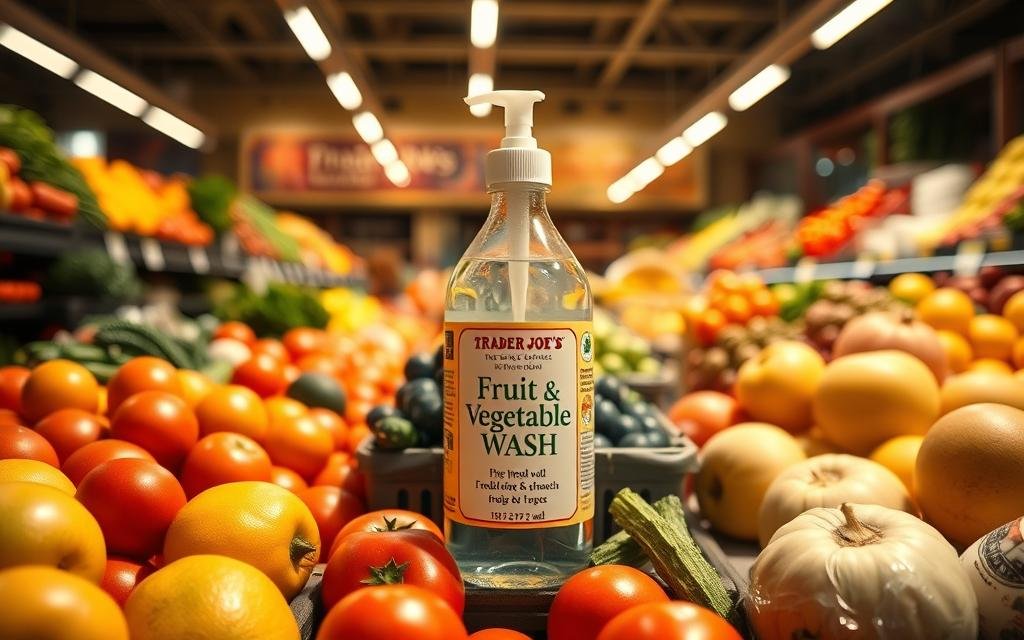
Is Trader Joe’s Fruit and Vegetable Wash safe to use on the produce you bring home every week? Based on its ingredient list and independent safety ratings, the short answer is yes. It’s a $3.99, 16 fl oz spray. It’s become a popular grocery-cart addition for shoppers who want extra reassurance beyond a plain water rinse. More people are paying attention to what’s on their produce these days. It’s a fair question to ask before spraying anything on food you’re about to eat.
This guide looks at what’s actually in the bottle and what independent reviewers say about its safety. It also covers how the wash stacks up against plain water and other low-cost washing methods, based on real research rather than marketing copy.

Key Takeaways
- Trader Joe’s Fruit and Vegetable Wash is rated a “Best Choice” by independent ingredient safety reviewers, formulated with water, glycerin, distilled white vinegar, soap bark extract, and grapefruit seed oil
- It costs $3.99 for a 16 fl oz bottle, making it an affordable add-on to a normal washing routine
- The FDA does not consider commercial produce washes necessary, since plain running water performs similarly for most household needs
- A 2026 peer-reviewed analysis found vinegar-based soaks reduced pesticide residue by a median of 54.2%, meaningfully better than plain water
- No washing method, commercial or homemade, removes 100% of contaminants from produce
Understanding Produce Wash Basics and Food Safety
Food safety starts before produce ever reaches your kitchen. Fruits and vegetables pick up dirt, handling residue, and sometimes pesticide traces on their way from field to store shelf. A quick rinse under the tap doesn’t always remove everything.

Produce travels through a lot of hands and surfaces before it gets to your cart. That includes growing fields, packing facilities, delivery trucks, and store displays. Each stop is a chance to pick up dirt, bacteria, or residue.
What Makes a Produce Wash Effective
A genuinely useful produce-washing method should accomplish a few specific things:
- Loosen and remove visible dirt and debris
- Reduce pesticide residue on the surface
- Lower surface bacteria counts
- Leave the produce itself unaffected in taste or texture
Common Contaminants on Fruits and Vegetables
| Contaminant Type | Potential Concern | Where It Tends to Sit |
|---|---|---|
| Pesticide Residue | Cumulative exposure over time | Surface, with some absorption in certain produce |
| Bacterial Contamination | Foodborne illness risk | Surface and, on damaged produce, deeper tissue |
| Wax Coatings | Trapped residue underneath the wax layer | Applied to the skin of some fruits after harvest |
The Importance of Proper Produce Cleaning
The FDA recommends washing produce under running water rather than soaking it in a basin. Moving water carries contaminants away instead of just loosening them. Even so, washing only addresses surface-level contamination. Francisco Diez-Gonzalez, a food microbiologist who has studied produce safety extensively, has pointed out that even the washing done at packing facilities before produce reaches stores “is not 100% effective.” That’s part of why rewashing at home still matters.
Is Trader Joe’s Fruit and Vegetable Wash Safe to Use?


When independent ingredient reviewers evaluate whether is Trader Joe’s Fruit and Vegetable Wash safe, the answer comes back favorably. Million Marker’s product safety database rates it a “GO,” their top safety tier. That rating notes it’s free of BPA, phthalates, parabens, and other endocrine-disrupting compounds commonly flagged in household products.
That’s a meaningfully different answer than the product’s marketing alone would give you. Here’s what the wash actually offers, based on verifiable information:
- Short, simple ingredient list built around organic vinegar and plant-derived surfactants rather than synthetic detergents
- Independently rated “Best Choice” by a third-party safety database, not just the manufacturer’s own claims
- Affordable at $3.99 for a 16 fl oz bottle
- No animal testing, according to the brand’s packaging claims
Where the Marketing Oversells It
Some retail listings and reviews for produce washes lean on specific-sounding numbers, like a precise percentage of bacteria “eliminated.” Those numbers don’t trace back to any published, brand-specific study. It’s worth being skeptical of exact percentages that aren’t tied to independent testing of that particular product. People often ask whether is Trader Joe’s Fruit and Vegetable Wash safe enough to trust with their family’s food. The more useful question is usually about ingredients and general effectiveness, not an unverifiable single statistic.
What can be said honestly is this: the ingredients are recognized as safe by independent reviewers, and the formula is vinegar-based. Independent pesticide-residue research, covered below, has linked vinegar to real, measurable results. That’s a solid foundation, even without a brand-specific clinical trial behind it.
Natural Ingredients Analysis: What’s Inside TJ’s Produce Wash


Knowing exactly what’s in the bottle matters. It helps answer whether is Trader Joe’s Fruit and Vegetable Wash safe for regular use in your kitchen. According to Million Marker’s ingredient breakdown, the formula includes:
- Water, the base of the formula
- Organic glycerin, a plant-derived humectant
- Organic distilled white vinegar, the primary active cleaning ingredient
- Organic quillaja saponaria (soap bark) wood extract, a natural plant-based surfactant
- Organic grapefruit seed oil, added for scent and mild antimicrobial properties
Why a Vinegar-Based Formula Matters
Distilled white vinegar isn’t just a filler ingredient here, it’s the ingredient doing most of the actual cleaning work. Acetic acid is the active component in vinegar. It has shown up repeatedly in peer-reviewed research as one of the more effective low-cost options for reducing pesticide residue on produce surfaces. That’s part of why this formula is built around vinegar rather than synthetic detergents.
Chemical-Free Formulation Benefits
Choosing a wash without synthetic detergents or added dyes means one less category of chemical exposure to think about. It’s also gentler for daily use across a wide range of produce, from delicate berries to thick-skinned melons.
Safety and Quality Assurance
Beyond the ingredient list itself, a few practical factors matter for everyday use:
- No animal testing, per the brand’s stated policy
- A short, recognizable ingredient list without synthetic fragrance or preservatives
- Formulated for use across multiple produce types, from leafy greens to root vegetables
Directions call for about 2 sprays per piece, or roughly 1 tablespoon diluted per 32 ounces of water for larger batches. That’s enough to treat about 10 pounds of produce. It also makes the wash a reasonably cost-effective option per use. It’s less expensive than buying a specialty produce wash that costs several times as much.
How to Use Trader Joe’s Produce Wash Effectively

Getting good results from any produce wash comes down to using it correctly, not just owning the bottle. The basic process is straightforward:
- Remove produce from any packaging first
- Rinse briefly under cool running water to remove loose dirt
- Spray the wash directly onto the produce surface
- Gently rub or scrub with hands or a soft brush
- Rinse thoroughly under running water to remove the wash itself
Different produce benefits from slightly different handling:
| Produce Type | Cleaning Method | Approximate Time |
|---|---|---|
| Leafy Greens | Gentle spray and rinse, leaf by leaf | 1-2 minutes |
| Soft Fruits | Light spray, gentle rub | About 30 seconds |
| Hard Vegetables | Spray and scrub with a brush | 45-60 seconds |
It’s worth noting that the FDA doesn’t consider commercial produce washes necessary. Their official guidance is that plain running water, combined with gentle rubbing or scrubbing, performs about as well as commercial products. That holds true for most household situations. That doesn’t make a wash like this one useless. Some people simply prefer the routine, the scent, or the added peace of mind. But water alone remains a perfectly valid baseline. That’s worth remembering for anyone still weighing whether is Trader Joe’s Fruit and Vegetable Wash safe enough to skip entirely.
- Always wash your hands before handling produce
- Use cool, clean running water for the final rinse
- Skip dish soap or household detergent entirely
- Dry produce with a clean towel before storing
Comparing TJ’s Wash to Regular Water Rinsing
Understanding how a vinegar-based wash actually compares to plain water rinsing helps put the marketing claims in context. That’s more useful than taking them at face value.
What the Research Actually Shows
A 2026 peer-reviewed analysis published by the Environmental Working Group reviewed 47 separate studies. Together, they covered 23 produce items and 79 pesticides. The analysis found real, measurable differences between washing methods:
| Washing Method | Median Pesticide Reduction |
|---|---|
| Water rinsing | 30.2% |
| Plain water soaking | 33.7% |
| Baking soda soaking | 50.9% |
| Vinegar (acetic acid) soaking | 54.2% |
That analysis didn’t test bottled commercial washes specifically, so it can’t confirm this exact product’s numbers. But Trader Joe’s formula is built around distilled vinegar as its primary active ingredient. That makes it reasonable to expect performance somewhere in the range vinegar-based methods showed in this research, well ahead of water alone.
Why This Still Matters for Food Safety
A CDC-funded analysis of outbreak data from 1998 to 2008 attributed 46% of foodborne illnesses to produce. It was published in the journal Emerging Infectious Diseases. Leafy greens alone were responsible for 22% of the total. Produce-related illness isn’t a rare or hypothetical concern. It’s one of the largest categories tracked.
Separately, our look at whether ultrasonic fruit cleaners work found similar patterns. Real, measurable improvement over plain water, but nothing that gets you to zero risk. The same honest framing applies here.
Real-World Considerations and Limitations
Bagged, pre-washed salad greens are a useful comparison point. A Consumer Reports investigation of 208 bagged salad samples found that 39% exceeded recommended limits for total coliform bacteria. Another 23% exceeded limits for enterococcus. That’s despite those products already being labeled “washed” or “triple-washed” before they reach the shelf. It’s exactly why food safety researchers like Diez-Gonzalez recommend rewashing bagged greens at home when time allows.
A few honest limitations worth knowing before you rely on any produce wash, Trader Joe’s included:
- It’s not independently tested as a finished product. The safety rating covers the ingredients; the pesticide-removal percentages come from separate research on vinegar as a category, not this specific bottle.
- It won’t remove absorbed residue. Anything that has moved beneath the produce’s skin needs peeling, not washing, to fully address.
- It’s optional, not required. The FDA’s official position is that plain water accomplishes most of the same result for most households.
- No wash guarantees zero bacteria or pesticide residue. Reduction, not elimination, is the realistic goal with any method.
If you’d rather skip a bottled product entirely, our guide to washing fruits and vegetables to remove pesticides covers what you can accomplish with water, baking soda, and a produce brush alone. And if you’re comparing several store-bought and gadget-based options side by side, take a look at our fruit and vegetable cleaner buyer’s guide. It breaks down a wider range of choices.
Who Should Consider Using It
Not every household needs a dedicated produce wash, but a few situations make it more worthwhile. Households that eat a high volume of fresh produce get more repeated value out of an affordable, independently rated wash. That’s especially true for items from the Dirty Dozen list, compared to someone who eats produce only occasionally. People who already prefer a vinegar-based cleaning routine may also find it a convenient fit. The same goes for anyone who wants a pre-mixed option instead of measuring vinegar and water themselves.
On the other hand, you may not need it. Plain water and the FDA’s baseline recommendation may already be enough for your household. The same goes if you already use a baking soda soak for produce that needs extra attention. Either way, whether it’s worth adding on top of your current routine comes down to preference more than necessity, once you already know is Trader Joe’s Fruit and Vegetable Wash safe to use in the first place.
Conclusion
So, is Trader Joe’s Fruit and Vegetable Wash safe? Based on independent ingredient review, yes. It’s rated a “Best Choice” by third-party safety databases. The formula is built from a short list of recognizable, plant-based ingredients led by organic vinegar. It’s free of the synthetic chemicals that show up in less transparent formulas.
What it isn’t is a miracle solution. No published research has tested this exact bottled formula against pesticide residue or bacteria in a controlled study. Government guidance still holds that plain running water gets most households most of the way there. The real value of a vinegar-based wash like this one comes from research on vinegar as an ingredient category. It doesn’t come from brand-specific marketing claims.
If you’re deciding whether it’s worth adding to your routine, treat it as a reasonably priced, ingredient-safe option. It likely performs somewhere in line with other vinegar-based methods. It’s not a replacement for basic food safety habits like washing your hands, using running water, and rewashing produce that’s already labeled pre-washed.


Hi, I’m Mamon, the content creator behind this blog. I share my experience in blogging, WordPress, SEO, and affiliate marketing through honest product reviews, in-depth buying guides, and practical how-to articles. Every piece of content is thoroughly researched and written to help readers make informed decisions.