

Water distillers are one of the oldest and most thorough ways to purify tap water at home. So how does a water distiller work? It copies a process nature has used for millions of years: it turns water into steam and then cools that steam back into liquid, leaving most contaminants behind in the process.
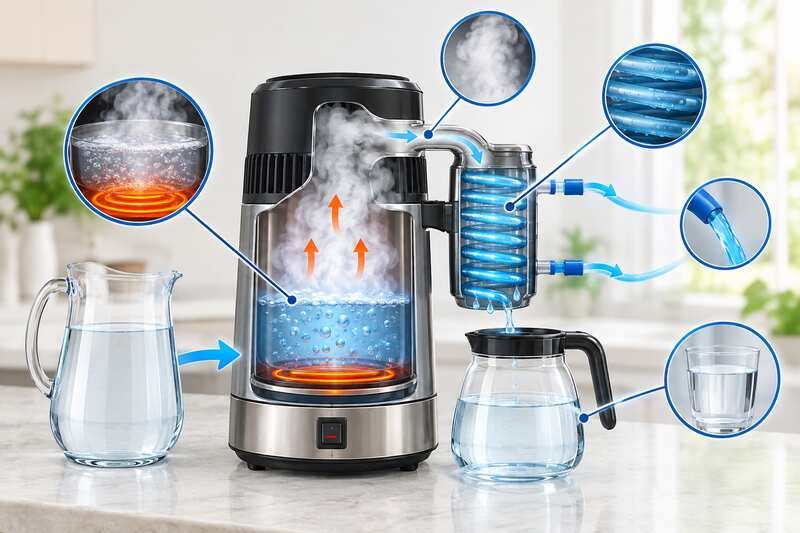
The machine does this by heating water to its boiling point until it turns into steam. That steam leaves behind dissolved minerals, heavy metals, and many other impurities. According to the CDC, distillation is effective against parasites, bacteria, and viruses. It also removes chemicals like arsenic, lead, and nitrate, which makes it one of the more thorough home water treatment options available.

Key Takeaways
- Distillation removes parasites, bacteria, viruses, and many heavy metals from tap water
- Countertop units typically produce about 1 gallon every 4 to 6 hours
- The process mirrors the Earth’s natural water cycle: evaporation, then condensation
- Distillation alone doesn’t remove volatile organic compounds (VOCs), so many units add a carbon filter
- Home units range from budget countertop models to whole-house and commercial systems
Understanding Water Distillation: Nature’s Purification Process
Water distillation mirrors the Earth’s own water cycle, and that similarity is a good starting point for anyone asking how does a water distiller work in everyday terms. Just as the sun heats water until it evaporates and later falls back down as rain, a home water distiller machine heats water until it evaporates. It then captures and cools that vapor back into liquid form.
The Natural Water Cycle and Distillation
Water distillation follows a simple, three-part approach:
- Water is heated until it reaches its boiling point
- Steam rises off the water, leaving contaminants behind
- The steam is captured and cooled back into purified water
Basic Principles of Water Purification
The distilled water benefits of this approach come down to what gets left behind. Minerals, salts, and most microorganisms can’t evaporate along with the water molecules. They stay in the boiling chamber while the purified steam moves on to the condenser.
A Long History of Use
Distillation is one of the oldest water purification techniques still in everyday use. Its roots go back to ancient civilizations that boiled and condensed water for drinking and medicine. Modern home water distiller units bring that same basic principle into a compact, largely automatic countertop appliance.

By understanding the science behind distillation, it becomes easier to see how it turns ordinary tap water into a purer, cleaner resource for your home.
Essential Components of a Water Distiller System
Knowing the main parts of a water distiller helps when comparing household models, and it makes it easier to see exactly how does a water distiller work from start to finish. Countertop water distillers share several core components that work together to turn tap water into purified drinking water.
- Boiling Chamber: Where water is heated to its boiling point of 212 degrees Fahrenheit
- Heating Element: Generates the heat needed to turn water into steam
- Condenser Coil: A stainless steel tube that cools rising steam back into liquid water
- Collection Container: Stores the finished distilled water
- Carbon Post-Filter: An optional add-on that catches VOCs the distillation step alone can miss
A typical countertop model produces about a gallon of distilled water every 4 to 6 hours, based on production rates reported for popular home units like the Megahome and Rovsun countertop distillers. For a closer look at timing, our guide on how long it takes to distill water at home breaks down production speed by unit size. Automatic units built for continuous use, such as whole-house or plumbed-in systems, can produce roughly 8 to 12 gallons a day without needing to be refilled by hand.
With regular cleaning, a well-built distiller can last for years. Some manufacturers back their stainless steel components with warranties as long as 15 years, while entry-level units typically carry a 1-year warranty.
How Does a Water Distiller Work
At its core, a water distiller works in three connected stages. Together, these stages turn ordinary tap water into water that’s largely free of dissolved solids, heavy metals, and microorganisms.

The Boiling Process
The first stage heats water to 212 degrees Fahrenheit. This step accomplishes several things at once:
- Kills most harmful microorganisms present in the water
- Separates water molecules from dissolved contaminants
- Converts liquid water into rising steam
Steam Condensation Phase
In the condensation phase, that rising steam travels through a cooled coil and turns back into liquid. This step matters because:
- Heavy metals and minerals stay behind in the boiling chamber
- Only purified water vapor continues through the system
- Most bacteria, viruses, and other contaminants never make it past this point
Final Collection and Filtration
The last stage collects the newly purified water in a storage container. Many distillers then route that water through an activated carbon post-filter. This helps catch volatile organic compounds and improve taste before the water is ready to drink.
Understanding this three-stage process makes it clear why distillation is considered one of the more thorough home water purification methods. Knowing how does a water distiller work also helps you get the most out of one.
Types of Water Distillers for Different Needs
Once you know how does a water distiller work, picking the right type comes down to your household’s water use, budget, and how hands-on you want to be with refilling and cleaning it.
- Countertop Water Distillers
- Ideal for individuals and small households
- Typically produce about 1 gallon every 4 to 6 hours
- Price range: roughly $150 to $800 for most home models
- Automatic or Plumbing-Integrated Distillers
- Connect directly to a home’s water line
- Produce distilled water continuously without manual refilling
- Often produce 8 to 12 gallons per day
- Commercial Water Distillers
- Built for high-volume, continuous production
- Used in labs, medical facilities, and industrial settings
- Sized to match demand well beyond household needs
If you’re deciding between models, our water distiller machine reviews and buyer’s guide compares several popular options side by side. Our home water distiller comparison also breaks down which type fits different households best.
Contaminants Removed Through Distillation
Distillation is a strong method for cleaning drinking water, but it helps to know exactly what it does and doesn’t remove before relying on one.
Common Water Impurities Eliminated
According to the CDC, distillation is effective against a wide range of contaminants, including:
- Parasites, bacteria, and viruses
- Heavy metals such as lead, arsenic, cadmium, and chromium
- Dissolved minerals like sodium and sulfate
- Nitrate and other dissolved solids
Limitations of Distillation
Distillation has real limitations. The CDC notes that it generally uses more energy and takes longer than other treatment methods. It also can’t remove volatile organic compounds, solvents, or certain pesticides that evaporate at or below water’s boiling point and travel along with the steam.
Role of Carbon Post-Filtration
To address that gap, many distillers pair the boiling and condensing process with an activated carbon post-filter. That extra step is what catches VOCs, giving the finished water a more complete level of purification. The CDC also points out that bacteria can occasionally recolonize a distiller’s cooling coils during periods of non-use. That’s part of why regular cleaning matters as much as the distillation process itself.
Before choosing distillation or any other treatment method, the CDC recommends testing your water first to see which contaminants you’re actually dealing with.
Benefits of Using a Water Distiller
A home water distiller is a reliable way to get consistently clean drinking water. These machines turn ordinary tap water into thoroughly purified water through the boiling-and-condensing process described above.
Key distilled water benefits include:
- Thorough removal of dissolved minerals, heavy metals, and dissolved solids
- Strong reduction of bacteria, viruses, and parasites
- No added chemicals in the purification process itself
- Lower ongoing cost per gallon compared to store-bought distilled water
Running a countertop distiller costs roughly $0.10 to $0.20 in electricity per gallon at typical U.S. electricity rates, since most units use about 0.7 to 1 kWh to produce a gallon of water. That’s meaningfully cheaper than store-bought distilled water, which commonly runs $1.00 to $1.50 a gallon at U.S. retailers, so a household that distills water regularly can offset the appliance’s upfront cost over time.
Maintenance and Operating Considerations
Keeping a water distiller in good shape takes some regular attention, but the routine is straightforward once it becomes a habit.
Cleaning Requirements
Water distiller maintenance is key to keeping the unit performing well. Regular cleaning prevents mineral scale and bacterial buildup:
- Clean the boiling chamber after every 3 to 4 uses
- Use white vinegar or a manufacturer-recommended descaling solution
- Rinse thoroughly with clean water after descaling
- Check seals, gaskets, and the condenser coil for wear
Energy Consumption Factors
Most countertop distillers draw between 600 and 1,000 watts while running. A full cycle to produce one gallon typically uses about 0.7 to 1 kWh. At the current U.S. average residential electricity rate, that works out to roughly $0.10 to $0.20 per gallon, though your actual cost depends on local utility rates.
Operational Best Practices
To get consistent results from a water distiller over time:
- Replace the carbon post-filter as often as the manufacturer recommends
- Check water level sensors and shut-off switches periodically
- Store finished distilled water in clean, sealed containers
- Test your water’s quality periodically, especially after a well or municipal supply change
Following these habits helps a distiller keep producing clean water reliably, and it protects the investment you made in the unit itself.
Conclusion
Home water distillers offer one of the more thorough ways to purify drinking water. They remove bacteria, viruses, heavy metals, and dissolved minerals through a simple boil-and-condense process, and pairing distillation with a carbon post-filter closes the gap on VOCs for a more complete setup overall.
When weighing a home water distiller, it helps to consider both sides. They’re effective against a wide range of contaminants and cost relatively little to run per gallon. On the other hand, they use more electricity and take longer than some other treatment methods, and most home units cost somewhere between $150 and $800 depending on capacity and features.
Whether a water distiller makes sense for your household depends on what’s actually in your water, your budget, and how much daily production you need. Testing your water first, as the CDC recommends, is the best way to know if distillation addresses the contaminants you’re most concerned about. Hopefully this breakdown of how does a water distiller work helps you decide whether one belongs in your kitchen.
FAQ: How Does a Water Distiller Work
Q1: How long does a typical water distiller take to produce distilled water?
A: Most household water distillers take 4 to 6 hours to produce a gallon of distilled water. The exact time depends on the model, its size, and the water’s starting temperature. Automatic or plumbed-in units built for continuous production can output 8 to 12 gallons a day.
Q2: Is distilled water safe to drink regularly?
A: Yes, distilled water is safe to drink. It’s very pure but lacks the minerals found in tap or spring water. It’s worth getting those minerals from food or, if preferred, a post-filter designed to reintroduce them.
Q3: Do water distillers remove all contaminants?
A: No. Distillation removes a wide range of contaminants, including bacteria, viruses, parasites, and heavy metals like lead and arsenic. According to the CDC, it can’t remove volatile organic compounds or certain pesticides that evaporate along with the water. That’s why many units add a carbon post-filter to catch what distillation alone misses.
Q4: How much electricity does a water distiller use?
A: Most countertop water distillers use between 600 and 1,000 watts. They need about 0.7 to 1 kWh of electricity to produce a single gallon of water. At typical U.S. electricity rates, that comes out to roughly $0.10 to $0.20 per gallon.
Q5: How often should I clean my water distiller?
A: Clean a water distiller after every 3 to 4 uses, or at least once a month with regular use. Routine cleaning prevents mineral scale and bacterial buildup on the boiling chamber and condenser coil. Most manufacturers recommend a descaling solution or a simple vinegar-and-water rinse.
Q6: Can I use distilled water for purposes other than drinking?
A: Yes. Distilled water is commonly used in medical equipment, lab work, steam irons, car batteries, and humidifiers. Its lack of minerals makes it useful anywhere mineral buildup or impurities could cause problems.
Q7: What’s the difference between distilled and filtered water?
A: Filtered water passes through a membrane or carbon filter that removes some contaminants. Distilled water is boiled, evaporated, and condensed, which removes a broader range of impurities. In general, distillation offers a more thorough level of purification than standard filtering alone.
Q8: Are water distillers expensive to buy?
A: Most home water distillers cost between $150 and $800, depending on capacity, automation, and build quality. Premium whole-house or automatic models sometimes run higher. While that’s a real upfront cost, many households offset it over time through lower per-gallon costs than store-bought distilled water. Our breakdown of distilled water costs compares those numbers directly.


Hi, I’m Mamon, the content creator behind this blog. I share my experience in blogging, WordPress, SEO, and affiliate marketing through honest product reviews, in-depth buying guides, and practical how-to articles. Every piece of content is thoroughly researched and written to help readers make informed decisions.