

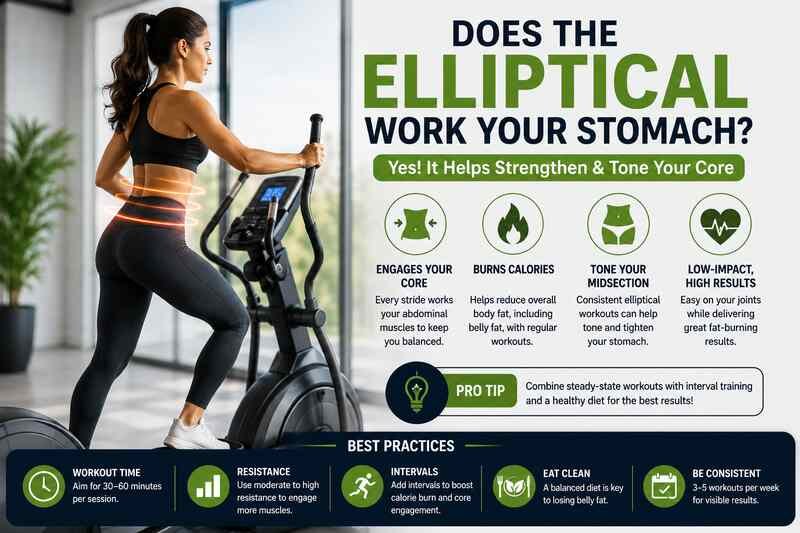

Does the elliptical work your stomach directly? Not really, and it’s worth knowing that upfront. No cardio machine can spot-reduce fat from one specific area, including your midsection. What the elliptical does do is burn calories and engage your core for stability. That supports overall fat loss, and your stomach is part of that eventually. This guide covers exactly how that process works. It also covers what the elliptical actually targets. And it covers the habits that make the biggest difference if a flatter stomach is your goal.
Key Takeaways
- The elliptical doesn’t directly work your stomach muscles. Spot reduction isn’t possible on any cardio machine.
- Your core stays engaged for balance throughout an elliptical session, but that’s stabilization, not targeted ab training.
- Losing belly fat requires an overall calorie deficit, built through consistent cardio and resistance training together.
- Visceral fat, the deeper, riskier belly fat, responds to the same overall fat-loss approach as fat anywhere else.
- Harvard Health recommends 30 to 60 minutes of moderate aerobic exercise on 3 or more days a week, alongside resistance training.
Does the Elliptical Work Your Stomach Directly?
The honest answer is no. Your body doesn’t let you choose where it pulls fat from during exercise. This is called spot reduction, and it’s a myth. According to Harvard Health, there’s no way to target one area of fat over another through exercise. Genetics and overall lifestyle determine where your body stores and releases fat first. That applies just as much to sit-ups as it does to elliptical sessions. Neither one burns fat specifically from your stomach.
What Muscles Does the Elliptical Actually Target?
The elliptical primarily works your lower body: glutes, hamstrings, quadriceps, and calves. Using the handles adds your arms, shoulders, and chest into the mix. Your core, including your abdominal muscles, stays engaged throughout each stride to keep you balanced and upright. That’s real muscle activation, just not the kind that builds visible abs on its own. Skipping the handles and locking your posture into one stiff position reduces core engagement even further. Your body simply has less balancing to do. Actively varying your stride length and posture keeps more muscle groups involved throughout the session.
How the Elliptical Helps You Lose Belly Fat Anyway
Even without spot reduction, the elliptical is still genuinely useful for a flatter stomach. Weight loss comes down to burning more calories than you consume. A steady elliptical habit builds exactly that kind of deficit. As your total body fat drops, your stomach loses fat along with everywhere else. There’s no way to speed that process up beyond building a real calorie deficit and staying consistent. The elliptical is simply an efficient, low-impact way to do that.

Visceral Fat vs. Subcutaneous Fat: Why It Matters
Cleveland Clinic explains that belly fat comes in two types. Subcutaneous fat sits just under your skin and is soft to the touch. Visceral fat sits deeper, surrounding your organs, and carries far more health risk. It’s linked to high blood pressure, high cholesterol, and high blood sugar. Left unchecked, those factors can lead to diabetes and heart disease over time. The good news is that visceral fat tends to respond well to consistent aerobic exercise. Regular elliptical sessions, done consistently, target exactly the kind of overall fat loss that reduces it.
Why “Toning Your Stomach” on the Elliptical Is a Common Myth
A lot of marketing around cardio machines implies you can “tone” or “target” a specific area. Working out on the machine alone doesn’t do that. That framing is misleading. Muscle tone comes from a combination of muscle definition and low body fat covering it. It has nothing to do with where you feel a machine working hardest. Your abs can get stronger from core engagement during an elliptical session without becoming visible. There’s simply still fat covering them. Does the elliptical work your stomach enough to make abs show through on its own? Not without the calorie deficit doing most of the work first. Strength and visibility are two separate outcomes, and it helps to stop expecting one machine to deliver both.
Diet Matters as Much as the Workout
No amount of elliptical time overcomes a calorie surplus from food. A single high-calorie meal can offset an entire week of workouts. That’s not meant to be discouraging, just realistic. Focus on a modest, sustainable calorie deficit rather than an aggressive one. Crash diets tend to backfire. They often cost you muscle along with fat, which works against the metabolism boost that resistance training provides. Whole foods, adequate protein, and reasonable portions do more for a flatter stomach than any workout tweak alone. Pair that approach with your elliptical routine, and the two reinforce each other instead of one canceling out the other.
Use the Elliptical Correctly
Poor form is one of the most common reasons people don’t see results. Slouching over the console or leaning heavily on the handrails reduces how much your core and legs actually work. Stand tall, engage your core, and keep your feet flat through each stride. Our guide on how to use the elliptical to lose weight covers form and technique in more depth. Getting the basics right matters more than any single workout hack.


Watch: Elliptical Technique and Tips
This video covers proper elliptical form, from posture to stride length to using the handles correctly.

Add Resistance Training for Faster Results
Cardio alone isn’t the whole picture. Building muscle raises your resting metabolic rate, which means you burn more calories even when you’re not working out. Harvard Health notes that building muscle mass through resistance training helps fuel belly fat loss. It’s more effective for that purpose than cardio alone. Squats, presses, and other strength moves, done two or three times a week, pair well with your elliptical sessions. The combination beats either approach done alone.
Increase Intensity With Intervals
Steady, moderate sessions work, but interval training tends to burn more total calories in the same amount of time. Alternate a minute of hard effort with a minute of easier recovery instead of holding one constant pace. That variation raises your average heart rate across the session. Our guide on how many calories you burn on an elliptical breaks down how intensity changes your total burn.
How Long Should You Train for Results?
You’ll often see 40 minutes a day cited as a target for belly fat loss. The real evidence-based guidance, though, is a bit more flexible. Harvard Health recommends 30 to 60 minutes of moderate aerobic exercise on 3 or more days a week, combined with regular resistance training. Spread across a full week, that’s well within reach for most people using the elliptical a few times weekly. Consistency across weeks and months matters far more than pushing extra minutes into any single session.
Elliptical vs. Other Machines for Belly Fat
People often ask whether a treadmill, rowing machine, or stationary bike works better than the elliptical for a flatter stomach. The honest answer is that none of them have a real edge here. Does the elliptical work your stomach any better than these alternatives? Not directly, since none of these machines can spot-reduce fat either. What actually varies between them is calorie burn per minute, impact on your joints, and how enjoyable you find the motion. The elliptical tends to land in a favorable spot on all three. It delivers a solid calorie burn with low impact on your knees and hips. The full-body motion also tends to feel easier to sustain over the long run than running or rowing. The best machine for belly fat loss is ultimately the one you’ll actually use consistently, week after week.
Related Elliptical Guides
If you want a complete weight loss plan, see our guide on how to use the elliptical to lose weight. It covers the full routine. And for calorie estimates by body weight, see our guide on how many calories you burn on an elliptical.
Frequently Asked Questions
Does the elliptical work your stomach the same way sit-ups do?
No. Sit-ups build ab strength directly, while the elliptical engages your core mainly for balance. Neither one burns fat specifically from your stomach.
Can I get visible abs just from using the elliptical?
Visible abs require low overall body fat. That comes from a calorie deficit built through diet and exercise together, not from any single machine.
How often should I use the elliptical to lose belly fat?
Three to five sessions a week, at 30 to 60 minutes each, lines up well. That matches Harvard Health’s general aerobic exercise guidance for fat loss.
Should I combine the elliptical with ab exercises?
You can, for muscle tone and strength, but don’t expect ab exercises to burn stomach fat specifically. That still comes down to overall calorie balance.
Is visceral fat more dangerous than the fat under my skin?
Yes. Visceral fat surrounds your organs. It’s linked to higher risks of diabetes, heart disease, and high blood pressure compared to subcutaneous fat.
Does the elliptical work your stomach better than a treadmill?
Neither machine targets stomach fat specifically. Both burn calories effectively, and the elliptical adds more upper-body engagement when you use the handles.
How long until I notice my stomach getting flatter?
Most people notice small changes within a month of consistent training and diet. Bigger, more visible changes usually take two to three months or longer.
Does resistance level on the elliptical matter for belly fat?
Yes, indirectly. Higher resistance builds more muscle and raises your calorie burn. Both support the overall fat loss that eventually reduces belly fat.
Will crunches or planks speed up results if I’m already using the elliptical?
They’ll strengthen your core and improve posture. They won’t accelerate fat loss on their own, though. Think of them as a strength addition, not a shortcut around the calorie deficit that actually drives fat loss.
Does sweating more on the elliptical mean I’m burning more belly fat?
Not necessarily. Sweat reflects your body’s cooling response and hydration level, not how much fat you’re burning. Heart rate and workout duration are far better indicators of effort and calorie burn.
Bottom Line
Does the elliptical work your stomach directly? No, and no machine does. What it does offer is an efficient way to build a real calorie deficit. That deficit drives overall fat loss, your stomach included. Pair consistent elliptical sessions with resistance training, proper form, and a reasonable diet. A flatter stomach becomes a realistic, if gradual, result. It just won’t come from any single machine or move working in isolation. Progress here is built session by session, week by week, not unlocked by one clever trick.


Hi, I’m Mamon, the content creator behind this blog. I share my experience in blogging, WordPress, SEO, and affiliate marketing through honest product reviews, in-depth buying guides, and practical how-to articles. Every piece of content is thoroughly researched and written to help readers make informed decisions.